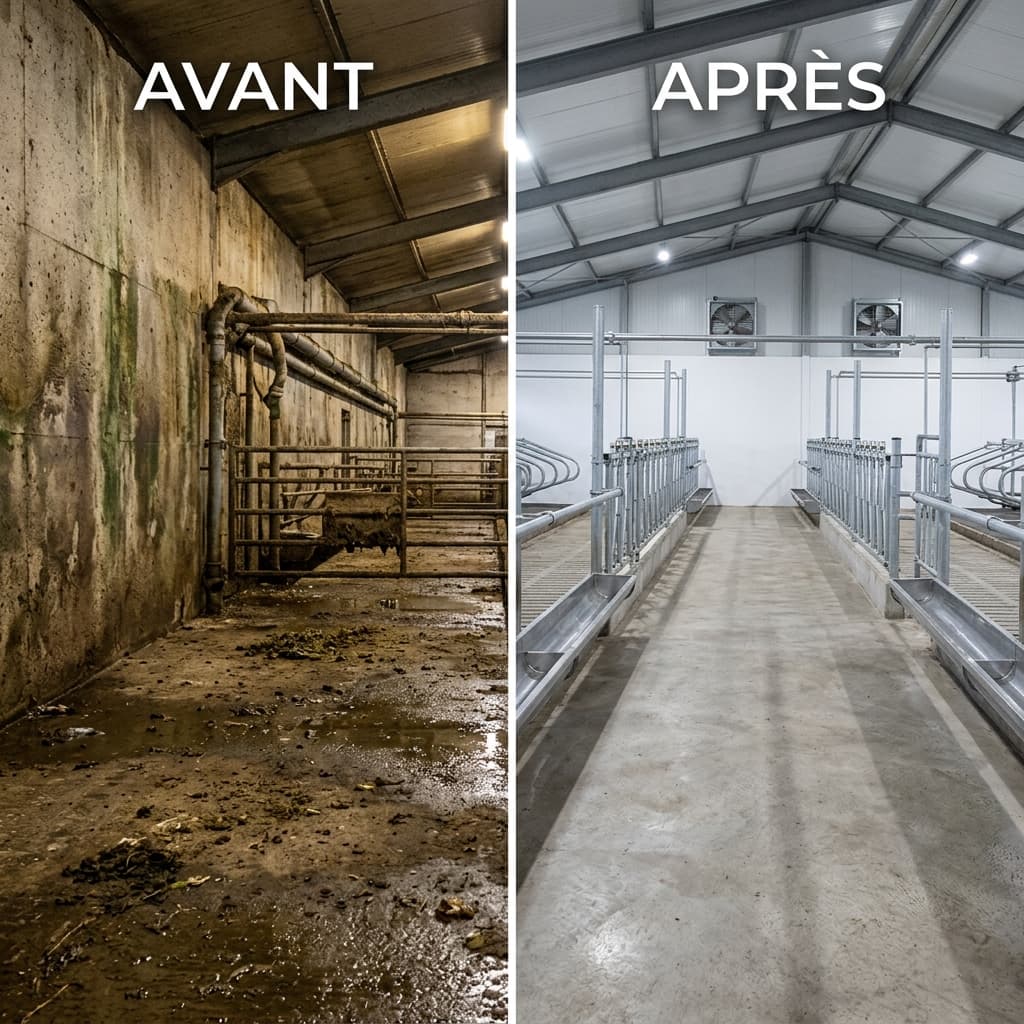
Same product. Same dose. Same frequency. Yet some farms remain chronically unstable. Performance fluctuates from one flock to the next, mortality rates surprise without apparent cause, and the sanitary environment never seems to stabilise long-term. This problem affects more farms than one might think — and the answer is almost never to increase dosages.
The problem is not always the disinfectant
In the majority of cases, chronic sanitary failures do not stem from the product used. They stem from how the overall protocol is structured — or rather, from its lack of structure. The most frequent causes are:
- Poor preliminary cleaning leaving residual organic matter
- Insufficient rinsing between steps
- Persistent biofilm never genuinely treated
- Water lines completely forgotten in the protocol
- Poorly managed building atmosphere after disinfection
Increasing disinfectant doses on a substrate still loaded with organic matter corrects nothing. It is like painting over rust.
Typical signs of chronic instability
- Recurring odours despite regular cleaning
- Persistent excessive humidity
- Irregular zootechnical performance from flock to flock
- Fluctuating mortality without identified pathological cause
- Heavy atmosphere from the very first days of placement
- Rapid recontamination between production cycles
What we observe in the field
Paradoxically, the most unstable farms are rarely those using the fewest products. They are often those where steps are mixed up, contact times are shortened due to time pressure, water lines are neglected because "they were flushed," and critical zones (under equipment, junctions, drains) are systematically overlooked.
The sequential protocol that works
1. Organic degradation with BIOACTIVE to break down encrusted protein and fat accumulations.
2. Stripping and cleaning with CLORAGRO to detach biofilm and residues loosened by the enzymatic step.
3. Final disinfection with OPTIMAGRO on genuinely clean surfaces, for maximum biocidal effect.
4. Continuous water line stabilisation with OXYLIS HOCl to maintain microbiological water quality from tank to drinkers.
5. Atmospheric management with OXYLIS HOCl via fogging to control airborne microbial load.
Key takeaway
A farm's sanitary stability depends less on the quantity of chemicals used than on the coherence of the overall protocol. A structured protocol, respecting the order of steps and contact times, can durably transform a farm's stability — even with moderate doses.
Recurring contamination problems?
Request a complete audit of your facilities by our biosecurity experts.
Request a Field Audit