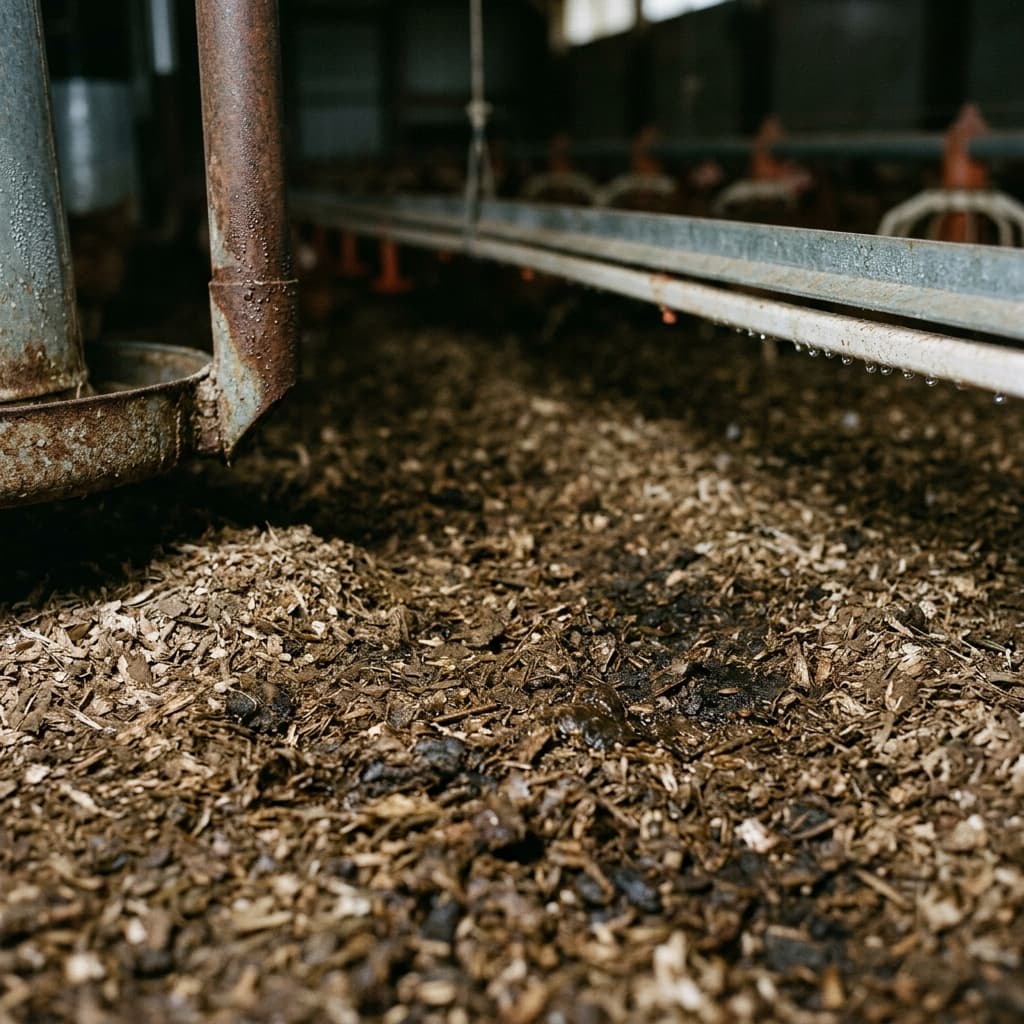
In poultry farming (broilers, turkeys), the state of the litter is the barometer of the flock's health and the building's ambient air quality. Dry litter supports the birds' thermal comfort and limits foot pad dermatitis (pododermatitis). However, many farmers observe that their litter becomes damp and "crusts" quickly, sometimes as early as the second week of placement. While the first reflex is to adjust ventilation parameters, the real cause of this imbalance is often microbiological and linked to water management.
Physiological and environmental causes of dampness
Litter moisture does not only come from ambient air. It is the direct result of water excreted by the animals or released by equipment:
- Digestive instability (enteritis): animals exposed to contaminated water or litter loaded with germs develop diarrhea or liquid droppings.
- Water wastage at drinkers (leaking nipples): scale and biofilm under the nipple balls prevent tight closure, creating permanent micro-leaks onto the floor.
- Relative humidity air saturation: preventing the natural evaporation of the litter under the action of ventilation.
Why the problem often originates from drinking water
Good quality incoming water can seriously deteriorate when circulating in lines heated to 30°C. If the network contains biofilm, bacteria multiply and release toxins. Chicks consuming this water develop chronic micro-enteritis. The damaged gut poorly absorbs nutrients, increasing the volume of water excreted in droppings. Furthermore, organic deposits in nipples cause direct water leaks onto the floor.
Consequences for animal health
- Increase in foot pad dermatitis and breast blisters.
- Massive ammonia (NH3) emissions through fermentation of damp litter.
- Degradation of the feed conversion ratio (FCR) due to discomfort and enteritis.
- Increased sensitivity to respiratory infections triggered by ammonia-laden air.
The global sanitation protocol recommended by N2K Laboratoires
To maintain dry litter throughout the cycle, you must act on the biological system of water and the environment:
Step 01 — Water line stripping with BIONET. During downtime, using BIONET eliminates scale and internal bacterial biofilm, stopping nipple leaks.
Step 02 — Continuous water stabilisation with OXYLIS HOCl. Dosing OXYLIS HOCl guarantees pathogen-free water from day one, protecting the birds' intestines.
Step 03 — Enzymatic sanitation with BIOACTIVE. Treating concrete surfaces before placement eliminates residual ammoniacal bacterial flora.
Step 04 — Atmospheric misting. Using OXYLIS HOCl via fine misting captures gaseous ammonia and improves ambient air quality.
Key takeaway
Damp litter is a symptom of digestive imbalance in animals or drinker malfunction, often caused by biofilm. Sanitising drinking water and stripping water lines is the most effective solution to keep litter dry.
Recurring contamination problems?
Request a complete audit of your facilities by our biosecurity experts.
Request a Field Audit