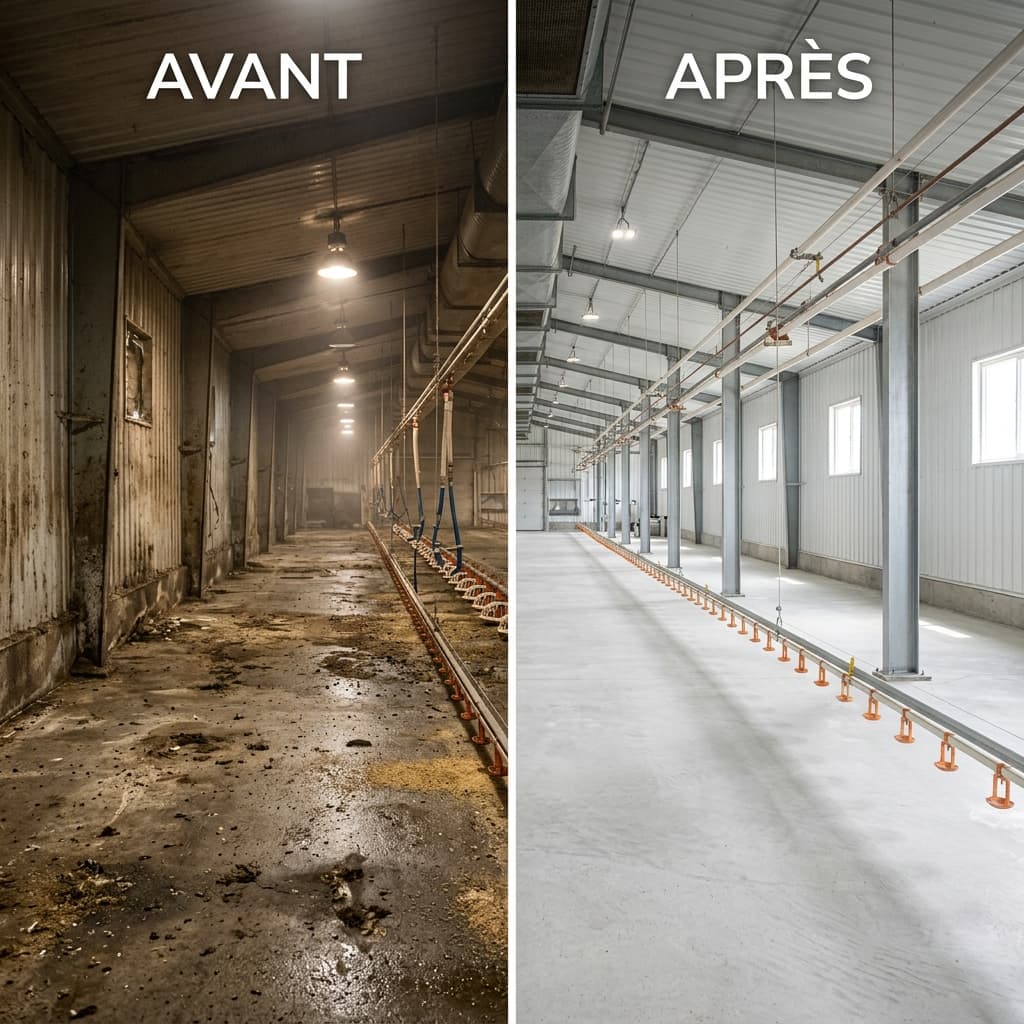
The building has been foam-washed, stripped with high pressure, and thoroughly rinsed. The team spent hours cleaning every surface until the concrete looked spotless. Yet as soon as the doors close and the building begins to dry and heat up, the odour returns. Heavy, organic, persistent. This scenario is one of the most frustrating in livestock farming, because it reveals an uncomfortable truth: the building is not as clean as it appears.
Where does this persistent odour really come from?
Many farmers believe that "if it smells like product, the building is clean." In reality, the opposite is often true. The most common mistake during a post-wash visual inspection is judging cleanliness on still-wet concrete. Water reflects light and creates a false impression of absolute cleanliness. In reality, most persistent odours come not from obvious dirt, but from organic residues deeply embedded in the porosity of the materials.
Concrete is not smooth. It consists of micro-cavities. Degraded faecal matter, proteins, uric acid and animal fats seep into these pores over successive production cycles. Once rehydrated by residual moisture and warmed by building temperature, these residues become an ideal substrate for spoilage bacteria that survived the wash.
Frequently overlooked shadow zones
The odour often originates from zones that the eye avoids or that high-pressure jets cannot properly reach:
- Wall bases: the junction between slab and wall accumulates successive layers of degraded litter that eventually mineralise and become encrusted.
- Under equipment: feeder lines and drinkers cast shadows on the floor where washing is often less thorough.
- Cracks and expansion joints: genuine refuges for organic matter, inaccessible to mechanical surface cleaning.
- Ventilation ducts: bacteria-laden dust agglomerates with moisture, forming an odorous crust.
- Drainage networks: traps and channels concentrate heavily loaded wash water, generating thick biofilm.
The mistake of "deodorant disinfection"
When faced with a stubborn odour, a common reflex on the ground is to increase the disinfectant concentration or spray a strongly scented product to "mask" the problem. This is a major strategic error. Any disinfectant, regardless of its action spectrum, sees its efficacy drop dramatically in the presence of residual organic matter. Biocidal molecules are consumed by proteins and fats before even reaching the target bacteria.
The field protocol for genuine deep sanitisation
Step 01 — Enzymatic treatment. Applying an enzymatic complex like BIOACTIVE specifically degrades complex organic bonds (fats, proteins, starches) deeply fixed in the porosity of concrete and joints.
Step 02 — Alkaline stripping. Once the organic matter is weakened, applying a powerful stripping detergent such as CLORAGRO saponifies remaining fats, detaches biofilm and brings encrusted dirt to the surface.
Step 03 — Final disinfection on clean surfaces. Only on these thoroughly cleaned surfaces can disinfection with OPTIMAGRO express its full biocidal potential.
Step 04 — Atmosphere management. Controlled fogging with OXYLIS HOCl stabilises the building atmosphere and reduces airborne microbial load.
Key takeaway
A persistent odour after cleaning is rarely "normal." It is often the first signal of an incomplete protocol. The sense of smell remains one of the best diagnostic tools during downtime. Attempting to disinfect over residual organic load is futile — one must accept going back to the biological cleaning step.
Recurring contamination problems?
Request a complete audit of your facilities by our biosecurity experts.
Request a Field Audit