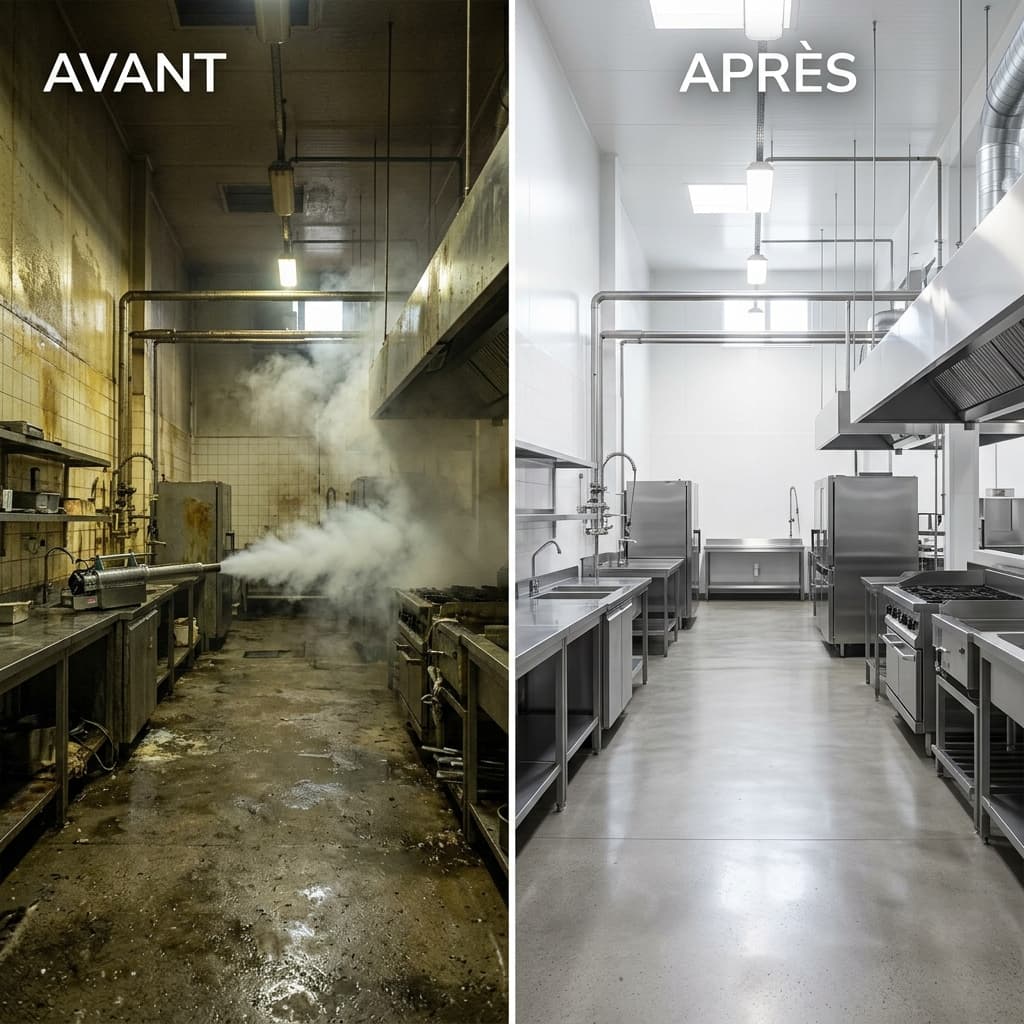
It is a classic scenario that frustrates many sanitary managers and farmers: a complete cleaning has been carried out, followed by rigorous disinfection by fogging or spraying. At the end of the protocol, the air feels fresh, neutral, or marked by the characteristic scent of the disinfectant. Yet, barely 48 hours later, before animals return or production even restarts, the heavy smell of fermentation, ammonia, or degraded organic matter reappears. This rapid return of olfactory nuisances is not just an inconvenience: it is proof of a major sanitary failure.
What the return of an odour actually reveals
Air does not generate odours on its own. A foul smell that quickly reinstalls after treatment scientifically indicates two failures:
- Persistence of an active nutrient source: organic matter (fats, embedded litter, blood, proteins) was not eliminated during preliminary cleaning and acts as a fermentation substrate.
- An active residual microbial or fungal flora: the disinfectant was unable to reach all microbial cells due to the protection offered by residual organic matter or biofilm.
Under the influence of stagnant moisture (from rinsing or product application) and ambient temperature, surviving micro-organisms multiply exponentially, restarting putrefaction processes.
Most common errors made in the field
- Disinfection by thermal fogging on greasy surfaces: the disinfectant mist deposits on the grease film without penetrating it, leaving bacteria intact underneath.
- Insufficient rinsing after detergent application: loosened dirt residues dry in place again, forming a protective crust.
- Forgetting humid hot spots: drainage channels, under-troughs, ventilation ducts, and mechanical corners where fermentable residues accumulate.
The recommended sequential protocol to eliminate odours durably
To permanently eliminate olfactory emissions, you must physically and chemically eliminate their anchoring point:
Step 01 — Deep organic stripping. Using an intensive degreasing treatment with CLORAGRO breaks down complex protein and fat bonds, eliminating accumulated residues in every corner.
Step 02 — Powerful alkaline cleaning with CLORAGRO. Applying CLORAGRO as an adhering foam emulsifies and permanently washes away these degraded organic materials during high-pressure rinsing.
Step 03 — Final disinfection. Applying a broad-spectrum biocide like OPTIMAGRO on a perfectly clean surface destroys the residual microbial flora.
Step 04 — Continuous air stabilisation. Using OXYLIS HOCl via continuous misting neutralises residual odour molecules and stabilises the overall microbial atmosphere.
Key takeaway
An odour returning within 48 hours is the alarm signal of an incomplete protocol. The disinfectant was applied over a surface still loaded with organic materials. The solution does not lie in using a masking perfume, but in the total elimination of the biological substrate of fermentations.
Recurring contamination problems?
Request a complete audit of your facilities by our biosecurity experts.
Request a Field Audit