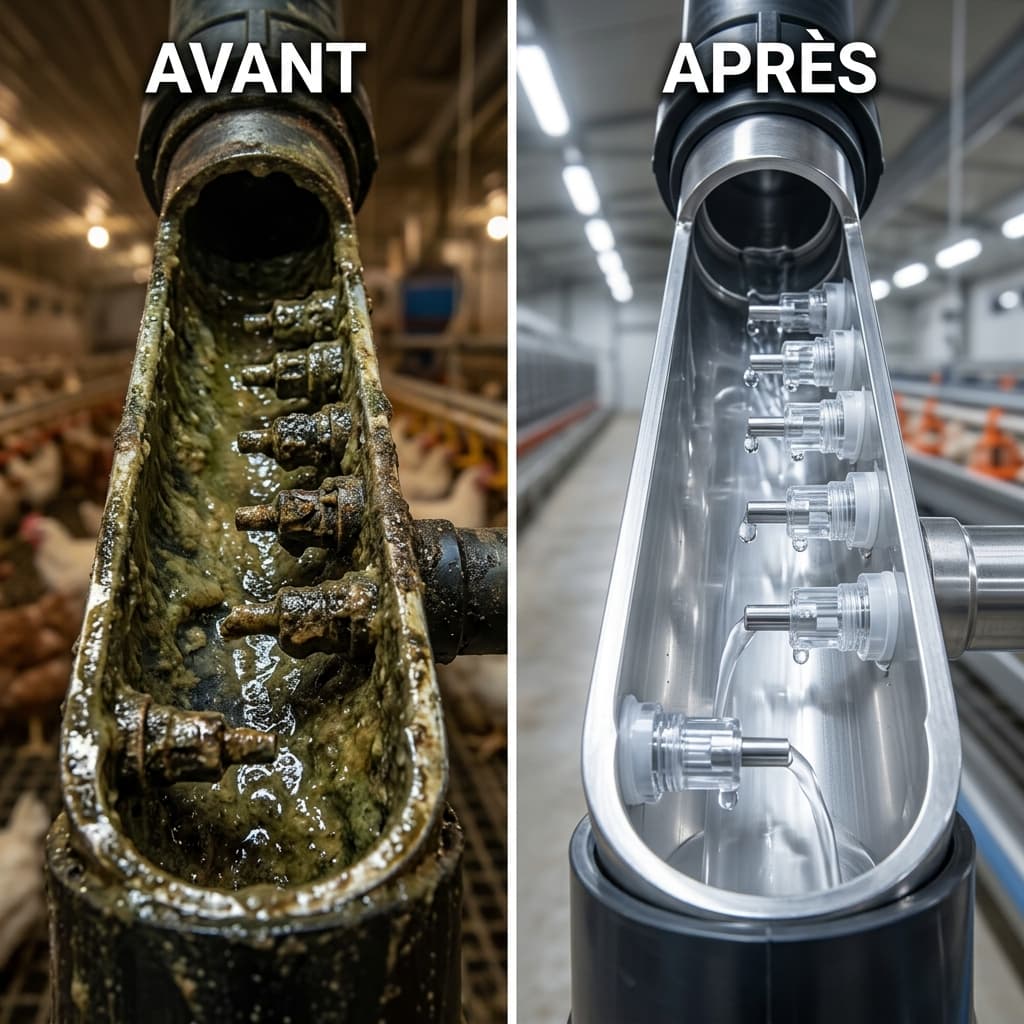
The building has been washed. The lines have been flushed. The water looks clear. Yet just a few days after placing the new flock, the first signs reappear: the nipple drinkers become slippery to the touch, some nipples get clogged, a subtle but unmistakable odour rises from the lines, and water consumption becomes erratic. This scenario is one of the most common — and most misunderstood — in poultry farming.
What is really happening inside the pipelines
The problem almost never comes from the incoming water supply. It comes from what has gradually built up inside the circuits over previous production cycles. Over time, pipelines silently accumulate successive layers of residue: limescale, proteins from veterinary treatments, organic deposits from the water itself, and above all, bacterial biofilm.
Biofilm is a complex biological structure. It is not simply dirt. It is a protective matrix secreted by the bacteria themselves, enabling them to adhere to the inner walls of the pipes and resist external aggression — including simple water flushing. A line can appear perfectly clean from the outside while being heavily colonised biologically on the inside.
Why simple flushing never works long-term
Pressurised water removes loose residues, suspended particles and some superficial deposits. But against established biofilm, it is powerless. The extracellular matrix of the biofilm acts as an adhesive layer that clings to internal walls. Without specific chemical stripping action, bacteria remain attached, circuits become recontaminated within days, and the water rapidly loses its microbiological stability.
This is precisely why nipple drinkers become greasy so quickly after a simple flush. The biofilm has not been destroyed — it has merely been superficially disturbed.
Field symptoms that every farmer recognises
In many buildings, the same observations recur after each placement:
- Nipple drinkers become greasy and slippery within just a few days
- Chicks drink less regularly, with erratic consumption patterns
- Litter becomes wet too quickly, indicating digestive imbalance
- Digestive disorders increase without any identifiable dietary cause
- An odour appears in the lines when flushing the end points
Very often, the problem starts in the water lines well before it manifests in the animals. By the time symptoms become visible, contamination has already been established for several days.
The recommended field protocol
Step 01 — Technical stripping of the circuits. Using a specific stripping product such as BIONET breaks down the organic deposits, limescale and established biofilm inside the pipelines. This step is fundamental: without it, any subsequent disinfection remains superficial.
Step 02 — Complete network flush. After the stripping agent's contact time, a thorough and methodical flush of the entire network is essential to evacuate the loosened residues.
Step 03 — Continuous water quality stabilisation. Implementing continuous treatment with OXYLIS HOCl from the tank to the last drinker maintains the microbiological stability of the water throughout the production cycle. It is this continuity that prevents biofilm from reforming.
Key takeaway
When lines become dirty again quickly after cleaning, the problem is rarely mechanical. It is almost always biological. And a biological problem cannot be solved with water pressure alone — it requires an adapted chemical protocol, applied in the correct sequence and with the proper contact times.
Recurring contamination problems?
Request a complete audit of your facilities by our biosecurity experts.
Request a Field Audit