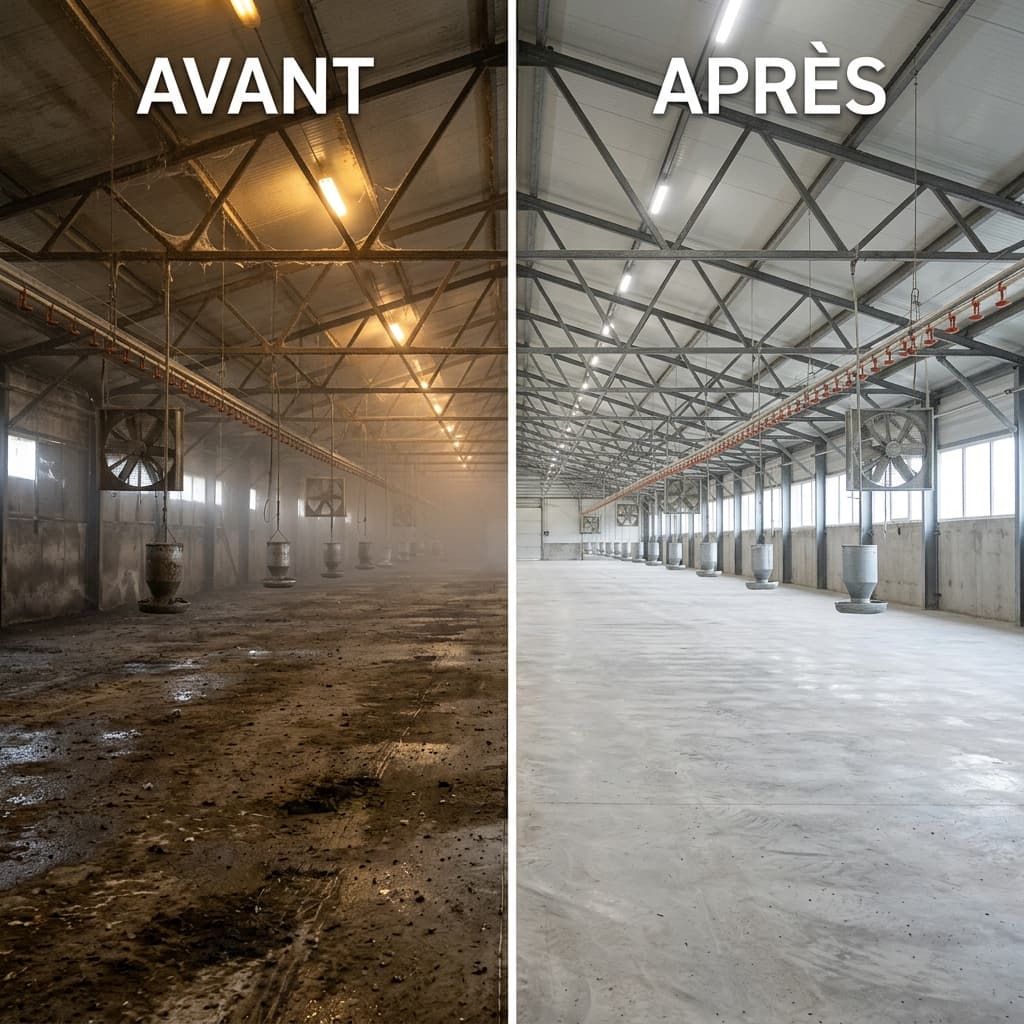
In many poultry houses and fattening barns, the presence of ammonia (NH3) is a daily battle. Just days after a thorough cleaning and the installation of fresh litter, the atmosphere becomes heavy and irritating to the eyes and respiratory tracts of both animals and operators. Faced with this, the most common explanation is to blame faulty or insufficient ventilation. Yet, ventilation is often only the regulator of a problem whose source is purely organic.
What actually produces ammonia in the building
Ammonia is not a magical gas; it is the direct product of the microbial and enzymatic breakdown of uric acid and urea present in animal droppings. This decomposition process requires two fundamental factors:
- Residual moisture: water is essential for the chemical and biological reactions that release the gas.
- An active organic load: nitrogen-degrading bacteria lodge in the pores of the concrete, under equipment, and in poorly cleaned areas.
The higher the organic load remaining after downtime, the faster ammonia production accelerates once animals begin emitting new droppings and raising the ambient temperature.
Typical signs of a problematic ammonia load
- A characteristic sharp, pungent odour present from the very first days of placement.
- Signs of eye irritation in animals (eyes closed or watery).
- Coughing, rales, and increased respiratory sensitivity to opportunistic bacterial infections.
- Litter quickly becoming damp and compacted ("crusted") under the effect of a poor general environment.
- Suspended dust loaded with odours and organic particles.
Why classic cleaning fails to eliminate the source
A classic high-pressure wash removes visible dirt. However, it leaves behind invisible layers of proteins, fats, and biofilms embedded in the concrete pores and equipment joints. As they dry, these residues form a stable matrix. During the next placement, rising temperatures and relative humidity instantly reactivate this ammoniacal bacterial flora.
The recommended field protocol by N2K Laboratoires
To durably eliminate the source of ammonia production, you must target organic matter in depth:
Step 01 — Enzymatic breakdown with BIOACTIVE. The application of BIOACTIVE liquefies and breaks down encrusted proteins and dry organic matter before washing, making mechanical cleaning much more effective.
Step 02 — Technical alkaline stripping with CLORAGRO. Running a foam lance with CLORAGRO removes greasy residual litter, whitens surfaces, and sanitises the substrate.
Step 03 — Continuous atmospheric management. During production, using OXYLIS HOCl via fine misting captures suspended ammonia molecules and significantly reduces the microbial load in the air.
Key takeaway
Ammonia in a livestock building is not an inevitability linked to weather or structure. It is the direct symptom of insufficient cleaning of deep organic matter during downtime. Treating the organic cause divides ammonia pressure from the very start of the cycle.
Recurring contamination problems?
Request a complete audit of your facilities by our biosecurity experts.
Request a Field Audit