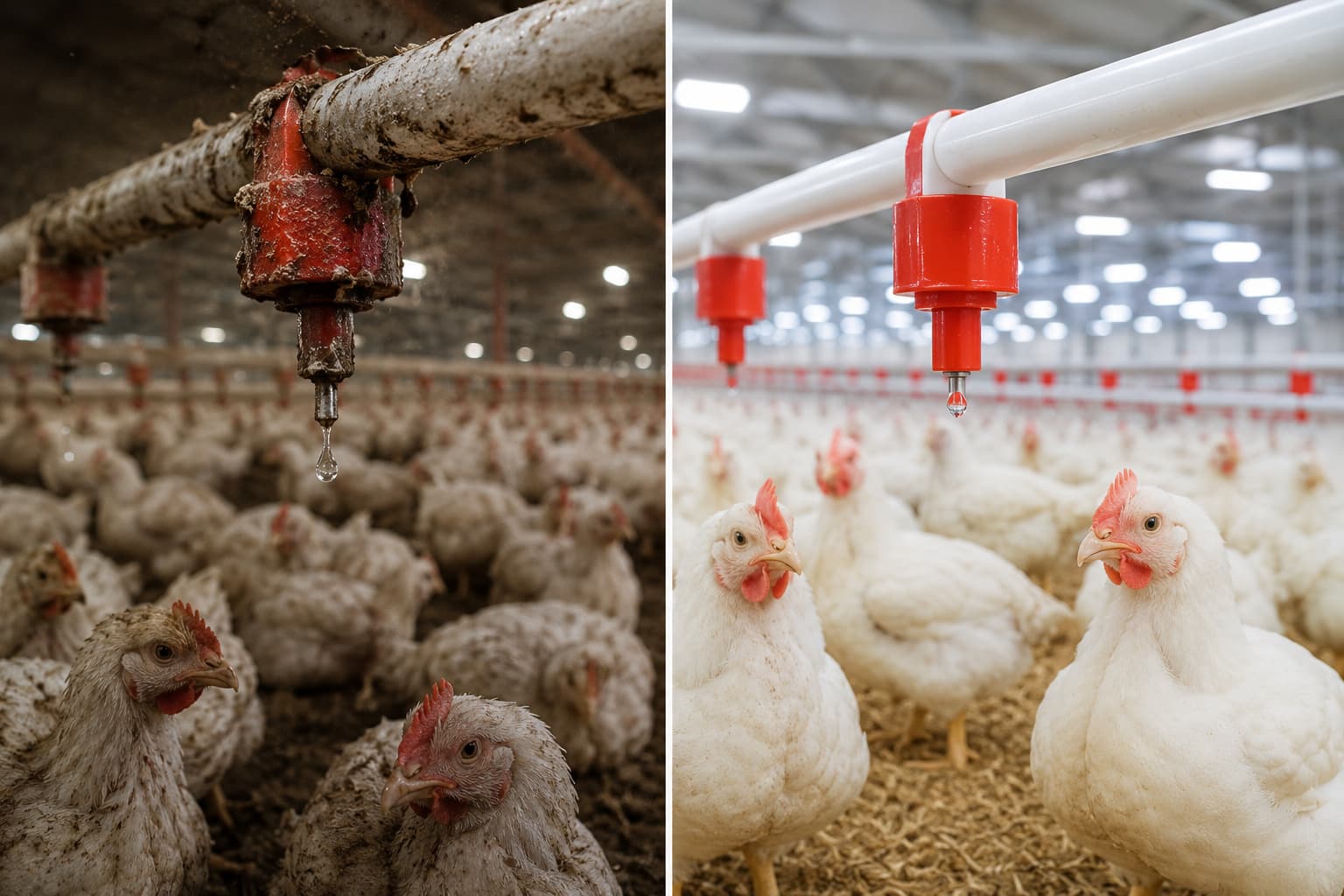
In many poultry farms, the appearance of leaks in drinking pipettes (or nipples) is a recurring problem. Often, these malfunctions are prematurely attributed to natural mechanical wear or manufacturing defects, prompting the farmer to replace entire lines. However, field observations reveal that most leaks result from a gradual accumulation of internal mineral and organic deposits that block the pipette closing mechanism.
The invisible mechanism of pipette fouling
Drinking water lines are environments conducive to the development of complex deposits that eventually hinder the operation of moving parts:
- Scaling and mineral deposits: Depending on water hardness, calcium carbonate (scale), iron, or manganese slowly deposit on the internal walls and along the metallic pin of the pipette. These micro-crystals create a surface roughness.
- The sticky matrix of biofilm: Bacteria naturally present in the water adhere to this roughness and secrete a viscous biofilm. This biofilm traps minerals and residues of drug treatments or additives administered through the drinking water.
- Locking of the ball or pin: The pipette operates using a metallic pin or ball that must fall back perfectly to seal the opening. When scale and biofilm encrust this seat, the pin remains slightly raised, causing a permanent drip.
Direct economic and sanitary consequences
A leaking pipette is not just a waste of water. The permanent drip rapidly degrades the litter located under the drinker lines, creating cold damp patches. This excessive litter moisture promotes ammonia release, irritates poultry footpads (pododermatitis), and increases the building's overall sanitary pressure by offering an ideal environment for enterobacteria growth.
The sanitation protocol recommended by N2K Laboratoires
To restore pipette sealing and protect flock health, combine curative descaling during sanitary downtime and continuous stabilisation during production:
Step 01 — Curative descaling and stripping with BIONET. During sanitary downtime, injecting BIONET into the water circuits dissolves scale and detaches the biofilm's organic matrix. Running the product deeply cleans each pipette, frees blocked pins, and restores initial flow rates without damaging rubber seals.
Step 02 — Continuous stabilisation and sanitation with OXYLIS HOCI. Throughout production, continuous injection of OXYLIS HOCI into the drinking water prevents biofilm reformation and limits mineral adhesion, ensuring proper pipette operation until the end of the flock.
Key takeaway
Leaking pipettes are often a sign of clogged piping. Before replacing your drinking equipment, apply a rigorous protocol combining curative acid descaling with BIONET and continuous hypochlorous acid disinfection with OXYLIS HOCI. You will preserve your equipment, save water, and maintain dry, healthy litter.
Recurring contamination problems?
Request a complete audit of your facilities by our biosecurity experts.
Request a Field Audit