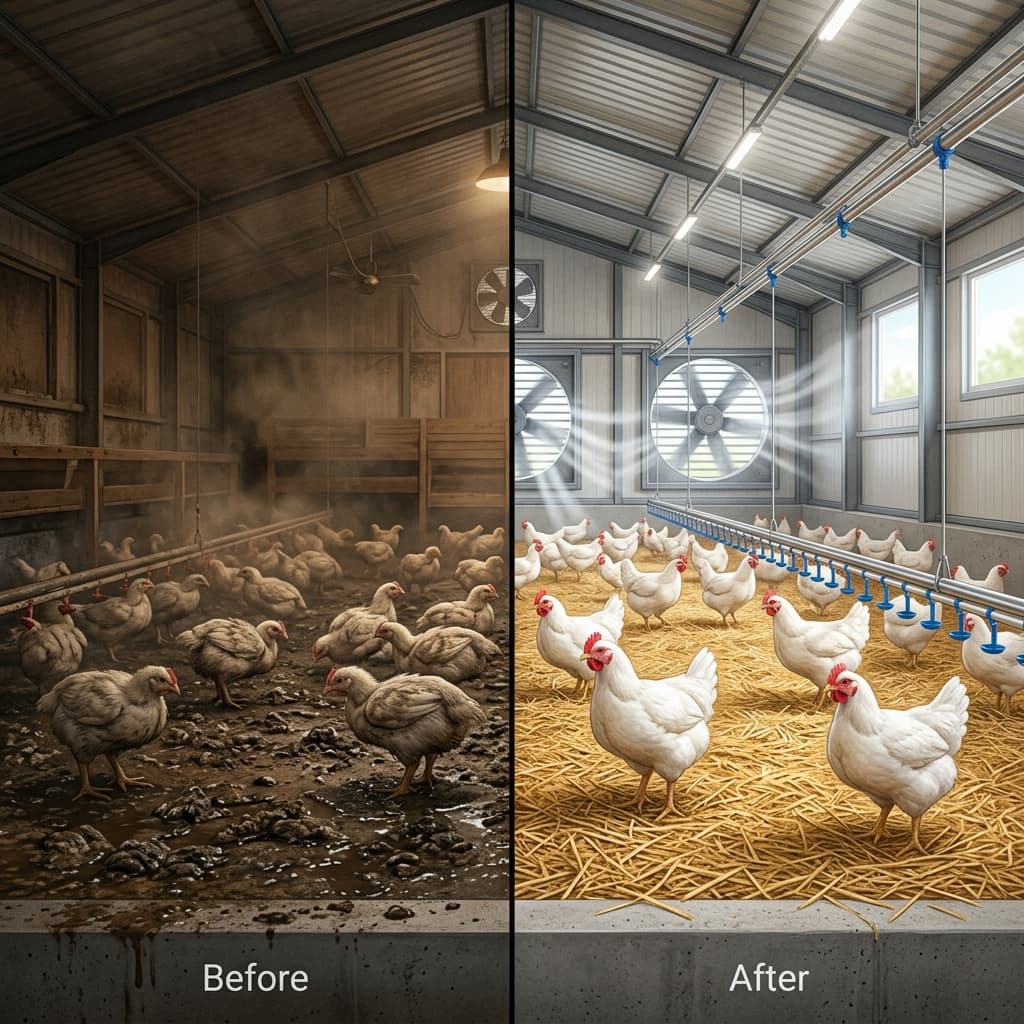
Every summer, poultry and livestock farmers face the same recurring challenge: an unexplained drop in zootechnical performance, an increase in digestive or respiratory issues, and global sanitary instability that lingers for weeks after the heatwave ends. This phenomenon is not just a fatigue reaction to heat stress. Heat acts as a giant biological accelerator, destabilising drinking water circuits and loading the building's atmosphere with pathogens.
Drinking water: the primary biofilm reservoir under heat pressure
In a poultry house or barn, drinking water pipes are often exposed to high ambient temperatures during summer. When water stagnates or flows slowly at temperatures above 25°C:
- Exponential bacterial multiplication: The growth rate of bacteria such as Pseudomonas, Escherichia coli, or Salmonella doubles every 20 minutes at these temperatures.
- Biofilm thickening: The slimy layer inside the pipes grows rapidly. It traps scale, vitamins, or vaccines administered through the water, forming a very dense protective organic matrix.
- Loss of classic treatment efficacy: Chlorine evaporates quickly under heat and organic load, leaving the water without disinfectant protection at the end of the line.
The building's atmosphere: dust and ammonia saturation
To combat heat, ventilation runs at maximum capacity. This continuous airflow dries out the litter and resuspends biologically charged dust particles. Additionally, heat accelerates the urease fermentation of droppings, causing a massive release of ammonia (NH3). This gas irritates the animals' eyes and respiratory tracts, lowering their natural defenses and facilitating superinfections.
How to stabilise the farm after hot weather waves
To restore sanitary balance and sanitise the animals' environment, act simultaneously on water circuits and the building's atmosphere:
Step 01 — Curative water circuit cleaning with BIONET. As soon as temperatures drop, flushing and stripping the pipes with BIONET is essential. This descaling acid-alkaline cleaner detaches the biofilm hardened by the summer and removes accumulated scale.
Step 02 — Continuous water stabilisation and disinfection with OXYLIS HOCl. Continuous injection of micro-doses of OXYLIS HOCl into drinking water prevents biofilm reinstallation and maintains bacteriologically pure water to the last nipple, even at high temperatures.
Step 03 — Air sanitation in the presence of animals. Misting hypochlorous acid (OXYLIS HOCl) knocks down fine dust to the floor via micro-condensation while destroying suspended viruses and bacteria and neutralising free ammonia in the air.
Key takeaway
Post-summer sanitary instability is mainly due to degraded water quality and atmospheric saturation of the building. Purging the biofilm from pipes and continuously disinfecting water and air with hypochlorous acid is key to securing your flocks year-round.
Recurring contamination problems?
Request a complete audit of your facilities by our biosecurity experts.
Request a Field Audit