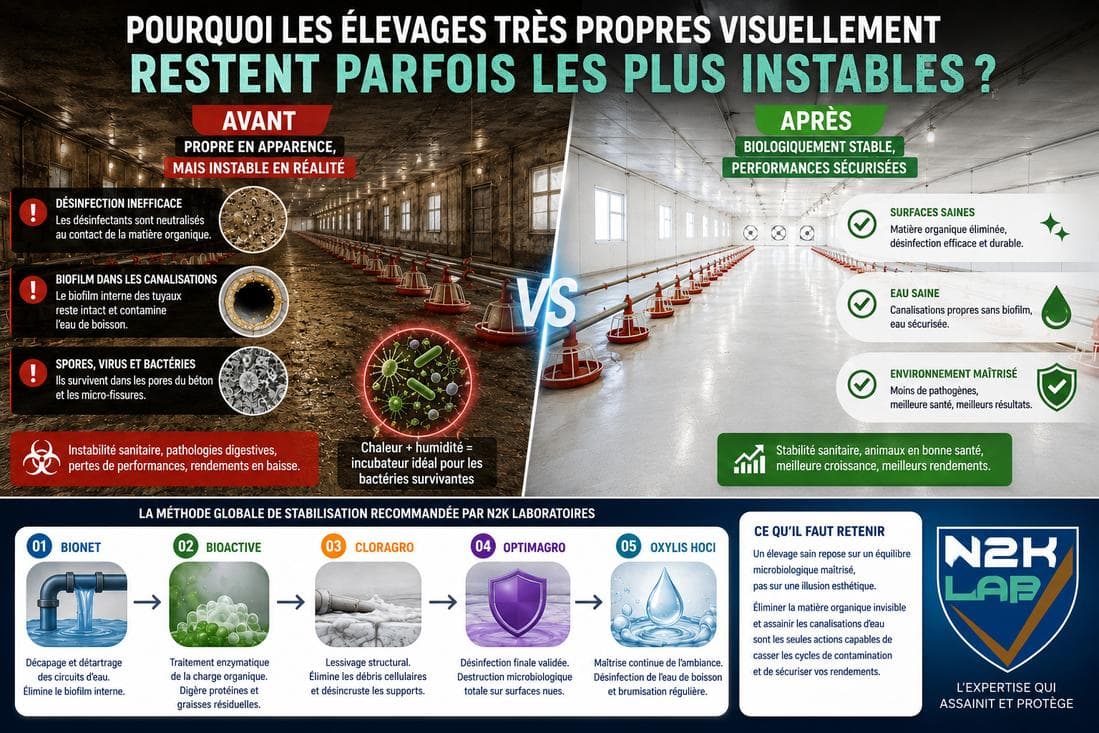
For a professional livestock breeder, the sanitary downtime is a sacred period. The building is completely emptied, cleared, washed under pressure, and disinfected. To the naked eye, the concrete floor is grey and clean, the feeders shine, and the ammonia smell has disappeared. Yet, a few days after introducing a new batch of chicks or animals, analyses reveal abnormal levels of Enterobacteriaceae, or digestive pathologies abruptly reappear. This paradox is explained by an invisible biological reality: the visual cleanliness of a livestock building does not guarantee its microbiological stability.
The trap of disinfecting on poorly prepared surfaces
Traditional cleaning focuses on removing visible coarse dirt (litter, dust, droppings). But at the microscopic level, surfaces remain covered with a micro-fine organic film composed of proteins and dried fats:
- Immediate biocide inactivation: Classic surface disinfectants (phenols, glutaraldehyde) are neutralised on direct contact with this residual organic matter. The product is consumed on the surface, leaving underlying bacteria intact.
- The internal biofilm of drinking water lines: This is the major source of failure. Drinking lines are washed externally, but the biofilm inside the pipes remains intact. As soon as the animals drink, they ingest millions of pathogenic bacteria that destabilise their gut flora.
- Persistence of spores and viruses: Enveloped viruses and bacterial spores lodge in concrete pores and plastic micro-cracks, protected by the unhydrolysed fat layer.
Why sanitary instability establishes quickly
When new animals arrive, building heating is activated (especially in poultry farming). This ambient warmth, combined with residual moisture, creates an ideal incubator. Surviving bacteria protected under organic matter multiply exponentially, finding a young and sensitive host whose immune system is still developing.
The global stabilisation method recommended by N2K Laboratoires
To obtain a biologically stable building, and not just a visually clean one, follow a complete protocol targeting all contamination reservoirs:
Step 01 — Water circuit cleaning and descaling with BIONET. Before the animals arrive, flush and clean the pipes to eliminate the internal biofilm.
Step 02 — Enzymatic treatment of the organic load with BIOACTIVE. Spray BIOACTIVE on concrete and equipment to digest inaccessible residual proteins and fats.
Step 03 — Structural washing with CLORAGRO. Applying CLORAGRO as a foam removes cellular debris and strips the substrates.
Step 04 — Validated final disinfection with OPTIMAGRO. Applying OPTIMAGRO on completely bare surfaces ensures total microbiological destruction.
Step 05 — Continuous atmosphere control with OXYLIS HOCl. Continuous disinfection of drinking water and regular misting of OXYLIS HOCl in the presence of animals prevent pathogen re-establishment.
Key takeaway
A healthy farm relies on a controlled microbiological balance, not an aesthetic illusion. Eliminating invisible organic matter and sanitising water lines are the only actions capable of breaking contamination cycles and securing your yields.
Recurring contamination problems?
Request a complete audit of your facilities by our biosecurity experts.
Request a Field Audit