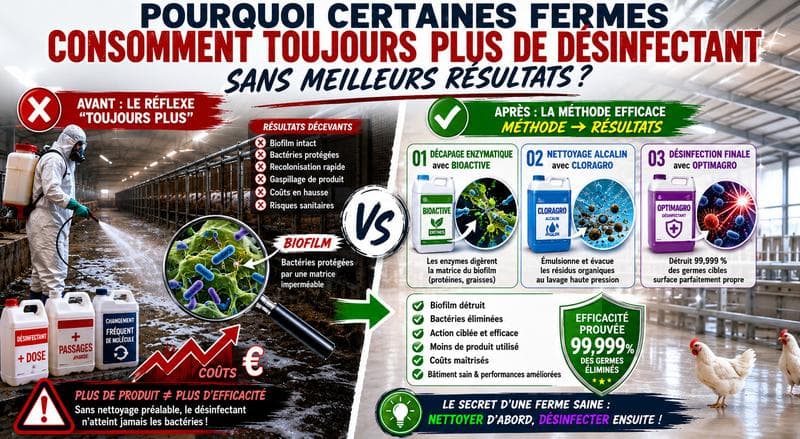
In industrial livestock farming (poultry, swine, cattle), biosecurity is a daily obsession. Faced with rising microbial pressure or deteriorating analysis results from one flock to another, the reflex of many farmers is to increase disinfectant concentrations, multiply applications, or regularly change chemical molecules. Yet, despite an obvious overconsumption of chemical products, sanitary performances plateau or decline. This paradox is easily explained: successful disinfection depends 90% on the quality of prior cleaning, not on the pure strength or concentration of the biocide.
Passive resistance: the biofilm shield
The fundamental mistake is believing that bacteria float freely on livestock building surfaces. In reality, 99% of micro-organisms live organised in biofilms. These are bacterial colonies embedded in a protective matrix of polymers (sugars and proteins) they secrete themselves:
- A physical barrier: the biofilm matrix physically blocks the disinfectant from penetrating. Biocidal molecules are neutralised on the surface before reaching bacteria lodged deep inside.
- Useless product consumption: increasing the dose of disinfectant on a biofilm is like burning the top layer without destroying the base. As soon as the product evaporates, deep bacteria recolonise the surface within hours.
- Selection of resistant strains: repeated exposure to local sub-dosages (within the biofilm) promotes the emergence of bacterial tolerance mechanisms.
Why chemical overconsumption harms the farm
- Skyrocketing costs: the hygiene bill rises without any return on sanitary investment.
- Equipment corrosion: high concentrations of disinfectants (especially acidic or chlorinated ones) attack metals (stainless steel, galvanised), plastics, and building concrete.
- Toxicity for operators and animals: chemical residues in the air or on the floor irritate animals' respiratory tracts upon placement.
What needs correcting: method over molecule
Successful disinfection is the result of a targeted mechanical and chemical action aimed first at destroying the biofilm support:
Step 01 — Enzymatic stripping with BIOACTIVE. Before applying any disinfectant, an enzymatic detergent like BIOACTIVE must be used. Enzymes specifically digest the biofilm's protective matrix (proteins and fats), exposing the bacteria.
Step 02 — Alkaline cleaning with CLORAGRO. Applying CLORAGRO then emulsifies and removes these unstructured organic residues during high-pressure washing.
Step 03 — Validated final disinfection with OPTIMAGRO. Once the surface is perfectly clean, applying OPTIMAGRO at the standard recommended concentration instantly destroys 99.999% of target germs, as the biocide directly accesses bacterial membranes without organic obstacles.
Key takeaway
Increasing disinfectant doses on a poorly cleaned surface is an economic and ecological waste. The secret to a healthy livestock building does not lie in biocide overconsumption, but in using precision enzymatic chemistry capable of breaking the bacteria's protective shield.
Recurring contamination problems?
Request a complete audit of your facilities by our biosecurity experts.
Request a Field Audit