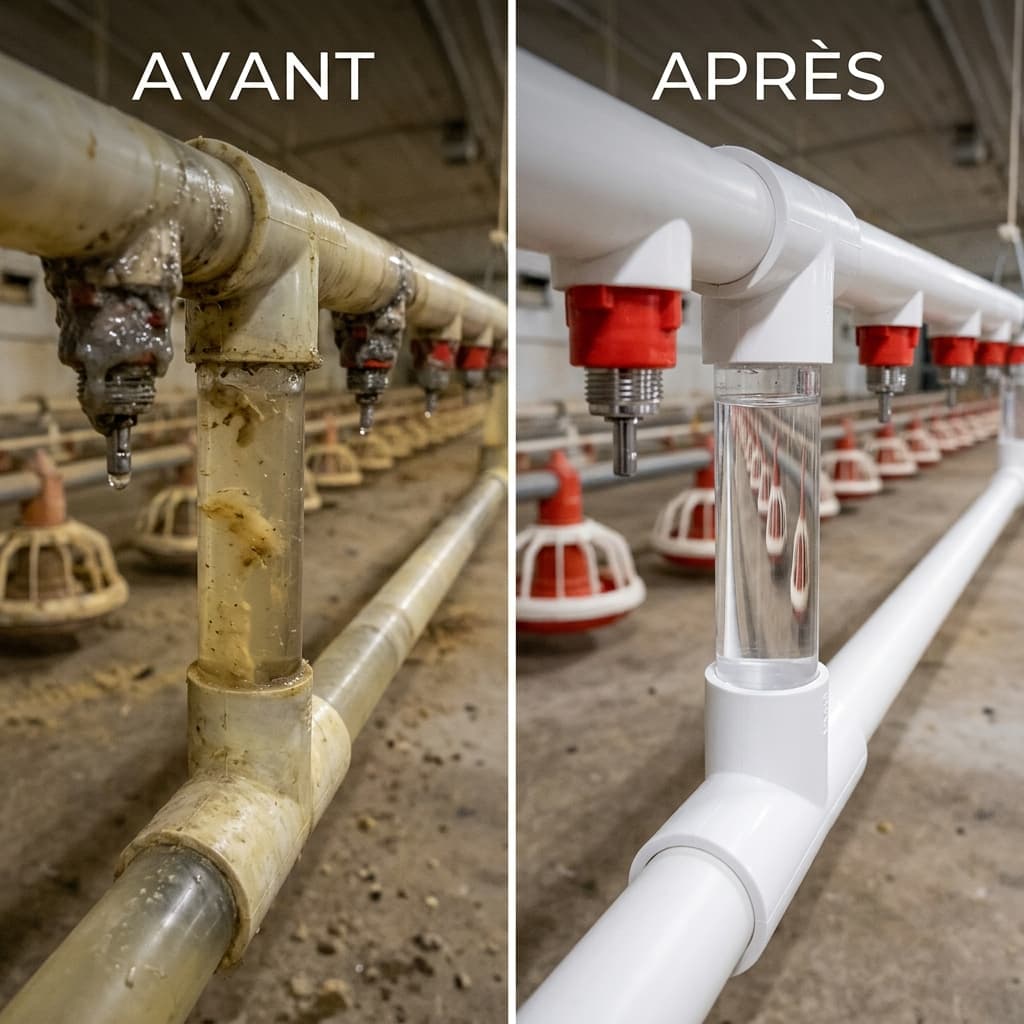
The building looks clean. The downtime period has been respected. Everything seems ready for the new flock. But just days after the chicks arrive, the first warning signs appear: humidity rises abnormally, droppings degrade rapidly, and water consumption becomes erratic. Recontamination has begun — often before the animals even arrived.
The real problem: forgotten water lines
In many farms, the drinking water circuits remain contaminated despite careful cleaning of the building itself. Attention logically focuses on visible surfaces — floors, walls, equipment — while the inside of the pipelines is simply "flushed" with clean water. Yet this is precisely where biofilm has established itself over previous production cycles, protected from any superficial cleaning.
The biofilm present in pipelines shelters an entire ecosystem: bacteria, yeasts, organic residues, contaminants invisible to the naked eye. As soon as water flow resumes at placement, this contamination is immediately distributed to every drinking point.
Common errors during preparation
- Simple flushing with clean water without any chemical action on pipelines
- Complete absence of technical stripping of internal circuits
- Forgetting nipples and drinkers during the cleaning protocol
- Resuming production too quickly without verifying water quality
- Exclusive focus on the visual cleanliness of surfaces
What this concretely causes
Chicks arrive in a visually clean building but drink biologically unstable water from the very first hour. The consequences are insidious: early intestinal microbial pressure translating into wet litter, soft droppings, and flock heterogeneity that sets in from the first days.
The recommended field protocol before placement
Step 01 — Technical stripping of circuits. Use of BIONET to break down organic deposits, limescale and biofilm fixed inside pipelines. This step must cover the entire network, from tanks to the last drinker.
Step 02 — Complete line flushing. Thorough and methodical evacuation of all residues loosened by the stripping process.
Step 03 — Daily maintenance of microbiological stability. Implementation of continuous treatment with OXYLIS HOCl to ensure water remains microbiologically stable from the first to the last day of the cycle.
Key takeaway
A building can be visually clean. But if the water flowing through the pipelines is biologically unstable, contamination restarts immediately — often invisibly during the critical first days.
Recurring contamination problems?
Request a complete audit of your facilities by our biosecurity experts.
Request a Field Audit