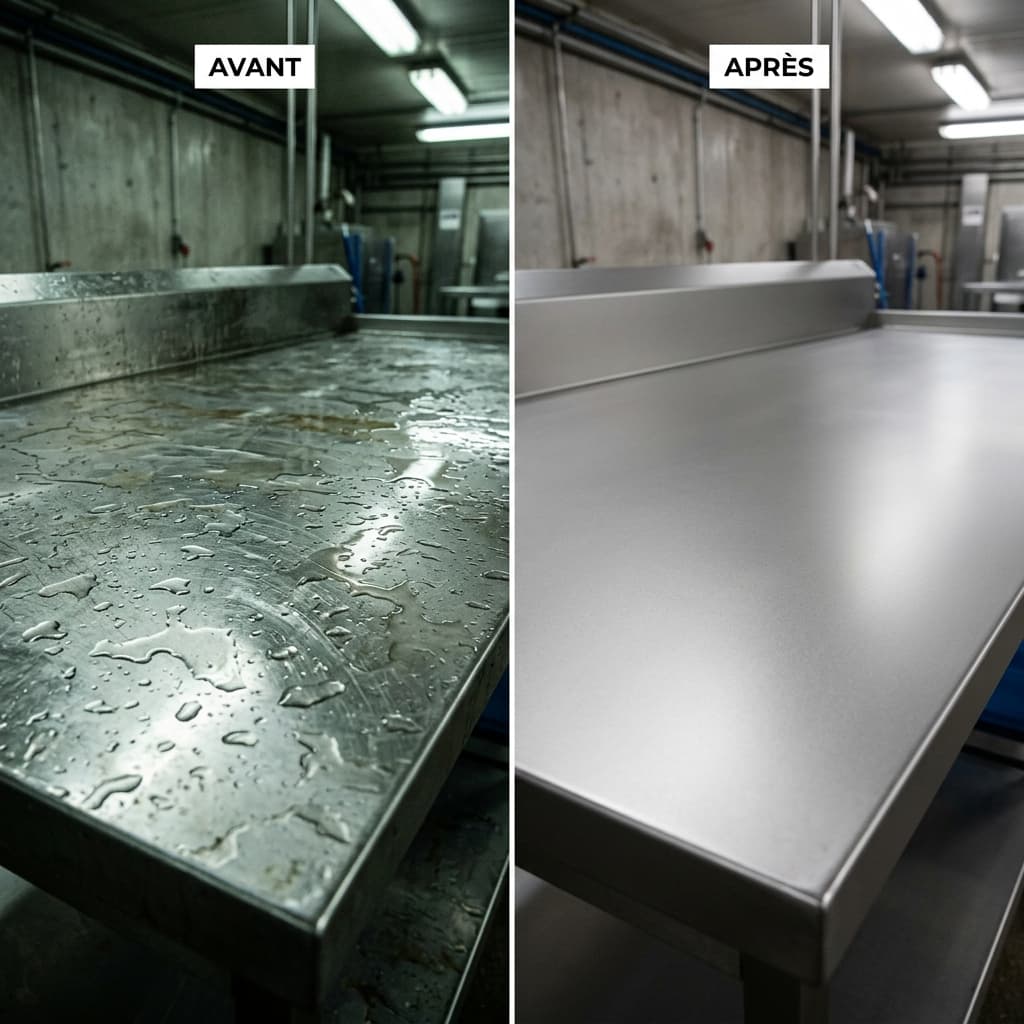
In both the food industry and modern livestock facilities, stainless steel, rigid plastics, and floor resins shine after meticulous washing. For the human eye, this shine is synonymous with absolute cleanliness. It is a well-known psychological bias: "if it shines and smells clean, it must be disinfected." Yet, from a microbiological standpoint, these smooth, gleaming surfaces can often be the most contaminated and dangerous areas of your production line.
The illusion of visual cleanliness
Shine is a physical quality of light reflection, not a biological indicator. Even after intensive hot water rinsing, numerous microscopic residues remains firmly attached to surfaces:
- Invisible bacterial biofilm: a thin layer of sticky polymers secreted by bacteria (such as Pseudomonas or Listeria) that adheres to stainless steel and resists simple washing.
- Protein film: transparent to the eye when dry, it acts as an anchoring base and nutrient source for rapid microbial recolonisation.
- Polymerised fats: forming a microscopic hydrophobic film that protects germs from disinfectant action.
Beneath this shiny glaze lies an active bacterial ecosystem, ready to contaminate food products or animals as soon as operations resume.
Areas most exposed to this false sense of security
- Stainless steel structures (cutting tables, conveyors, chutes): whose smooth appearance masks the persistence of microbial adhesion.
- Inner walls of pipelines and process lines: which appear clean at junctions but host massive biofilms along their straight lengths.
- Evaporators and ventilation grates: subject to permanent condensation that promotes fungal and bacterial growth.
- Seals and gaskets (silicone or rubber): which retain surface shine while being deeply porous or micro-cracked.
Why disinfectants fail on a shiny but ungreased surface
If a shiny surface retains an invisible organic film (fat or protein film), applying a disinfectant is useless. The biocidal molecules react chemically with the surface organic residues. This reaction consumes the active principle before it can penetrate and destroy the cell membranes of the pathogenc germs hidden underneath. The disinfection literally slides off the biofilm without eliminating it.
The recommended real hygiene protocol
To overcome the visual illusion and guarantee real microbiological control, N2K Laboratoires recommends a structured approach:
Step 01 — Chlorinated alkaline stripping. Using CLORAGRO dissolves grease and breaks down the protective matrix of the bacterial biofilm fixed on metals or plastics.
Step 02 — Chlorinated alkaline cleaning with CLORAGRO. Applying CLORAGRO emulsifies fats and mechanically detaches the organic debris liquefied by the enzymatic phase.
Step 03 — Certified final disinfection. Only after these two mechanical and chemical stripping steps will the application of OPTIMAGRO guarantee a real, measurable bacterial reduction, validated by surface swab tests or ATP-metry.
Key takeaway
Do not trust your eyes to evaluate the sanitary quality of a surface. A visually shiny surface can host millions of pathogenic bacteria under an invisible biofilm. Only the rigour of a protocol combining organic degradation and chemical disinfection guarantees genuine microbiological safety.
Recurring contamination problems?
Request a complete audit of your facilities by our biosecurity experts.
Request a Field Audit