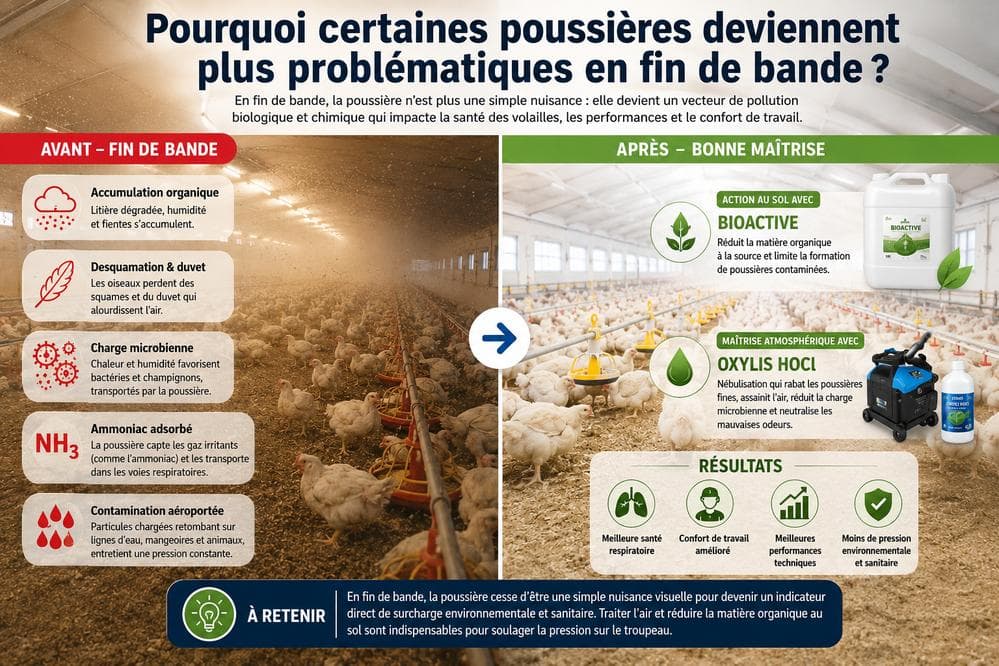
In poultry farming, climate management is a continuous challenge. As the cycle progresses, farmers often notice a marked deterioration in air quality, particularly visible as abundant dust towards the "end of the batch." What makes this dust problematic is not just its quantity, but primarily its nature: it becomes a true biological and chemical vector.
The transformation of dust throughout the cycle
At the beginning of the flock, dust is mainly composed of inert particles from fresh litter or feed. However, as the animals grow, the environment becomes saturated:
- Organic accumulation: Droppings accumulate, litter degrades, and becomes humid in areas.
- Desquamation and down: Birds lose dander and down, which heavies the atmosphere.
- Microbial load: Moisture and heat favor the proliferation of bacteria and fungi, which use dust as a means of transport.
Why the problem accelerates
At the end of the flock, the increase in biomass (the animals are larger) reduces the free air volume and alters ventilation dynamics. Fine suspended particles are no longer just debris; they are "loaded":
- Adsorbed ammonia: Dust captures irritating gases (like ammonia) emanating from degraded litter, transporting them directly into the respiratory tracts of the poultry and farmers.
- Airborne contamination: These particles, loaded with organic matter and microorganisms, fall back onto water lines, feeders, and animals, maintaining constant environmental pressure.
Consequences for the flock
A saturated atmosphere at the end of the batch has immediate impacts:
- Respiratory health: Irritation of mucous membranes, increased respiratory issues in poultry.
- Working comfort: Heavy atmosphere, pungent odors, and difficulty breathing for operators during interventions.
- Technical performance: Decreased animal comfort that can impact feed conversion ratios and downgrade rates.
The recommended protocol: from floor to air management
To break this dynamic at the end of the flock, action must focus on emission sources and the atmosphere:
Action on accumulations with BIOACTIVE. The preventive use of BIOACTIVE on targeted areas (around drinkers, degraded litter) actively reduces organic matter before it becomes a source of contaminated dust.
Atmospheric control with OXYLIS HOCl. Fogging with OXYLIS HOCl helps to "knock down" this fine dust. Its mild oxidative action helps sanitize the air by reducing the airborne microbial load while neutralizing some of the molecules responsible for bad odors, thus restoring a breathable atmosphere.
Key takeaway
At the end of the batch, dust ceases to be a mere visual nuisance and becomes a direct indicator of environmental and sanitary overload. Treating the air and reducing organic matter on the floor are essential to relieve the pressure on the flock.
Recurring contamination problems?
Request a complete audit of your facilities by our biosecurity experts.
Request a Field Audit