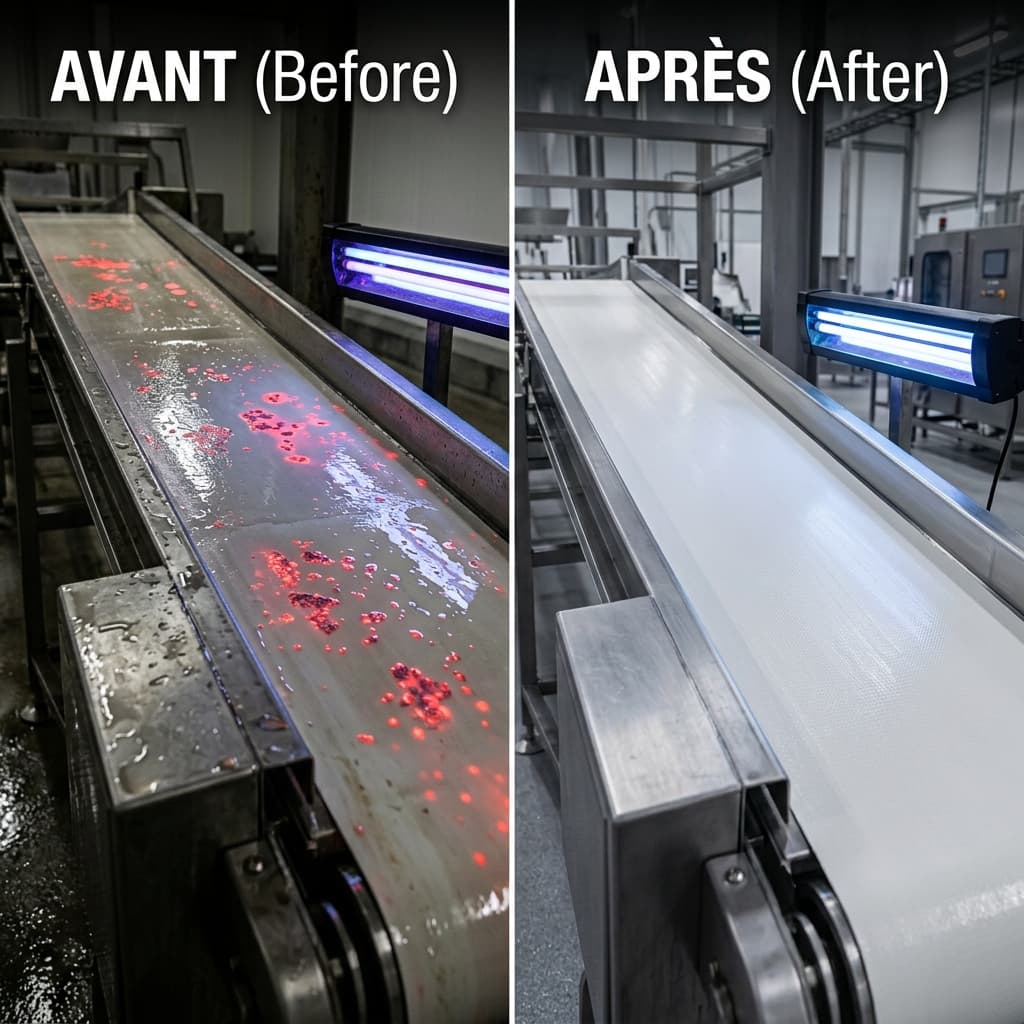
In many industries and agricultural operations, the completion of the cleaning and disinfection protocol is greeted with relief. It is assumed that health risks are now under control. However, the biological reality is quite different: the first few hours following the resumption of production are often the most critical and the most conducive to rapid recontamination.
Resumption of activity: a biological catalyst
As soon as machinery restarts or animals return to the buildings, environmental conditions change abruptly. This change stimulates the development of residual micro-organisms:
- Increased humidity: Water routing, wet product passage, or animal respiration create an ambient humidity ideal for bacterial multiplication.
- Rising temperatures: The operation of conveyor motors or the heating of livestock buildings raises surface temperatures, accelerating microbial metabolism.
- Air and personnel circulation: The movement of equipment, raw materials, and operators disperses any surviving germs throughout the workspace.
- Availability of new nutrients: The passage of the first food products or the supply of animal feed provides an immediate source of nutrients for emerging bacterial colonies.
Signs of early recontamination
Several clues indicate that sanitation is not stable and that contamination is restarting too quickly:
- Rapid appearance of unpleasant organic odors just hours after restarting
- Excessive condensation on walls and equipment
- ATP measurements (cleanliness testing) that drift abnormally fast after production begins
- Non-compliant surface or finished product test results early in the cycle
The recommended protocol
To avoid this early drift, surfaces must be perfectly free of protective organic load and sanitized continuously:
Preparation: BIOACTIVE. Prior use of BIOACTIVE ensures the degradation of deep organic residues, preventing bacteria from finding nutrients and shelter upon restart.
Stripping: CLORAGRO. Applying CLORAGRO removes the protective matrix and exposes the actual substrate of the equipment.
Disinfection: OPTIMAGRO. Using OPTIMAGRO guarantees maximum elimination of the microbiological load before restarting.
Intermediate control: ALCOSEPT PRO. For high-risk contact areas, a quick intermediate spray of ALCOSEPT PRO during breaks or shift changes helps block biological recolonization without interrupting the production flow.
Key takeaway
Cleaning is not an end in itself, but the beginning of a production phase that must remain under control. Securing the first few hours requires a rigorous initial protocol combined with targeted intermediate interventions.
Recurring contamination problems?
Request a complete audit of your facilities by our biosecurity experts.
Request a Field Audit