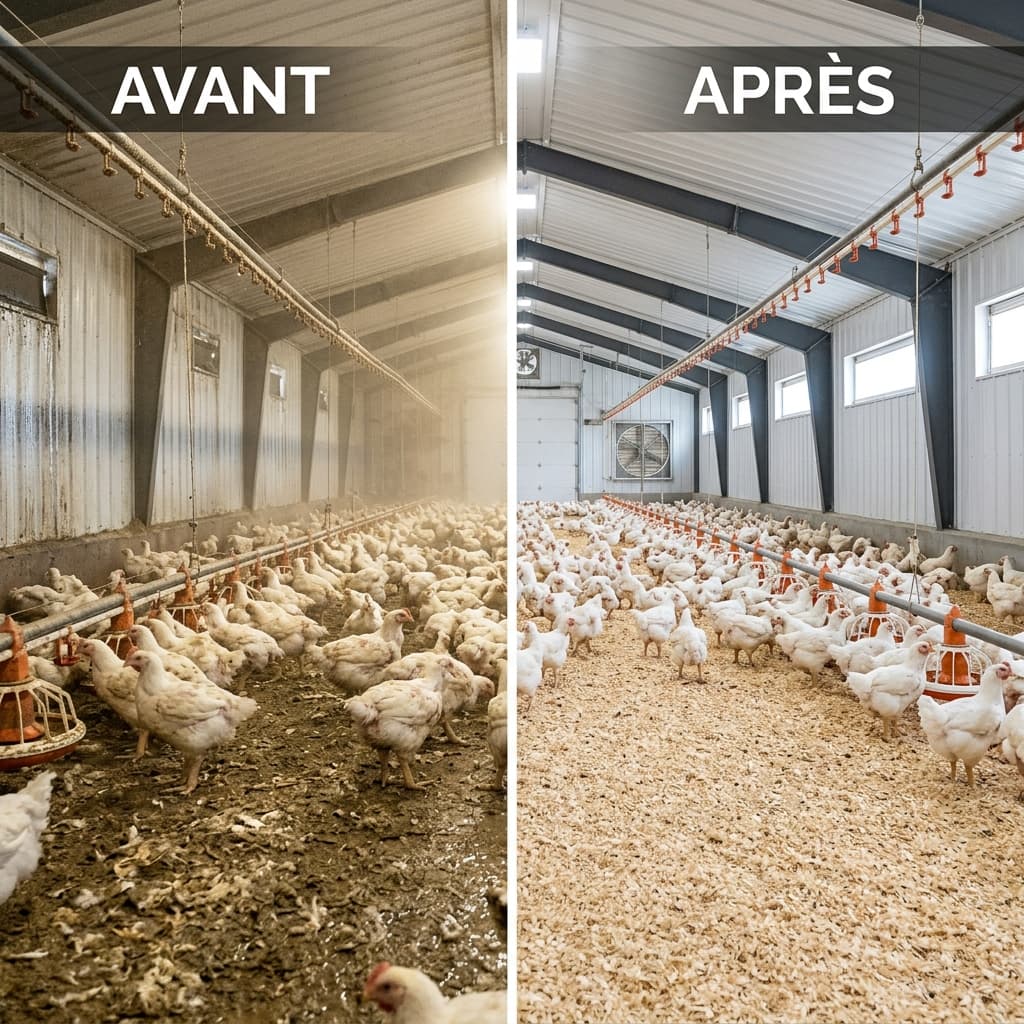
During periods of intense heat, certain odours become much harder to control in livestock buildings. This phenomenon, well known to field professionals, is far from trivial: heat acts as a genuine accelerator of all biological imbalances already present in the environment.
What heat really promotes
When temperatures rise, several mechanisms are triggered simultaneously inside buildings:
- Accelerated organic fermentation: Organic residues present in litter, on surfaces and in circuits ferment much more rapidly under the effect of heat, releasing foul-smelling volatile compounds.
- Litter moisture: Heat combined with animal respiration generates excessive humidity that degrades litter and promotes bacterial development.
- Intensified microbiological activity: High temperatures stimulate micro-organism multiplication, increasing the biological load of the environment.
- Water instability: Water circuits become more vulnerable to contamination, with biofilm developing more rapidly in warm pipelines.
- Ammonia accumulation: Accelerated degradation of droppings produces more ammonia, degrading air quality.
The first warning signs
In the field, indicators of a heat-related imbalance often appear very quickly:
- A heavy odour noticeable from early morning, even before peak activity
- A noticeable decline in respiratory comfort for both animals and operators
- Biologically charged dust particles, visible in light beams
- A generally more humid atmosphere that is harder to ventilate effectively
Why the problem develops so rapidly
When temperatures rise, imbalances already present in the building — even those that were invisible — become apparent much faster. Heat does not necessarily create a new problem: it amplifies and reveals existing weaknesses in the sanitary protocol.
A building that seemed stable at 20°C can quickly become unmanageable at 35°C if organic residues have not been properly eliminated and water circuits have not been maintained.
The recommended protocol
Organic residue reduction with BIOACTIVE. Applying BIOACTIVE breaks down organic accumulations that fuel fermentations and odours. This step is essential to reduce the very source of the problem.
Atmosphere and water network management with OXYLIS HOCl. Continuous use of OXYLIS HOCl helps stabilise the microbiological quality of water and control the building's atmospheric environment through controlled fogging.
Periodic line maintenance with BIONET. Regular stripping of circuits with BIONET prevents deposits and biofilm from establishing permanently in pipelines, particularly during hot periods.
Key takeaway
Heat does not always create the problem. It often reveals an imbalance already established in the building. By anticipating hot periods with an adapted protocol, it is possible to maintain a stable and controlled environment throughout the summer.
Recurring contamination problems?
Request a complete audit of your facilities by our biosecurity experts.
Request a Field Audit