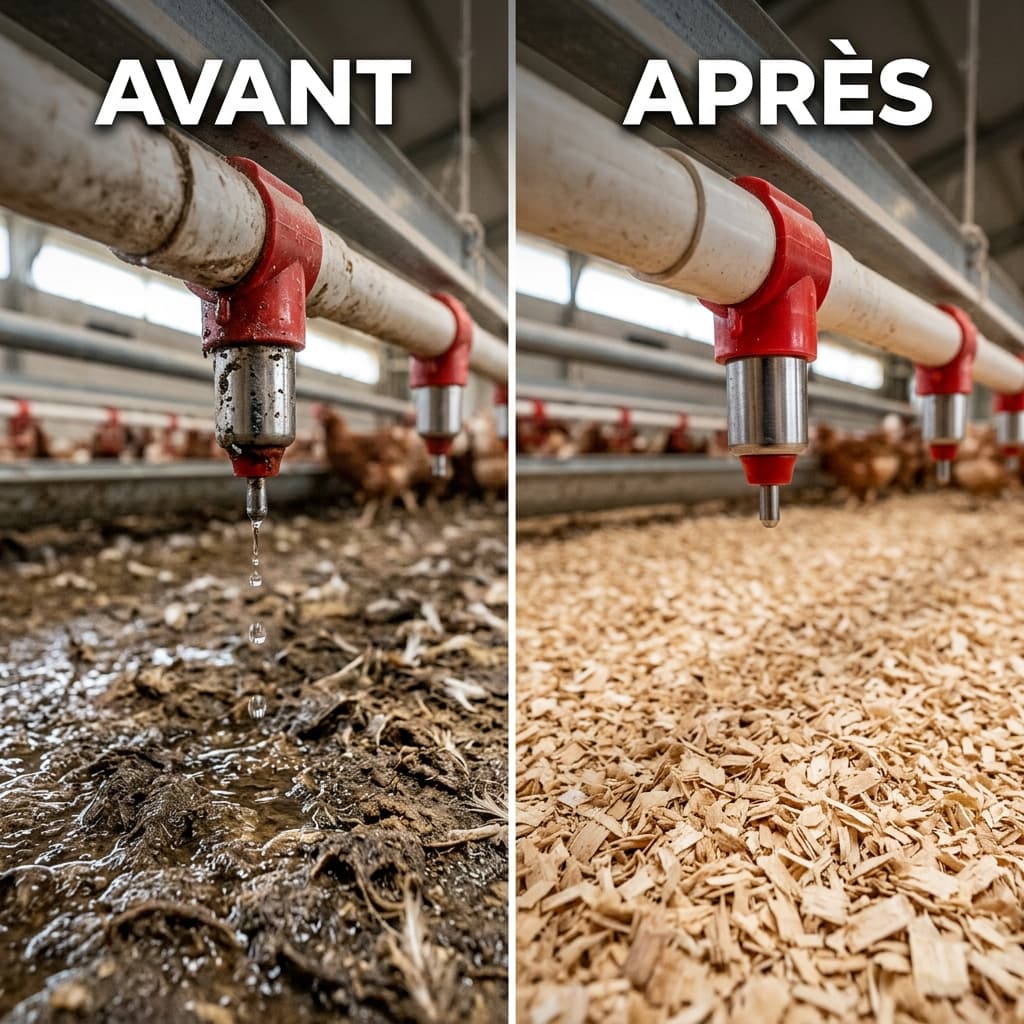
In modern farming, litter quality is a key indicator of animal welfare and zootechnical performance. Sometimes a breeder notices a rapid and abnormal degradation of the litter—which becomes wet and sticky—even though the water meters indicate a perfectly normal daily consumption for the age and breed of the animals.
The illusion of normal consumption
When faced with wet litter, the first reflex is often to suspect overconsumption of water due to a problem with temperature, ventilation, or pressure settings. However, when these parameters are correct and the overall volume of water consumed remains within the norms, the origin of the problem is often more insidious and lies right inside the pipes.
The true causes: biofilm and internal deposits
The problem does not come from the quantity of water entering the building, but from the way it is distributed by the nipple drinkers. This malfunction is generally linked to a degradation of the microbiological and physico-chemical quality of the lines:
- Internal biofilm: A slimy film of bacteria settles in the pipes. Fragments of this biofilm regularly break off and lodge in the delicate mechanisms of the nipples.
- Mineral deposits: Scale or iron create microscopic roughness that prevents the nipple pin from closing perfectly.
- Circuit instability: These deposits and biofilms cause irregular flow. The nipples no longer close tightly.
Consequences in the field
This phenomenon generates targeted problems that degrade the environment:
- Continuous dripping (leakage): A slight leak, invisible on the scale of the building's main water meter, is enough to saturate the litter located directly under the drinking line.
- Localized moisture: "Puddles" or areas of crusty moisture form under certain sections of the lines.
- Rapid degradation of droppings: Excess local moisture changes the consistency of droppings, promoting footpad dermatitis and ammonia emissions.
The recommended protocol
To solve this wet litter problem related to the lines, a curative then preventive action on the water network is necessary:
Total restoration with BIONET. During the sanitary break, shock stripping of the lines with BIONET is essential. Its powerful acid action dissolves mineral deposits (scale, iron) and destroys the biofilm matrix, restoring the nipples to perfect mechanical tightness.
Maintaining stability with OXYLIS HOCl. During the flock (in the presence of animals), the continuous injection of OXYLIS HOCl guarantees constant water disinfection. It prevents the reformation of biofilm and keeps the network clean, thus avoiding the return of pernicious leaks.
Key takeaway
A biologically unstable drinking line can disrupt the entire balance of the animal environment by creating micro-leaks. Maintaining dry litter also requires rigorous maintenance of the inside of the pipes.
Recurring contamination problems?
Request a complete audit of your facilities by our biosecurity experts.
Request a Field Audit