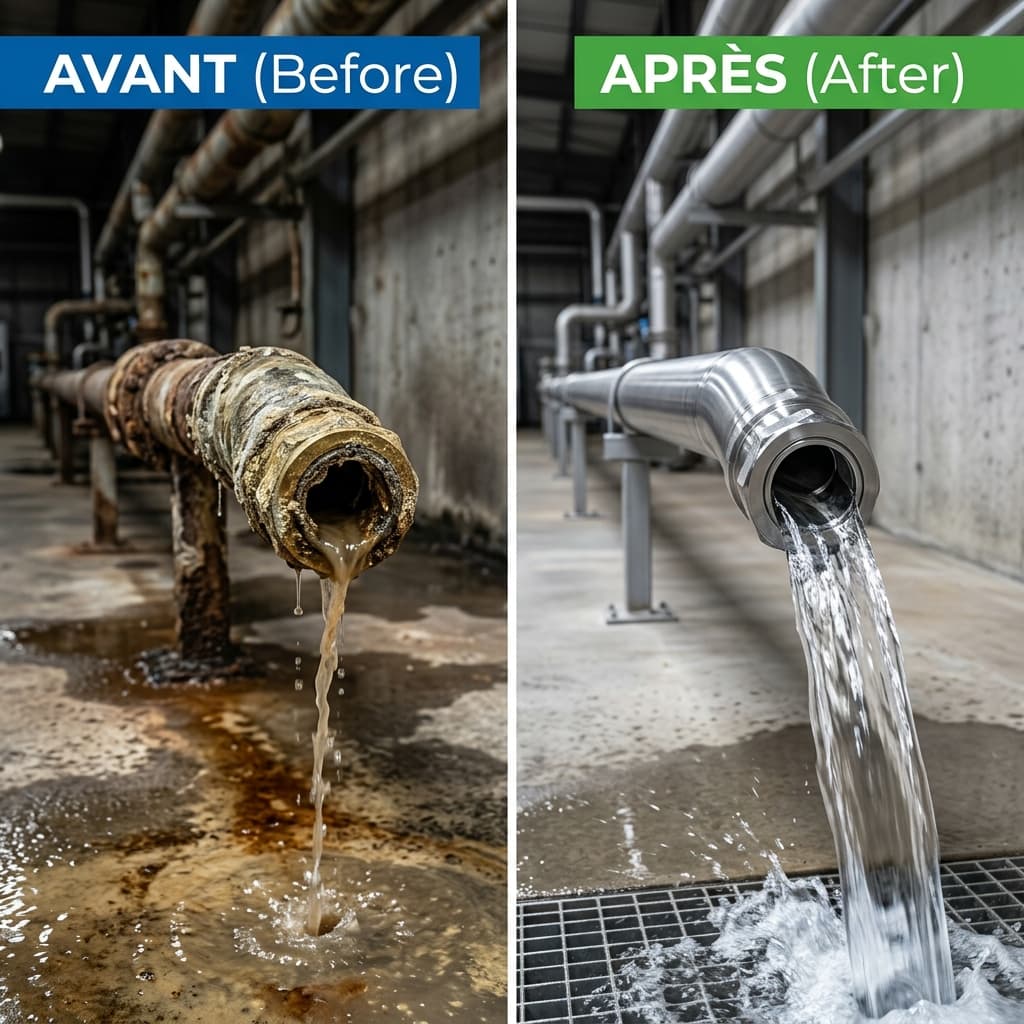
In large structures (long livestock buildings, vast food processing plants), managing water quality presents a major structural challenge. It is common to find that the water at the end of the line has a significantly lower microbiological quality than that measured at the beginning of the network. This phenomenon of instability is intrinsically linked to the length of the pipes, which amplifies hydraulic and physico-chemical defects.
Instability factors in large networks
The longer a water network is, the more the residence time of the water inside the pipes increases, favoring a series of degradations:
- Pressure and flow variations: Over a long distance, pressure naturally drops. A lower flow rate at the end of the line reduces the mechanical cleaning effect (shear) of the water on the walls, promoting the deposition of suspended particles.
- Local stagnation: "Dead legs", elbows, and low-draw areas (fewer animals or fewer machines at the end of the line) create stagnation zones where water warms up and bacteria proliferate.
- Depletion of standard disinfectants: Traditional water treatment products (like free chlorine) are consumed quickly upon contact with organic matter right from the start of the circuit, leaving the water at the extremities completely devoid of residual protection.
Signs of a network at its limit
The instability of a long network often manifests itself through symptoms localized in its extremities:
- The last draw-off points (or the last nipples) are visually dirtier or scaled.
- The water flow there is irregular or insufficient.
- An abnormal odor is released during end-of-line purging.
- Bacteriological analyses show systematic recontamination despite correct treatment at the injection point.
The recommended protocol for long networks
To guarantee homogeneous water quality from the first to the last meter of pipe, a two-phase protocol is necessary:
Phase 01 — Hydraulic restoration with BIONET. The periodic application (during sanitary breaks or major cleanings) of BIONET dissolves accumulated scale and iron deposits. By eliminating these internal roughnesses, a fluid hydraulic profile is restored and biofilm attachment zones are removed, even in low-pressure areas.
Phase 02 — Persistent stabilization with OXYLIS HOCl. Unlike standard disinfectants that deplete quickly, OXYLIS HOCl maintains excellent stability throughout the network. Injected continuously, it guarantees effective residual disinfection even at the ends of the longest water lines, thereby preventing any bacterial recontamination.
Key takeaway
In long networks, health problems often start invisibly at the ends of the circuit. Total control requires regular internal mechanical cleaning and the use of a disinfectant capable of traveling to the end of the line without losing its effectiveness.
Recurring contamination problems?
Request a complete audit of your facilities by our biosecurity experts.
Request a Field Audit