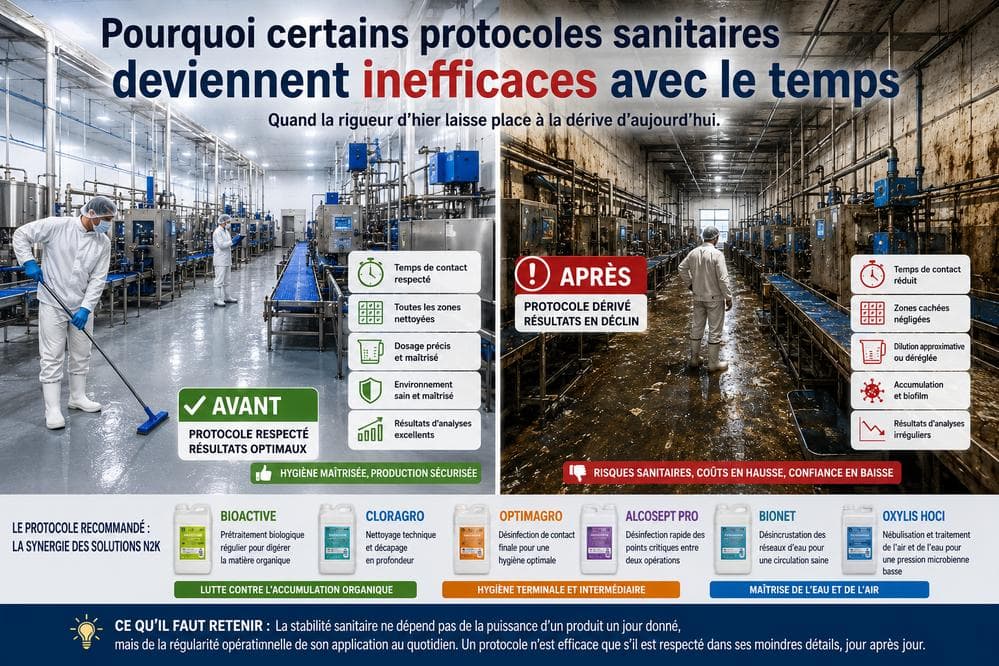
When a new hygiene protocol is implemented, the results are often spectacular: swabs are perfect, odors disappear, and surfaces shine. Yet, in many facilities, a few months later, the situation degrades. Test results become irregular, environmental pressure rises, and the teams feel that "the product no longer works." In reality, the chemistry hasn't changed. It's the application of the protocol that has drifted, often imperceptibly.
The silent drift of habits
The ineffectiveness of a protocol over time is rarely due to a sudden failure, but rather a sum of small daily omissions. With routine and production pressure, shortcuts are taken:
- Reduction of contact times: This is the number one cause. Applying a detergent foam or disinfectant and rinsing almost immediately cancels the chemical action. The product doesn't have time to break down fats or destroy bacteria.
- Forgetting hidden areas: Flat, visible surfaces are cleaned, but the undersides of conveyors, siphons, evaporators, or the tops of walls are gradually neglected. These areas become strongholds for the daily recontamination of the workshop.
- Approximate dilution: Without a precise dosing system, or if it is misadjusted, the product is either under-dosed (ineffective) or over-dosed (waste and risk to equipment).
The vicious cycle of accumulation
When the protocol is no longer strictly applied, a residual organic load takes hold. Every day, a tiny layer of protein or fat escapes cleaning. Week after week, this accumulation polymerizes and acts as a thermal and chemical shield for bacteria (biofilm formation). From then on, even if the correct dosage of disinfectant is resumed, it can no longer reach its target.
The warning signs
Sanitary degradation manifests itself through several progressive symptoms:
- Increased consumption of chemicals (teams try to compensate with quantity).
- Appearance of slippery floors and persistent odors, even after cleaning.
- Erratic swabbing results.
The recommended protocol: the synergy of N2K solutions
To break this drift and ensure lasting sanitary stability, you must rely on a strict routine and complementary products:
Fighting organic accumulation: BIOACTIVE as a regular biological pretreatment to digest organic matter before it becomes embedded, followed by technical cleaning with CLORAGRO for perfect stripping.
Terminal and intermediate hygiene: Applying OPTIMAGRO for final contact disinfection, and using ALCOSEPT PRO to quickly neutralize critical points (knives, screens) during breaks.
Water and air control: BIONET to descale water networks, and OXYLIS HOCl via fogging and in water to maintain low microbial pressure throughout the environment (air and pipes).
Key takeaway
Sanitary stability does not depend on the power of a product on any given day, but on the operational regularity of its daily application. A protocol is only effective if it is respected in its smallest details, day after day.
Recurring contamination problems?
Request a complete audit of your facilities by our biosecurity experts.
Request a Field Audit