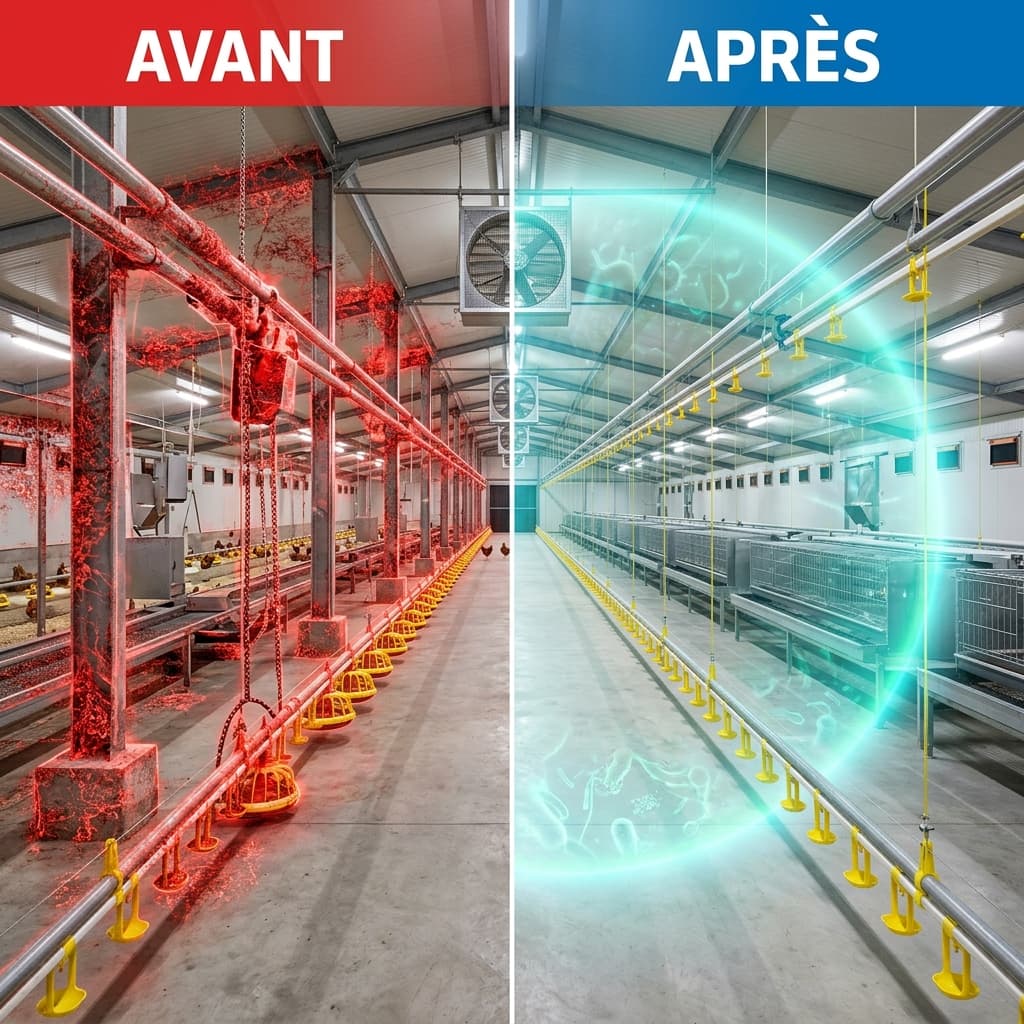
When visiting a livestock building, everything might give a first impression of spotless cleanliness: an acceptable overall smell, visually clean surfaces, and properly rinsed equipment. However, this visual impression is often misleading, as a major part of sanitary instability remains completely invisible to the naked eye.
What hides behind apparent cleanliness
The absence of visible dirt does not mean the absence of a microbiological threat. Several contamination reservoirs can persist silently:
- Colonized water lines: The inside of drinking lines often harbors bacterial biofilm and deep organic deposits, even when the water flowing through them looks clear.
- Residual moisture: Areas left damp after washing encourage the survival and rapid multiplication of remaining bacteria.
- Contaminated technical zones: Equipment undersides, feeder corners, and ventilation systems are often forgotten or poorly disinfected.
- Old organic deposits: A thin layer of dried organic matter can persist on rough surfaces and serve as a protective shield for germs.
- Microbiological atmosphere: Ambient air and suspended dust can maintain a high bacterial or viral load.
Real field consequences
This invisible biological instability always ends up manifesting itself concretely when flocks are started:
- Erratic zootechnical performance from one flock to another without any apparent cause
- An abnormally rapid wetting of litter in the first few days
- A rapid increase in ammonia odors after animals are introduced
- An early and unexplained recontamination of the building's environment
The recommended protocol
To durably stabilize a building, all risks must be addressed in a consistent manner:
Step 01 — Organic preparation with BIOACTIVE. Applying BIOACTIVE degrades accumulations of residual organic matter on all surfaces.
Step 02 — Alkaline chlorinated cleaning with CLORAGRO. Using CLORAGRO removes the protective matrix and exposes the actual surfaces.
Step 03 — Final disinfection with OPTIMAGRO. Applying OPTIMAGRO ensures effective destruction of micro-organisms on exposed surfaces.
Step 04 — Water circuit sanitation with BIONET and OXYLIS HOCl. Cleaning inside the lines with BIONET followed by continuous water treatment with OXYLIS HOCl prevents biofilm persistence.
Key takeaway
The long-term sanitary stability of a livestock building rarely depends on a single isolated action. It relies on the overall consistency of the applied protocol, capable of addressing both visible and invisible threats.
Recurring contamination problems?
Request a complete audit of your facilities by our biosecurity experts.
Request a Field Audit