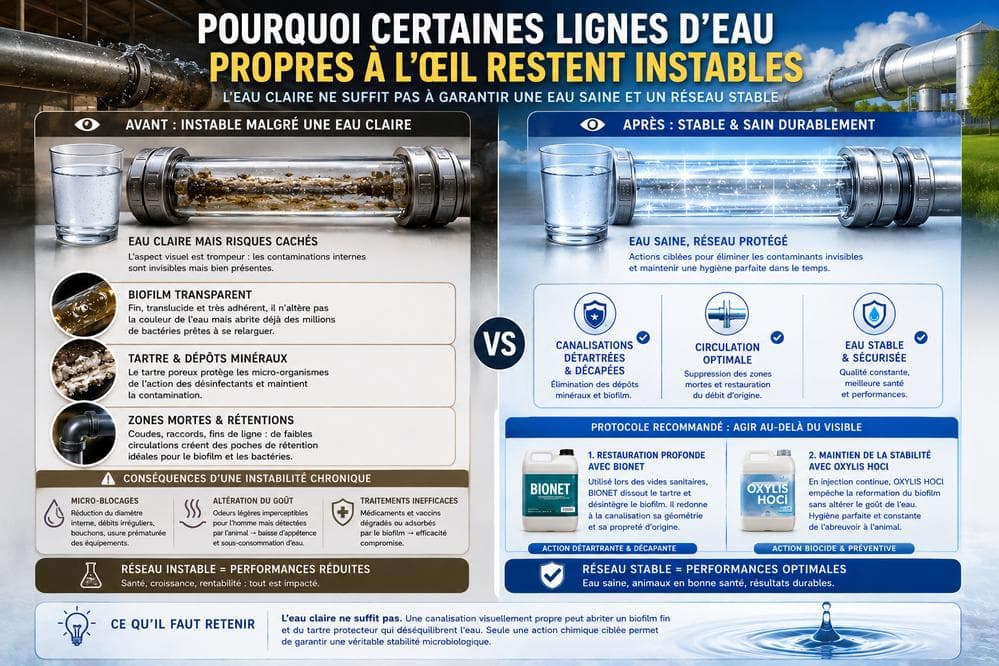
In water management for livestock or industry, visual appearance is often deceptive. It frequently happens that water drawn at the end of a line is perfectly clear, odorless, and limpid, giving the impression of a healthy network. However, despite this apparent clarity, recurring problems persist (variable bacteriological analyses, digestive issues in animals). Why this discrepancy between what is seen and what is actually happening?
The trap of visual cleanliness
Clear water does not mean healthy water, nor does it mean a clean pipe. The internal contamination of circuits is mostly invisible from the outside, and sometimes even undetectable during a simple flush:
- The transparent biofilm: At the beginning of its development, a biofilm is thin, translucent, and highly adherent. It does not color the water but already harbors millions of bacteria ready to intermittently release pathogens.
- The role of scale: Mineral (limescale) or iron deposits line the inside of pipes. If they do not detach, the water remains clear. Yet, this porous scale is the ideal refuge for microorganisms, protecting them from the action of standard disinfectants.
- Dead zones: Elbows, poorly designed fittings, or line ends are areas of very low circulation. A line can appear clean at high flow while hiding pockets of contamination in these retention zones.
The consequences of chronic instability
A visually clean but biologically unstable line leads to insidious inconveniences:
- Micro-blockages: The slow development of biofilm or scale reduces the internal diameter, causing irregular flow rates or partial blockage of pipettes and nipples.
- Taste alteration: Very slight odors (sometimes imperceptible to humans but detected by animals) lead to decreased palatability and therefore under-consumption of water.
- Treatment ineffectiveness: The administration of medications or vaccines via drinking water is compromised, as the active ingredients are degraded or adsorbed by the biofilm.
The recommended protocol: act beyond the visible
To guarantee the true cleanliness of a network, you must dissolve the invisible mineral and organic shields:
Deep restoration with BIONET. The periodic application of BIONET during sanitary breaks is essential. Its strong descaling and stripping power removes minerals and disintegrates the biofilm, restoring the pipe to its original geometry and cleanliness.
Maintaining stability with OXYLIS HOCl. During the production cycle, the continuous injection of OXYLIS HOCl maintains this cleanliness. This highly effective biocide prevents the biofilm from reforming without altering the taste of the water, ensuring perfect and constant hygiene from the drinker to the animal.
Key takeaway
Clear water is not enough. A visually clean pipe can harbor a thin biofilm and protective scale that unbalance the water. Only targeted chemical action can guarantee true microbiological stability.
Recurring contamination problems?
Request a complete audit of your facilities by our biosecurity experts.
Request a Field Audit