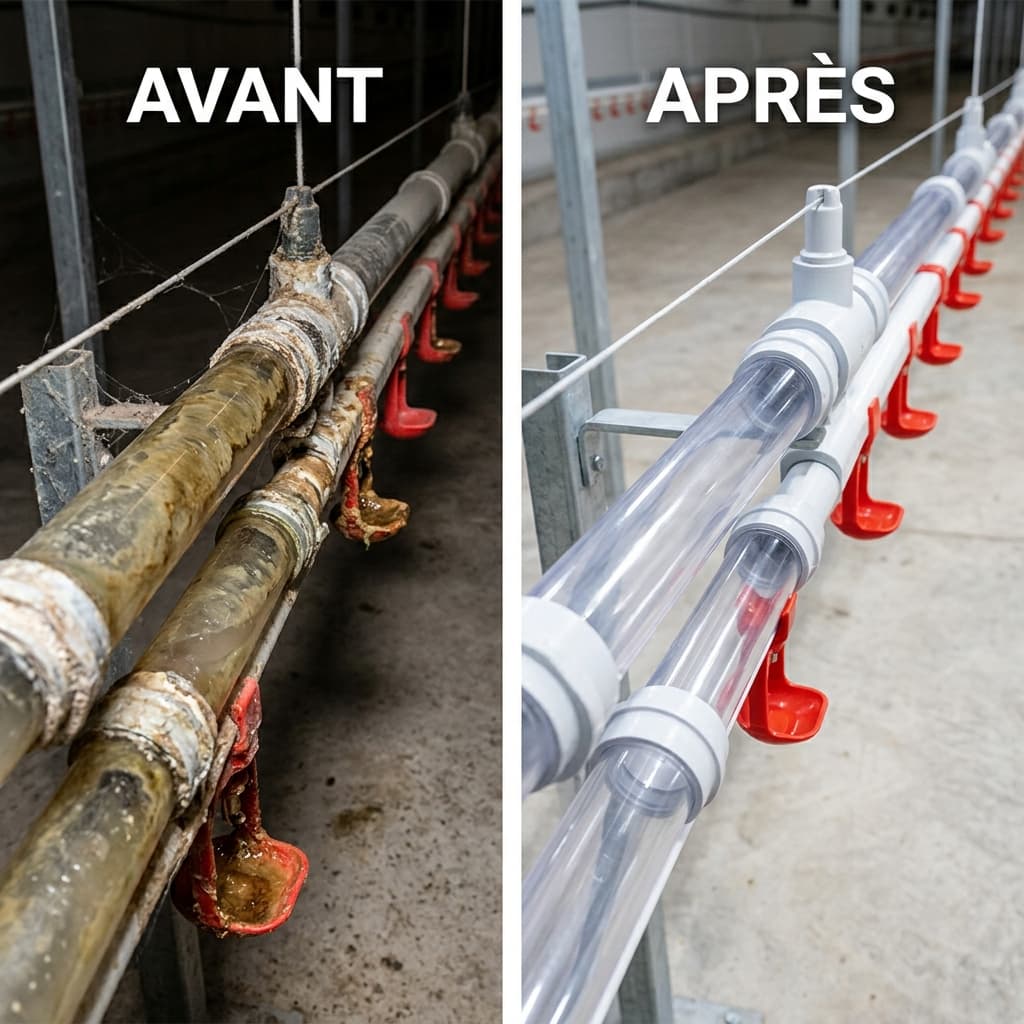
In some livestock operations, water lines are properly treated during the sanitary break: stripping, flushing, sometimes even intensive chemical disinfection. Yet a few weeks later, the same problems return — deposits, odours, irregular nipple drinkers. This phenomenon is frustrating but is explained by a simple, often overlooked principle.
Why shock treatment alone is not enough
A shock treatment, however effective, acts at a single point in time. It eliminates existing deposits, breaks down established biofilm and restores the network to a microbiologically acceptable state. But as soon as water begins circulating through the pipelines again, the recolonisation process naturally restarts.
Circuits gradually become re-exposed to multiple destabilising factors:
- New mineral deposits: Limescale and salts present in the supply water continuously redeposit on internal walls, providing an anchoring surface for micro-organisms.
- Environmental contaminations: Circulating water carries bacteria from the tank, connections or the building environment.
- Water quality variations: Seasonal changes in temperature, pH or mineral load alter the network's balance and promote biofilm reformation.
What really happens after stripping
After effective shock treatment, the internal surfaces of pipelines are laid bare. Paradoxically, this clean surface becomes favourable ground for new colonisation if no continuous protection is implemented. Without maintenance treatment, biofilm can reform in just a few weeks.
The recommended protocol
Periodic stripping with BIONET. Regular use of BIONET maintains circuits in an acceptable state of internal cleanliness by eliminating new deposits before they become problematic.
Daily maintenance with OXYLIS HOCl. Continuous injection of OXYLIS HOCl into the water network helps stabilise the microbiological quality of circuits throughout the production period. It is this continuity that makes the difference between a stable and a deteriorating network.
Key takeaway
A stripped network without continuous maintenance can quickly become unstable again. Shock treatment prepares the ground — but it is the maintenance treatment that guarantees lasting results.
Recurring contamination problems?
Request a complete audit of your facilities by our biosecurity experts.
Request a Field Audit