Water:
The drinking network, primary contamination vector
An uncontrolled water network transmits pathogens to the entire flock within hours. Control starts at the source and is maintained to the last drinker.
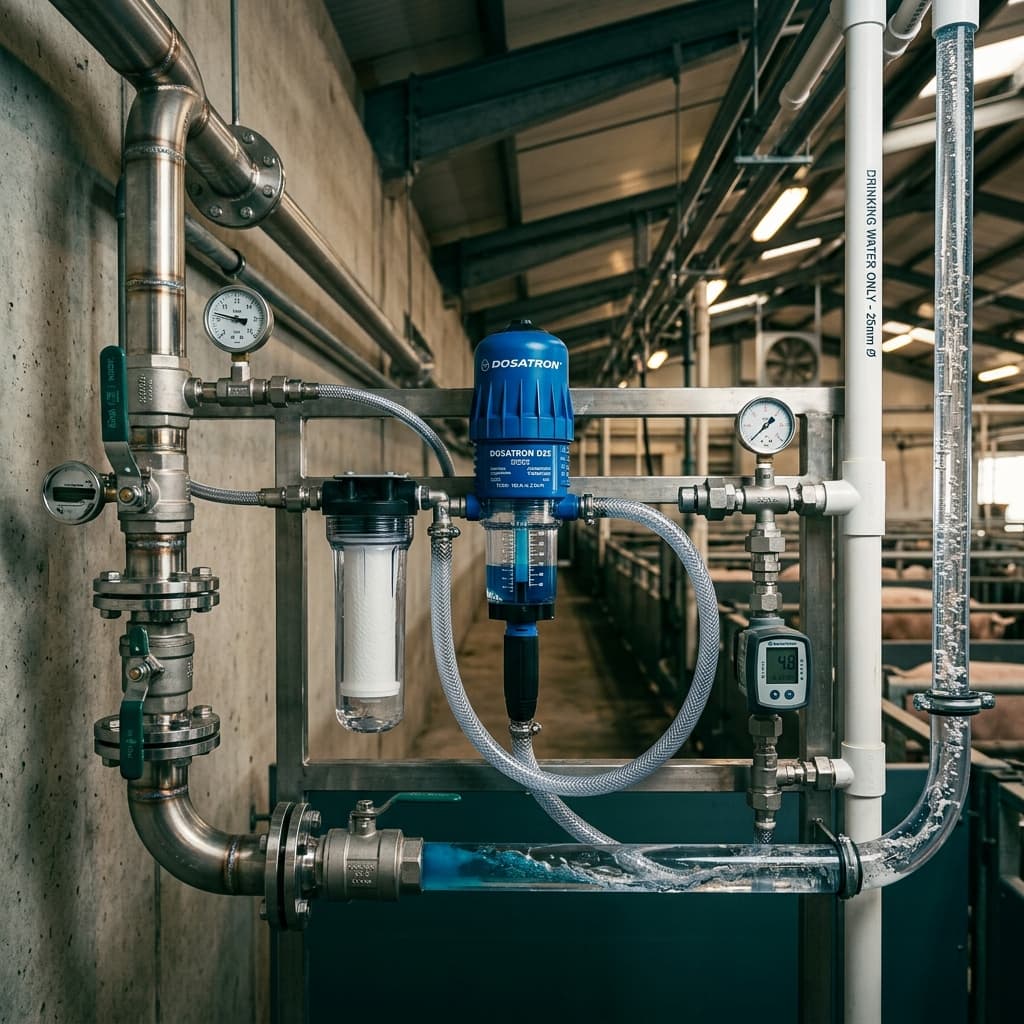
The Problem
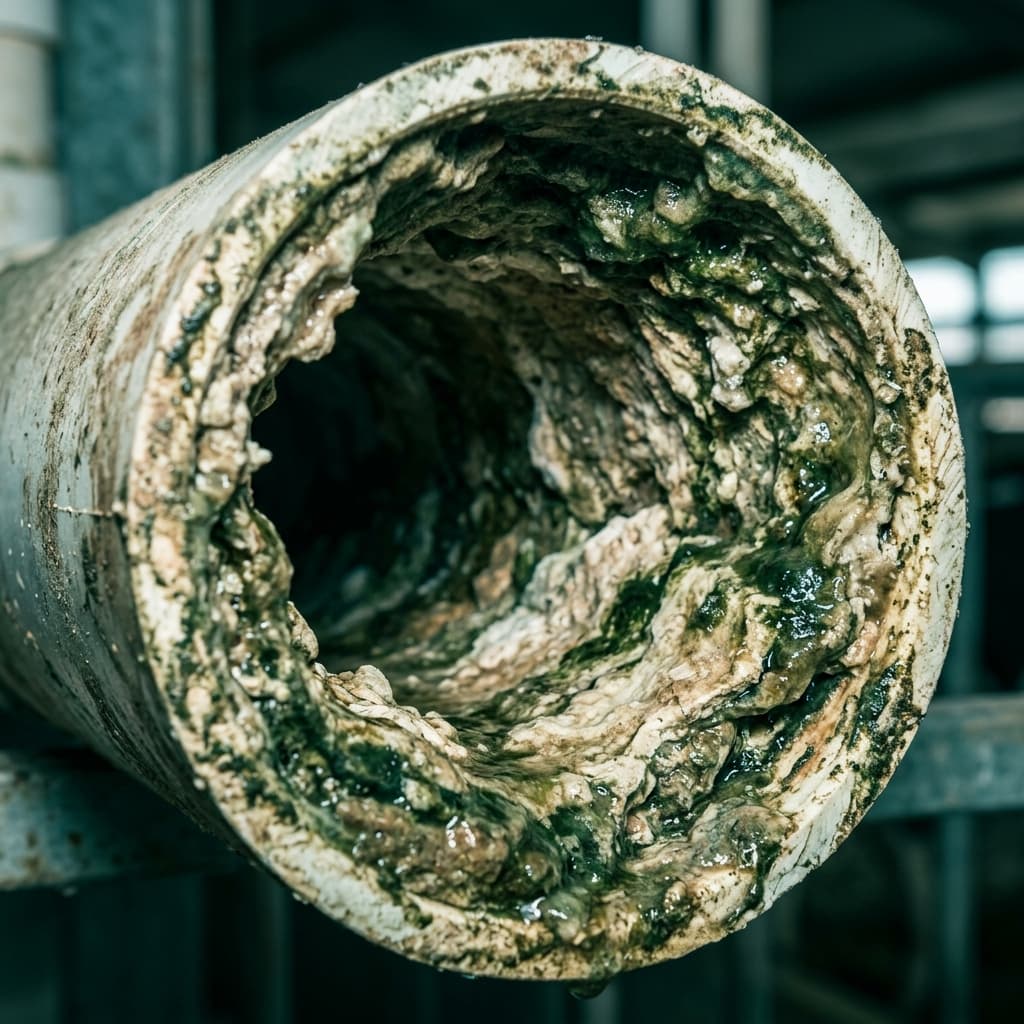
The water contamination cycle in livestock follows a predictable path: reservoir → main pipeline → sub-lines → nipples/drinkers → animal. At each junction point, bacterial biofilm develops in dead zones of the network, elbows, reducers and internal pipe surfaces.
Deposits accumulate in successive layers: limestone scale due to water hardness, bacterial biofilm (E. coli, Pseudomonas, Salmonella), medication and vitamin residues, and organic deposits from the animals themselves. This stratification creates a self-sustaining pathogenic reservoir.
The impact on performance is direct: decreased water consumption (partial obstructions), FCR degradation, increased digestive and respiratory pathologies. An animal drinking contaminated water develops chronic intestinal inflammation that reduces nutrient absorption.
In Tunisia, water hardness (often >30°F) accelerates limestone scale formation. Residual chlorine in the network water is frequently insufficient to maintain acceptable bacteriological quality to the last distribution points.
Our Protocol
BIONET
Curative Technical Pipeline Cleaning
BIONET is an agent combining descaler, decruster and detergent for shock cleaning of drinking pipelines. It dissolves limestone deposits, destroys biofilm and eliminates organic residues accumulated in circuits.
- Triple action: descaler + decruster + detergent
- Dissolution of limestone scale and mineral deposits
- Biofilm destruction in nipples and drinking circuits
- Shock treatment between flocks: concentration 1% to 3%, soaking 2 to 4 hours
- Compatible with PVC, polyethylene, stainless steel, rubber gaskets
OXYLIS HOCl
Continuous Bacteriological Stabilization
OXYLIS HOCl is a bacteriological stabilizer for drinking water. It maintains constant microbiological quality from reservoir to last drinker, throughout the production cycle. Its mode of action controls microbial load without creating resistance.
- Continuous bacteriological stabilization of drinking water
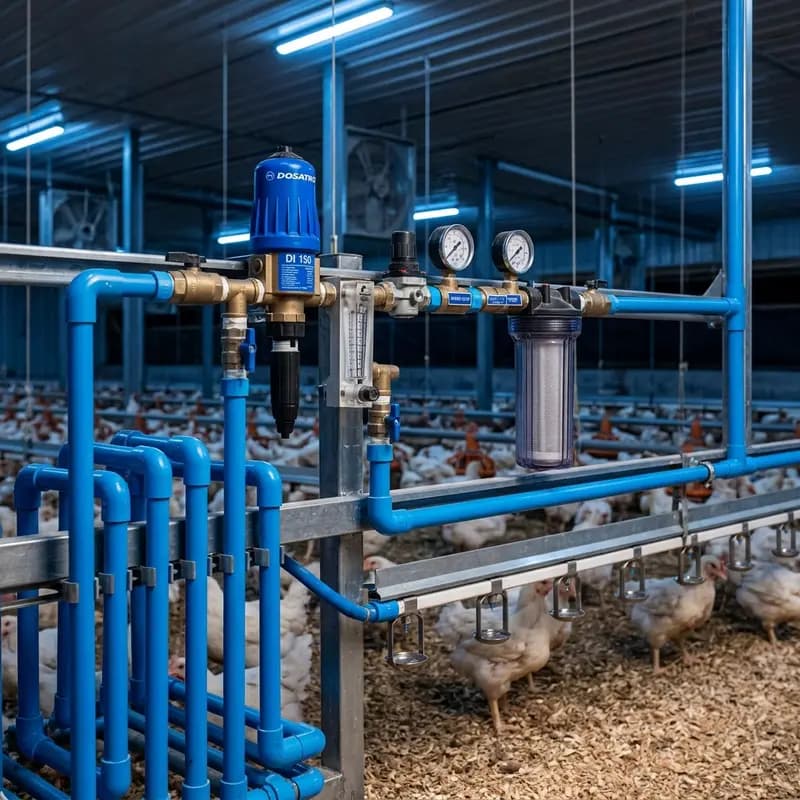
- Automatic dosing: compatible with proportional systems (Dosatron, etc.)
- Recommended dosage: 0.1% continuous
- No residue in animal tissues at recommended doses
- Field monitoring: test strips or rapid kits available
Comparatif Avant / Après
| Indicator | Without N2K protocol | With N2K protocol |
|---|---|---|
| Water bacterial load (CFU/mL) | >10,000 CFU/mL | <100 CFU/mL |
| Pipeline deposits | Thick scale + biofilm | Clean surfaces, free flow |
| Water consumption | Reduced (obstructions) | Optimal (+15 to 20%) |
| Water-related sanitary incidents | Frequent | Rare to none |
| Cleaning interval | Unplanned | Shock between flocks + continuous |
Compatibility & Safety
- Compatible with water vaccination (respect 24h delay after BIONET treatment)
- Compatible with water-soluble medications and vitamins (check specific interactions)
- No residue in animal tissues at recommended doses
- BIONET: mandatory and thorough rinsing before restoring drinking water
Field Results
<100
CFU/mL — Water bacterial load after treatment
+20%
Water consumption restored after BIONET descaling
Continuous
OXYLIS HOCl protection throughout the cycle
Technical FAQ
Yes. OXYLIS HOCl is designed for continuous use from animal placement. The 0.1% dosage is safe for chicks from day one. It is recommended to start treatment before animal arrival to stabilize the network.
For severe scale, use BIONET at reinforced concentration (3%) with extended soaking of 4 to 6 hours. For heavily scaled individual nipples, disassembly and direct soaking may be necessary. Rinse thoroughly before restoring service.
After BIONET treatment, rinse the entire circuit thoroughly with potable water. Verify absence of foam and residues. Drinking water can be restored immediately after complete rinsing. Plan 2 to 3 network volumes in rinse water.
Yes, this is the recommendation. OXYLIS HOCl is designed for continuous dosing at 0.1% throughout the production cycle. Stopping treatment exposes the network to rapid recontamination, especially in hot climatic conditions.
Average water consumption is approximately 200 to 250 mL/bird/day in broilers (variable by age and temperature). For 20,000 birds: approximately 4,000 to 5,000 liters/day. At 0.1% OXYLIS HOCl: 4 to 5 liters of pure product per day, via proportional doser.