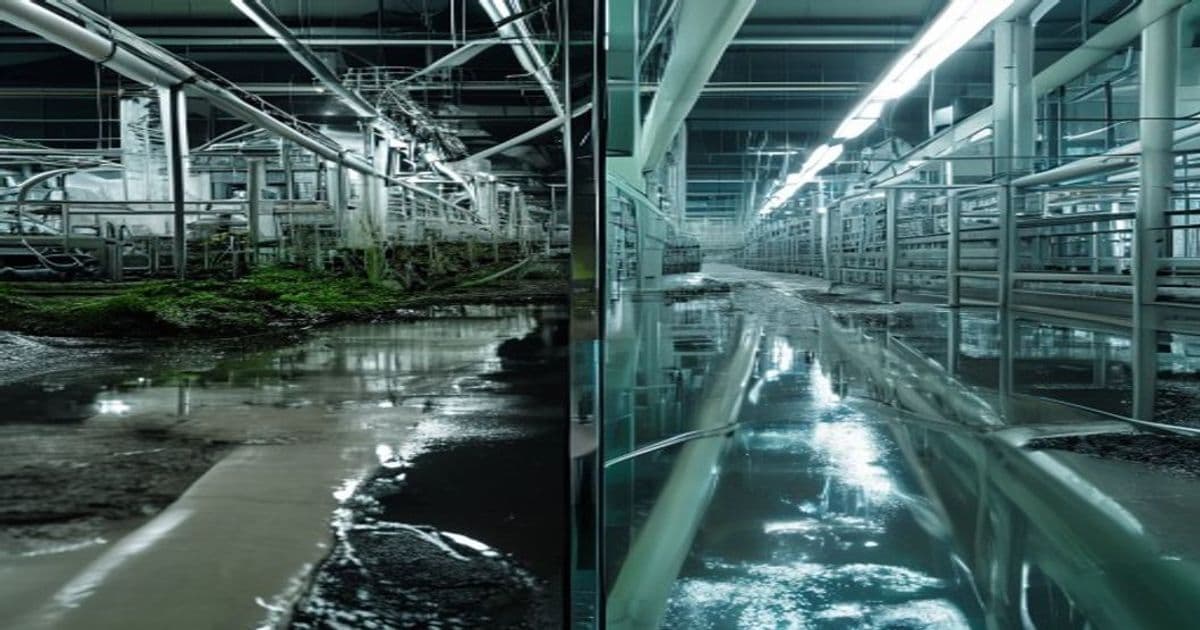
In food processing plants and slaughterhouses, the microbiological quality of water is a pillar of food safety. It is used at every stage: washing raw materials, cleaning equipment, preparing brines, and cooling products. While water delivered by the public network or treated at the intake station is systematically compliant, analyses carried out at points of use in the plant sometimes reveal serious microbiological instability (presence of coliforms, high total count, Pseudomonas). Drinking water deteriorates within the loops of your internal piping under the influence of biofilm.
Water degradation in the internal distribution network
A food factory houses kilometers of pipes, with bends, valves, dead legs, and varying diameters. This complex network presents several factors promoting the deterioration of water quality:
- Inevitable biofilm formation: bacteria naturally present in very low quantities in drinking water attach to pipe walls, multiply, and secrete a protective matrix.
- Scale and mineral deposits: precipitation of limestone and metal oxides creates rough surfaces ideal for bacterial anchoring.
- Dead legs and stagnation zones: unused pipe sections or connections from old machines form areas of standing water where disinfectants are quickly consumed, allowing active microbial growth.
- Thermal variations: proximity to steam or hot water lines locally heats cold process water, accelerating bacterial multiplication.
Why intake disinfectants (like chlorine) are not enough
Chlorine gas or sodium hypochlorite dosed at the plant entrance have limited residual efficacy. As water progresses through pipes loaded with scale and biofilm, the disinfectant reacts chemically with this organic matter. Its concentration drops rapidly along the network. At final points of use, the free disinfectant dose is insufficient to inhibit bacteria, which detach from the biofilm in waves and contaminate the process water.
Major risks for the production facility
- Cross-contamination of finished products (reduced shelf-life, risks of Listeria or Salmonella).
- Loss of efficacy in cleaning-disinfection operations (rinsing with polluted water).
- Premature clogging of spray nozzles and heat exchangers.
- Recurring non-compliances during HACCP audits and official controls.
The stabilisation protocol recommended by N2K Laboratoires
To guarantee compliant water at every point of use, curative stripping must be combined with continuous preventive treatment:
Step 01 — Periodic curative stripping with BIONET. Dosing BIONET periodically into water circuits dissolves scale and detaches the bacterial biofilm fixed to the inner walls.
Step 02 — Continuous preventive stabilisation with OXYLIS HOCl. Continuous automated injection of OXYLIS HOCl at the network intake maintains a stable residual disinfecting power to the furthest points of use, without altering taste or odour, and while respecting the passivity of stainless steel piping.
Key takeaway
Clean water at the intake does not guarantee clean water at the outlet. Microbiological control of industrial water requires periodically eliminating biofilm from internal pipes and maintaining a continuous residual disinfection capable of traveling without depletion to the final point of use.
Recurring contamination problems?
Request a complete audit of your facilities by our biosecurity experts.
Request a Field Audit