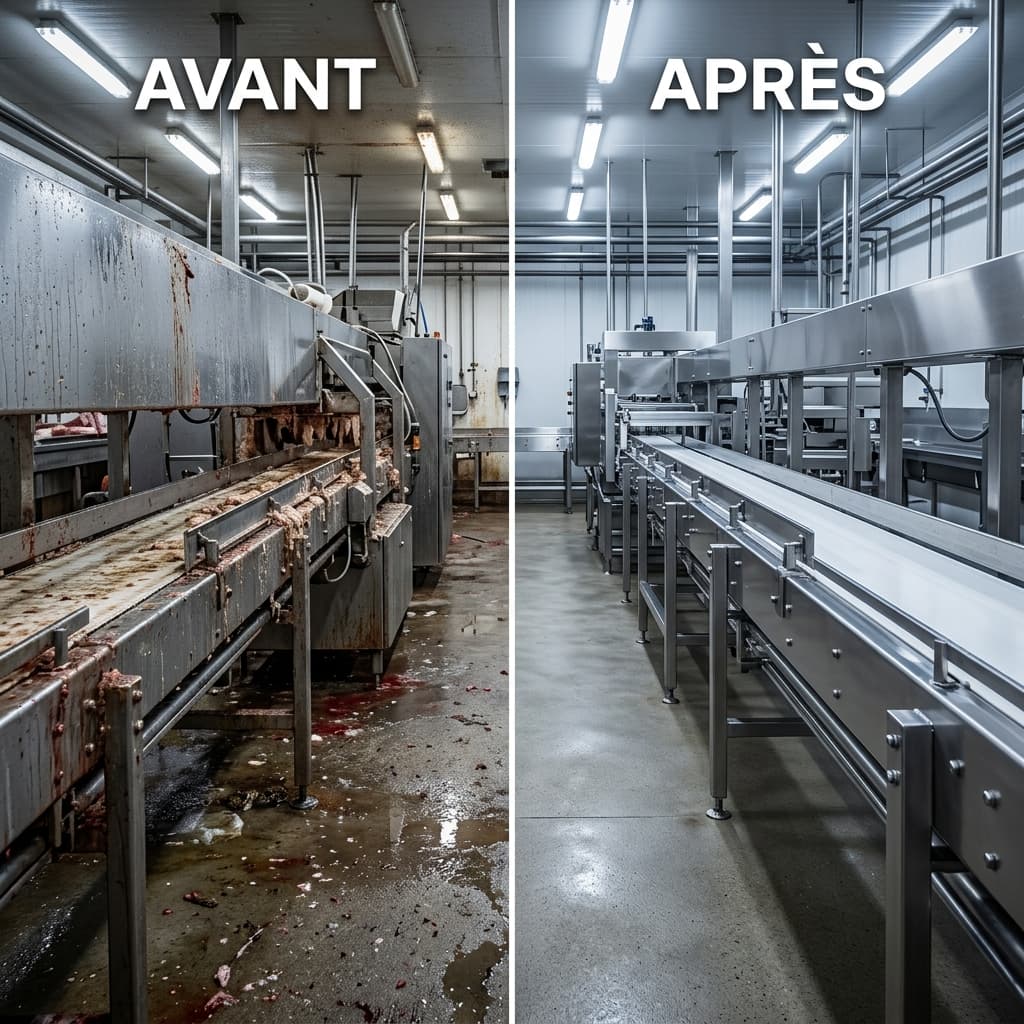
In many slaughterhouses and meat processing facilities, the same issues recur persistently from one control to the next: cross-contamination by pathogens, unstable microbiological surface results, HACCP audit non-compliance, and persistent organic odours. When these warnings arise, the typical response is to increase disinfection frequency or switch biocidal molecules. Yet in the majority of cases, the disinfectant is not the cause.
Critical zones: genuine biofilm factories
Slaughter and meat processing lines are subject to a constant and massive influx of complex organic matter: animal fats, myofibrillar proteins, fresh blood, and tissue debris. Certain equipment, due to its mechanical design and continuous load, accumulates these residues at an extreme rate:
- Conveyors and transport belts: micro-scratches and mechanical wear on plastic or articulated modular belts create ideal micro-refuges for bacteria.
- Suspension hooks and shackles: difficult to reach with brushes and subject to permanent friction.
- Polyethylene cutting boards: knife cuts create deep grooves where organic matter becomes embedded out of reach of water jets.
- Scalding tanks and chillers: these warm or cold temperature baths concentrate suspended matter and promote microbial proliferation if the water is not treated continuously.
- Process water circuits: internal pipelines of carcass washing machines can harbour massive biofilms.
Why disinfectant alone is powerless
A classic mistake is underestimating the preliminary cleaning phase and relying solely on disinfection to destroy microbial flora. A disinfectant applied directly over fat, blood, or a biofilm matrix sees its efficacy drop by over 90%. Organic materials instantly consume the active biocidal molecules before they can reach the bacterial cell wall.
Biofilm protects pathogens (such as Salmonella or Listeria) beneath a shield of organic polymers. To destroy these germs, you must first destroy this shield.
Severe economic consequences for industrial operations
Poor hygiene management on a slaughter line goes beyond bad lab reports. It has direct repercussions on commercial activity:
- Product recalls and market withdrawals
- Loss of export approvals for demanding markets
- Adverse veterinary audits leading to regulatory warnings
- Repeated production shutdowns for unscheduled corrective cleaning
- Brand image damage with retail clients
The recommended sequential protocol
To durably break the contamination loop on a production line, N2K Laboratoires recommends the following professional hygiene protocol:
Step 01 — Organic surface stripping. Applying a highly alkaline stripping detergent like CLORAGRO emulsifies fats and dissolves protein deposits on stainless steel structures, conveyors, and floors.
Step 02 — Final disinfection. Disinfection only becomes fully effective on a thoroughly degreased surface. Applying a certified disinfectant like OPTIMAGRO achieves maximum microbial reduction.
Step 03 — Process circuit treatment. Internal pipelines and washing water circuits must be stripped regularly with BIONET to eliminate internal biofilm.
Step 04 — Continuous process water stabilisation. The controlled dosing of a food-grade biocide like OXYLIS HOCl stabilises process water and prevents waterborne cross-contamination.
Key takeaway
In a slaughterhouse, visible contamination is only the tip of the iceberg. Sanitation control failures are almost always linked to an invisible accumulation of organic matter and biofilm in retention areas. The solution lies in the mechanical and chemical rigour of the preliminary cleaning, long before choosing the disinfectant.
Recurring contamination problems?
Request a complete audit of your facilities by our biosecurity experts.
Request a Field Audit