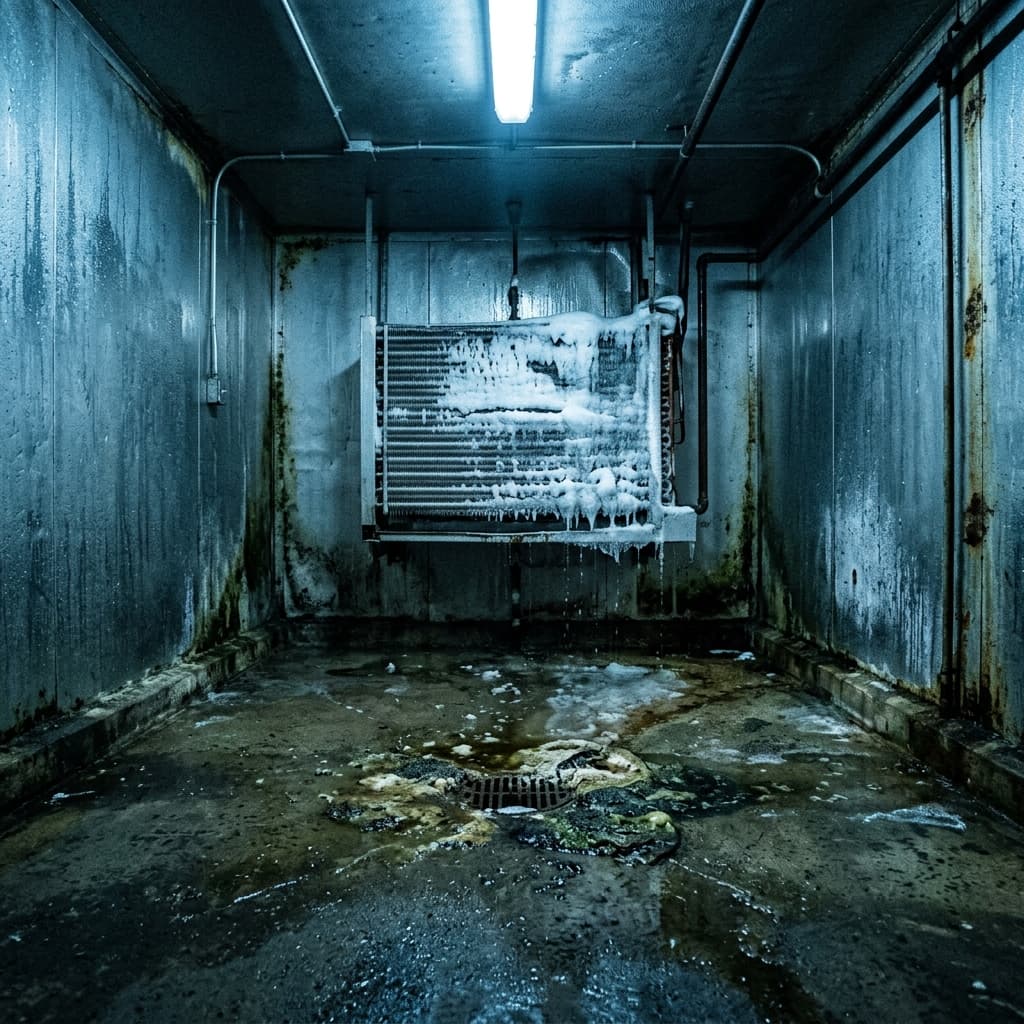
In the food industry, cold rooms are often perceived as biologically secure spaces. The underlying logic seems obvious: cold temperatures paralyze microbial growth. Thus, after a standard wash and regular disinfection, surfaces are expected to remain compliant. Yet, analyses frequently reveal recurring contamination, particularly by Listeria monocytogenes or storage molds. Cold does not protect; it merely hides the flaws of an incomplete hygiene protocol.
The false sense of security of cold
Low temperatures (typically between 0 and 4°C) slow down the division of many bacteria but do not kill psychrotrophic germs. On the contrary, the confined and moisture-saturated atmosphere of cold rooms constitutes an ideal ecosystem for these resistant micro-organisms:
- Persistence of Listeria: this formidable bacterium tolerates cold and humidity perfectly, forming highly adherent biofilms there.
- The role of evaporators: these units continuously circulate air, dispersing fungal spores and microbial aerosols throughout the room.
- Condensation water: drops forming on the ceiling or along pipes absorb impurities and fall directly onto stored products.
Critical zones systematically overlooked
- Evaporator fins and recovery trays: rarely dismantled during routine cleaning operations.
- Rubber door gaskets: whose porosity and mechanical crushing create inaccessible micro-cavities.
- Suspension rails for carcasses and trolleys: lubricated with greases that trap dust and germs.
- Condensate drainage channels: which channel contaminated standing water.
Why surface disinfections fail in cold conditions
If a cold room retains a load of residual animal proteins or fats (from handling meat, fish, or dairy products), classic disinfectants lose all efficacy. Cold slows down the chemical reaction rate of active principles. Applying a diluted disinfectant to a cold, greasy wall is a waste of product: the biofilm blocks penetration and neutralises the biocidal molecule before it can reach the underlying bacteria.
The sanitation protocol recommended by N2K Laboratoires
To permanently eliminate recurring contamination in refrigerated areas, you must break the protective organic structure:
Step 01 — Chlorinated alkaline stripping with CLORAGRO. The application of CLORAGRO emulsifies encrusted proteins and fats at low temperatures, destructuring the protective matrix of the biofilm.
Step 02 — Technical washing with CLORAGRO. Applying CLORAGRO as an adhering foam emulsifies degraded deposits and sanitises the substrate in depth.
Step 03 — Certified final disinfection with OPTIMAGRO. After complete rinsing, applying a broad-spectrum disinfectant like OPTIMAGRO ensures total elimination of the residual flora.
Step 04 — Targeted atmospheric stabilisation. Using OXYLIS HOCl via thermal fogging or fine misting in evaporator ducts destroys fungal spores and purifies the air continuously.
Key takeaway
A cold room is not sanitised like a conventional process room. Cold alters bacterial behaviour and reduces chemical reactivity. Only an enzymatic elimination protocol followed by continuous atmospheric disinfection guarantees long-term sanitary safety.
Recurring contamination problems?
Request a complete audit of your facilities by our biosecurity experts.
Request a Field Audit