In the food industry, cold rooms are considered a barrier against bacterial growth. Dropping temperatures indeed slows the multiplication of most spoilage germs. However, there is a formidable pathogen that stands as an exception: Listeria monocytogenes. This psychrophilic bacterium is capable of surviving and multiplying at very low temperatures (down to 0°C). Industrial cold rooms, due to their constant moisture and complex structures, frequently become permanent reservoirs for Listeria.
Why does Listeria specifically colonise cold zones?
Listeria has adaptive mechanisms that modify its cell membrane structure to resist cold. It finds an ideal ecosystem in cold rooms where competition from other bacteria is heavily reduced:
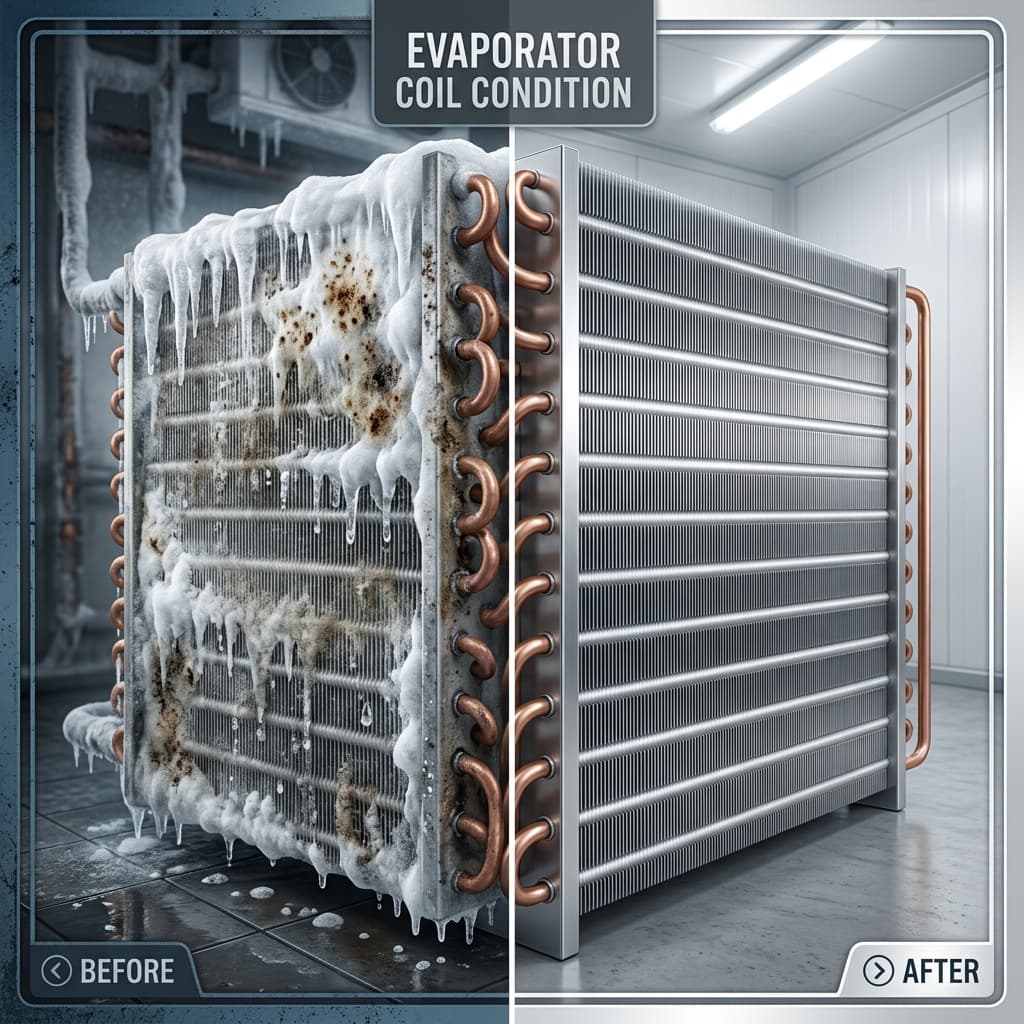
- Evaporators and condensate pans: This is the most critical area. Air circulates continuously, creating wet condensation. Evaporator fins accumulate organic micro-dust that forms a Listeria biofilm. When the fan runs, it projects spores and bacteria into the cold room air.
- Door seals: Seal rubber presents micro-cracks where moisture stagnates with no mechanical action possible.
- Suspension rails and high structures: Often overlooked during daily washing, they receive organic splashes that slowly oxidise.
- Wet floors and drains: Greasy standing water on the floor maintains the constant moisture needed for the bacterium to survive.
Why classic cleaning fails in cold rooms
Washing a cold room with hot water without controlling relative humidity is a common mistake. Hot water generates a condensation fog on cold walls and ceilings. This residual moisture reactivates dormant bacteria and helps Listeria colonise clean surfaces. Moreover, standard disinfectants applied at low temperatures lose much of their biocidal efficacy, as chemical kinetics are slowed by the cold.
The eradication protocol recommended by N2K Laboratoires
To eliminate Listeria from cold zones and prevent its reinstallation, break down residual organic matter and treat the atmosphere:
Step 01 — Targeted treatment with OXYLIS HOCl. Apply OXYLIS HOCl to evaporators (while turned off), door seals, and rails. It rapidly destroys the Listeria biofilm's protective matrix, remaining highly effective even at low temperatures.
Step 02 — Technical washing with CLORAGRO. Applying CLORAGRO as a foam removes hydrolysed fats and deeply sanitises the substrate.
Step 03 — Validated final disinfection with OPTIMAGRO. After rinsing and draining standing water, applying OPTIMAGRO ensures final microbiological elimination.
Step 04 — Continuous atmospheric stabilisation with OXYLIS HOCl. Fogging cold OXYLIS HOCl disinfects the ambient air and evaporator fins continuously without generating toxic or corrosive condensation.
Key takeaway
Cold does not protect against Listeria; it assists its establishment by eliminating bacterial competition. To secure your cold rooms, use enzymatic cleaners capable of breaking biofilms at low temperatures and sanitise ventilated air through hypochlorous acid misting.
Recurring contamination problems?
Request a complete audit of your facilities by our biosecurity experts.
Request a Field Audit