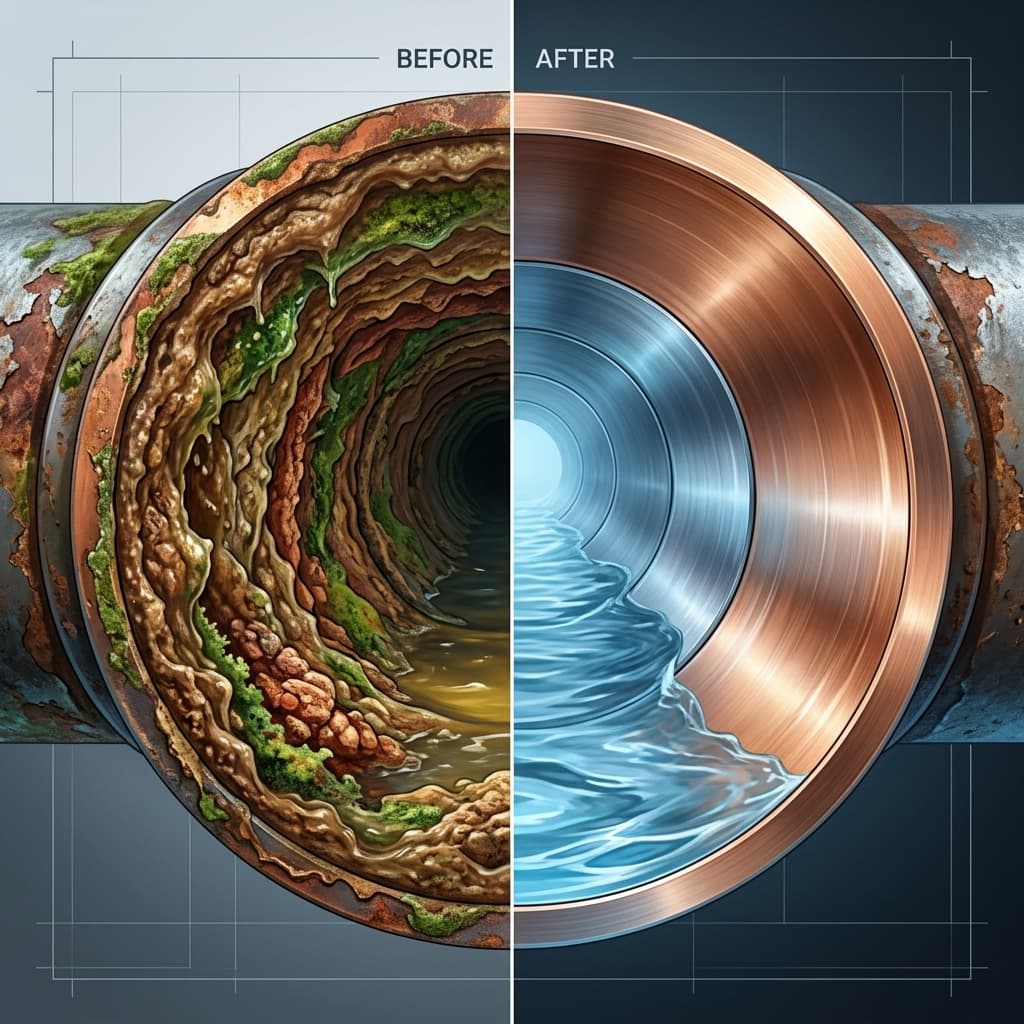
In slaughterhouses, meat processing, and seafood plants, temperature control is vital. Cooling circuits (cooling towers, plate heat exchangers, carcass showering tanks, chilled water lines) run continuously to lower product temperatures. Yet, these technical water networks are often overlooked in classic hygiene protocols. Closed or semi-open cooling circuits quickly accumulate scale, corrosion, and organic matter, becoming invisible bacterial reservoirs that indirectly contaminate production.
Factors of microbiological accumulation in cooling circuits
Water circulating in these systems undergoes constant temperature variations. These physical conditions promote cumulative fouling phenomena:
- Accelerated development of thermophilic and psychrophilic biofilms: Depending on the circuit zone, water temperature fluctuates, creating ideal ecological niches for different bacterial species (Pseudomonas, Legionella, Listeria).
- Scale and corrosion accumulation: Mineral salts deposit on pipe walls and heat exchangers. This scale forms a porous structure that mechanically protects biofilms against ordinary disinfectants.
- Presence of organic nutrients: In slaughterhouses, showering carcasses or cooling offal releases fats and proteins that are sucked back or carried into water recovery tanks, feeding bacterial flora.
Why this represents a major sanitary hazard
Microbiologically contaminated cooling water can directly pollute finished products through physical contact (misting, showering) or cross-contamination via workshop air. Scaled heat exchangers also lose thermal efficiency, slowing the carcass cooling process and promoting superficial bacterial multiplication before cold room entry.
The technical treatment protocol recommended by N2K Laboratoires
To sanitise these complex circuits and maintain pathogen-free water, N2K Laboratoires recommends a two-step treatment:
Step 01 — Chemical cleaning and descaling with BIONET. Periodically injecting BIONET into the circuit dissolves scale and metal oxides while detaching the organic matrix of the encrusted biofilm. Heat exchanger internal surfaces return to their original state.
Step 02 — Continuous microbiological stabilisation with OXYLIS HOCl. Automated continuous injection of OXYLIS HOCl (hypochlorous acid) into the water stream instantly destroys free bacteria and prevents line recolonisation without generating toxic or metal-corrosive byproducts.
Key takeaway
Cooling circuits must not be treated as simple mechanical equipment. The technical water circulating within them must meet strict microbiological criteria. A protocol combining curative descaling with BIONET and continuous stabilisation with hypochlorous acid secures production and optimises thermal yields.
Recurring contamination problems?
Request a complete audit of your facilities by our biosecurity experts.
Request a Field Audit