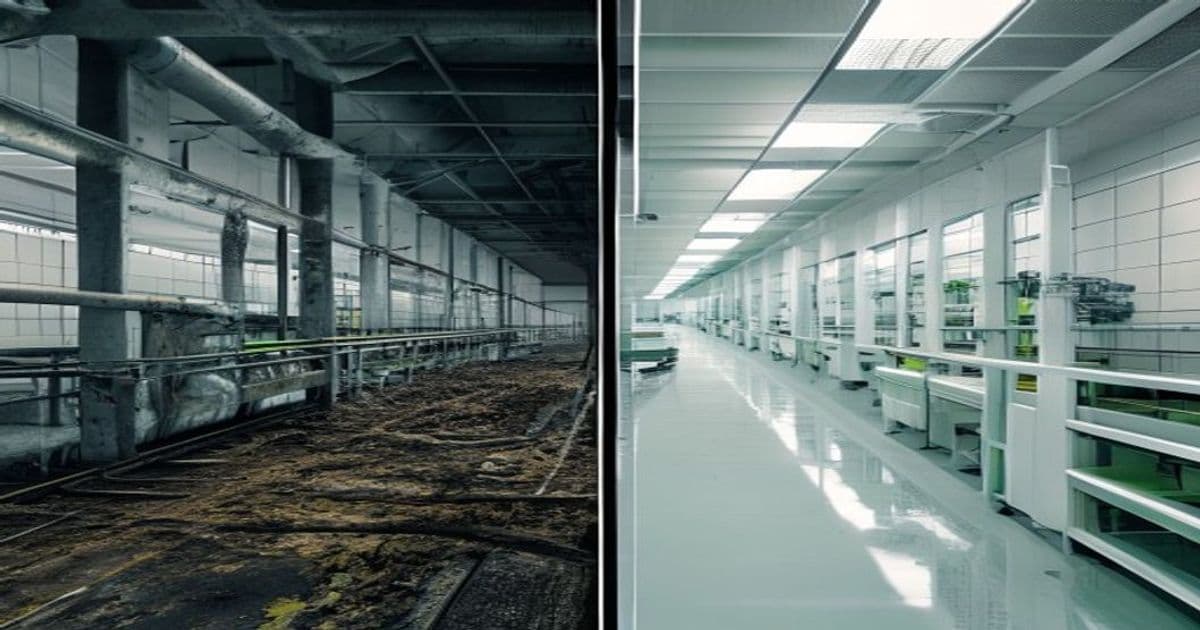
In many food industries, starting up production lines after a weekend shutdown or sanitary downtime is a critical phase. Quality managers regularly observe that the first products manufactured have higher microbiological contamination rates than those produced at the end of the day. This anomaly reveals that contaminants do not appear during production, but were already active and established on equipment before the first ingredient even circulated.
Causes of early recontamination at startup
The absence of movement and air stagnation during the plant shutdown phase does not halt bacterial activity. On the contrary, several technical factors promote invisible proliferation:
- Un-dried residual moisture: After final washing and disinfection, if equipment (conveyors, hoppers, dosing units) is not properly dried, residual water accumulates in low points. Surviving bacteria exploit this quiet time to rebuild their biofilms.
- Night condensation: Temperature variations between hot water disinfection and resetting the workshops to cold cause condensation on ceilings and high machine parts. This condensate drips directly onto clean surfaces.
- Stagnation in water and fluid circuits: Water that remains stationary in machine supply piping warms up and undergoes rapid bacterial multiplication, contaminating the circuit as soon as the first valve is opened.
Why traditional sanitary downtime is sometimes poorly executed
Effective sanitary downtime does not consist merely of spraying chemicals and closing the workshop. If the drying phase is bypassed or if technical circuits (water, compressed air) are not deeply disinfected, bacteria reactivate as soon as machines vibrate and heat up at production startup.
The pre-production securing protocol recommended by N2K Laboratoires
To guarantee perfectly sterile lines from the very first manufactured product, apply a complete preventive hygiene methodology:
Step 01 — Intensive organic cleaning with CLORAGRO. Apply CLORAGRO to eliminate complex organic matter residues serving as nutrients for bacteria during the shutdown.
Step 02 — Structural washing with CLORAGRO. Perform a complete foam cleaning with CLORAGRO over the entire line to detach the organic matrix.
Step 03 — Validated final disinfection with OPTIMAGRO. Applying OPTIMAGRO ensures maximum microbiological surface destruction.
Step 04 — Flushing water circuits with BIONET and stabilisation with OXYLIS HOCl. Before starting, flush water supply circuits with BIONET and inject OXYLIS HOCl continuously to sanitise process water.
Step 05 — Ventilation and forced drying. Maintain a dry airflow in the workshop to eliminate all traces of standing moisture before production.
Key takeaway
If contamination is present in the first minutes of production, it means your cleaning protocol did not eliminate dormant biofilms or that drying was insufficient. Securing technical water circuits and eliminating residual moisture are essential to start your day in full compliance.
Recurring contamination problems?
Request a complete audit of your facilities by our biosecurity experts.
Request a Field Audit