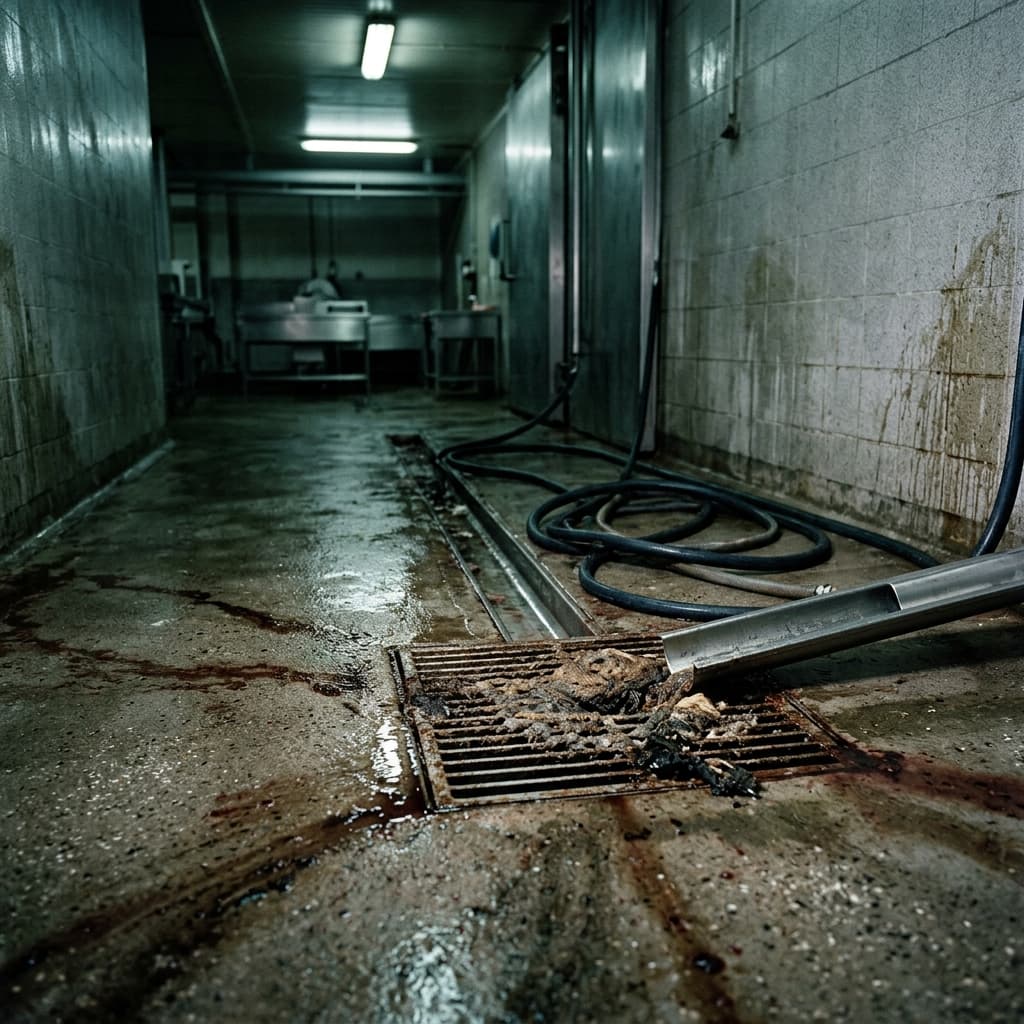
In slaughterhouses (poultry, cattle, or sheep), odour management is a key indicator of general hygiene control. Despite heavy daily cleaning and disinfection protocols, often using large quantities of hot water and chlorine agents, unpleasant and persistent odours can linger in slaughter, bleeding, or cutting rooms. These residual odours are not an inevitable part of the business; they indicate the accumulation of inaccessible organic matter undergoing decay.
The chemistry of slaughterhouse odours
Materials processed in slaughterhouses are biologically highly active and rich in nutrients for decomposing bacterial flora:
- Blood: rich in iron and complex proteins, it ferments rapidly under the action of bacteria if not evacuated instantly. Its degradation products (sulfur and ammonia compounds) release aggressive odours.
- Animal fats: they embed on walls, conveyors, and porous floors, oxidising in the air to give rancid and stubborn odours.
- Stercoraceous matter (guts, viscera): a source of highly malodorous anaerobic bacteria.
Invisible retention zones: where odour takes root
Washing protocols mainly target direct contact surfaces (tables, knives, upper conveyors). However, odour sources often reside in less visible areas:
- Drains, siphons, and discharge pipes: they receive the majority of soluble and insoluble organic loads. The absence of mechanical action inside promotes the growth of giant fermentation biofilms.
- Undersides of worktables and equipment welds: where splashes of blood and wash water accumulate without being brushed.
- Floor expansion joints and concrete cracks: saturated with stagnant greasy water.
Why chlorine and classic disinfectants fail against odours
Massive use of chlorine (sodium hypochlorite) to mask odours is an ineffective and toxic solution. Chlorine instantly reacts with organic matter to form chloramines with a suffocating odour, but it does not penetrate the greasy core of deposits. Once the chemical masking effect fades, the decay odour reappears. Direct disinfection on a poorly degreased surface is useless because organic matter consumes the biocide before it can act on the bacteria causing the fermentation.
The elimination protocol recommended by N2K Laboratoires
To permanently eliminate odours at the source, you must move from simple masking washing to biological sanitation that destroys organic matter:
Step 01 — Chlorinated alkaline degreasing with CLORAGRO. Applying CLORAGRO eliminates dried blood proteins and liquefies encrusted fats at low temperatures in drains and bleeding areas.
Step 02 — Deep washing with CLORAGRO. Applying CLORAGRO as an active foam emulsifies biological deposits degraded by enzymatic action and sanitises the substrate in depth.
Step 03 — Validated final disinfection with OPTIMAGRO. Applying OPTIMAGRO destroys residual putrefaction bacterial flora on surfaces free of any organic film.
Key takeaway
Persistent odours in slaughterhouses indicate a failure in physical and enzymatic cleaning. Only a protocol that degrades fats and proteins at the source, particularly in siphons and drainage structures, achieves a healthy and odour-free environment.
Recurring contamination problems?
Request a complete audit of your facilities by our biosecurity experts.
Request a Field Audit