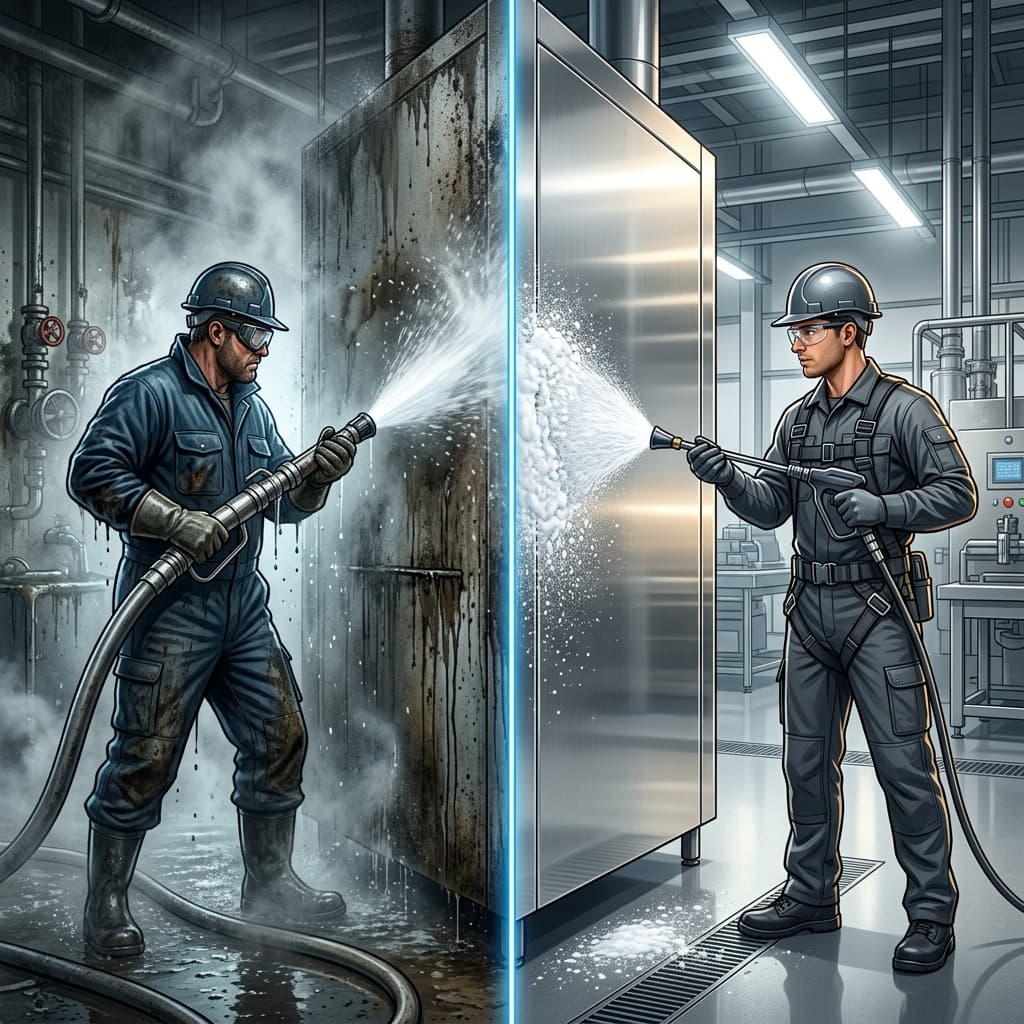
In the food industry, water consumption is a major economic and environmental challenge. Yet, in many plants, a striking paradox is observed: the more water hygiene crews consume washing installations, the more microbiological non-conformities persist or reappear. This excessive water consumption, far from sanitising the environment, often promotes the dispersion of contaminants and the development of resistant biofilms.
The error of washing with large amounts of water without pre-stripping
Using high-pressure water hoses is a common practice to quickly remove coarse debris. However, without targeted chemical and enzymatic action to break down fats and proteins stuck to surfaces, water alone has severe limitations:
- Water glides over biofilms: Biofilms have a matrix of hydrophobic polymers that repels water. The water flow merely rinses the surface without detaching the underlying bacterial colony.
- Creation of contaminated aerosols: High-pressure jets spray water into micro-droplets. These aerosols carry bacteria (Listeria, Pseudomonas) through the air, which then resettle on ceilings, overhead structures, and already cleaned surfaces.
- Permanent excessive moisture: Massive water input saturates the atmosphere with relative humidity, creating ideal conditions for the proliferation of moulds and psychrophilic bacteria during cooling.
Why washing more can worsen the situation
Without a rigorous hygiene protocol, mechanical cleaning with hot water under pressure superficially detaches soil but spreads microbiological contamination over wider surfaces. Bacteria exploit this constant moisture to colonise micro-cracks and inaccessible corners of stainless steel.
The rational hygiene protocol recommended by N2K Laboratoires
To reduce water consumption while drastically improving sanitary results, focus on enzymatic chemistry and foam cleaning:
Step 01 — Degreasing pretreatment with CLORAGRO. Applying CLORAGRO as a fine foam emulsifies proteins and fats stuck to walls without excessive water, dissolving organic bonds in minutes.
Step 02 — Targeted foam cleaning with CLORAGRO. Applying CLORAGRO as a foam emulsifies degraded materials and chemically cleans the substrates.
Step 03 — Controlled low-pressure rinsing. Targeted rinsing at low pressure prevents the formation of contaminated aerosols and consumes up to 40% less water.
Step 04 — Validated final disinfection with OPTIMAGRO. Applying OPTIMAGRO on bare surfaces guarantees optimal microbiological safety.
Key takeaway
Better hygiene does not require using more water. It is chemical precision that eliminates biofilms. By replacing high-pressure jets with targeted enzymatic degradation and foam washing, you secure production while reducing your water footprint.
Recurring contamination problems?
Request a complete audit of your facilities by our biosecurity experts.
Request a Field Audit