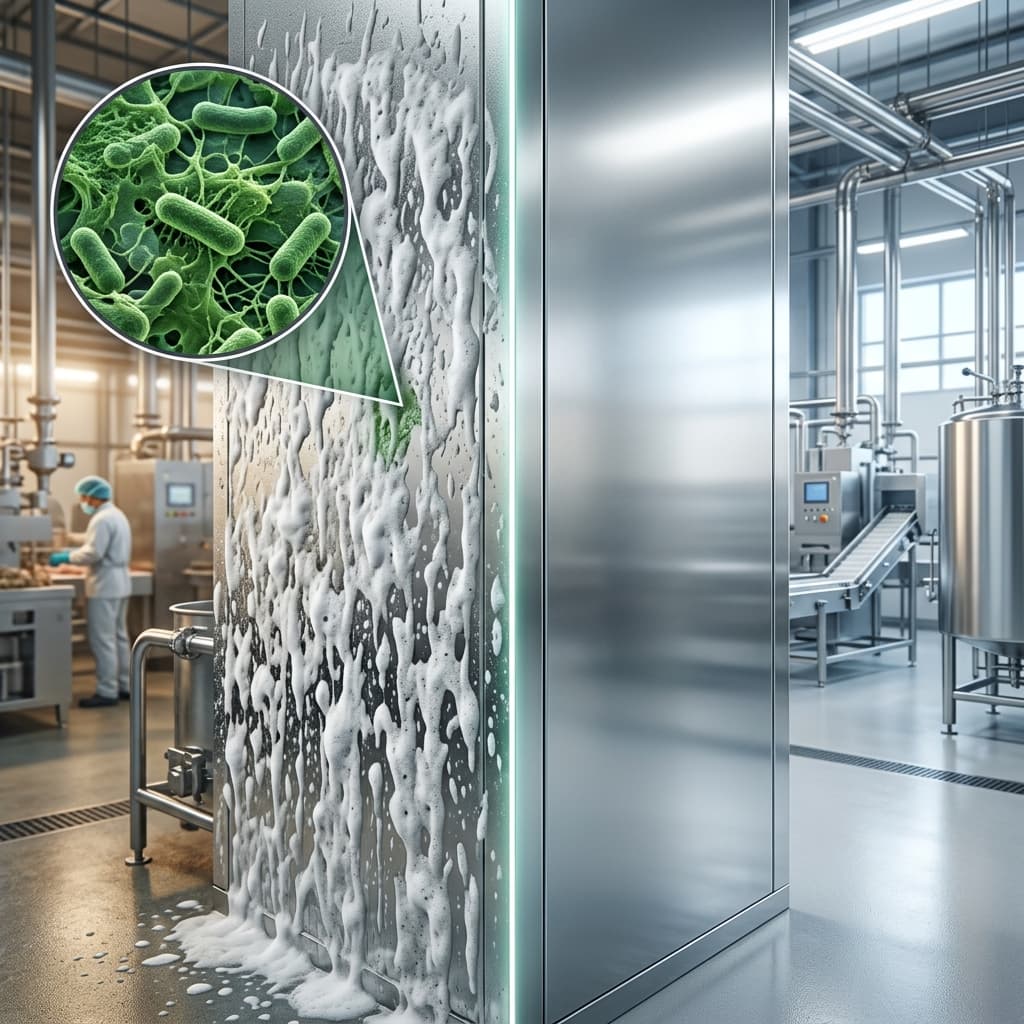
In the food industry, hygiene audits and quality controls are strict. Yet, a persistent misconception remains among cleaning crews: "If it smells strongly of chlorine or disinfectant, it must be clean." This strong chemical smell after washing gives a false sense of security. In reality, a pronounced chemical odor does not guarantee microbiological control. Worse, it often masks persistent bacterial contamination protected under poorly removed organic residues.
The olfactory mirage of chemical cleanliness
Using heavily scented disinfectants or aggressive chlorinated agents saturates operators' olfactory receptors. However, this chemical masking has no mechanical effect on biofilms and organic deposits encrusted in equipment corners:
- Greasy surfaces under foam: Poor quality or poorly rinsed detergent foam can leave a transparent lipid (grease) film on stainless steel.
- Residues in blind spots: Worn seals, conveyor undersides, and valve threads accumulate proteins that escape product flow.
- Immediate biocide inactivation: Classic disinfectants (peracetic acid, quaternary ammoniums, chlorine) react instantly with residual fats and blood. The product is consumed oxidizing this superficial organic matter, leaving no active biocidal power to destroy underlying bacteria.
Why the reversed classic protocol is dangerous
Rushing to disinfect quickly before completing physical cleaning is a major cause of recurring microbiological non-conformities. The bacterial biofilm thickens daily under the protective fat layer, becoming impermeable to standard chemical washes. During production runs, food passage dislodges these biofilms through friction, leading to direct contamination of finished products (Listeria, Salmonella).
The total sanitation protocol recommended by N2K Laboratoires
To eliminate the bacterial reservoir without relying on masking odors, apply a rigorous hygiene methodology:
Step 01 — Alkaline organic stripping with CLORAGRO. Before any disinfection action, using CLORAGRO specifically removes proteins and lipids stuck to stainless steel, breaking the sticky matrix of biofilms.
Step 02 — Chlorinated alkaline cleaning with CLORAGRO. Applying CLORAGRO as a foam emulsifies hydrolysed fats and detaches remaining organic residues.
Step 03 — Abundant rinsing with clean water. To remove all surfactants and suspended residues, leaving a perfectly bare surface.
Step 04 — Validated final disinfection with OPTIMAGRO. Applying OPTIMAGRO on bare, organic-free surfaces guarantees total 99.999% microbiological destruction without aggressive chemical masking odors.
Key takeaway
A clean plant should smell neutral, not like chemical disinfectant. If the product odor persists, it is often a sign that rinsing is insufficient and organic residues have not been fully removed. Only an enzymatic cleaning protocol followed by targeted disinfection durably secures production.
Recurring contamination problems?
Request a complete audit of your facilities by our biosecurity experts.
Request a Field Audit