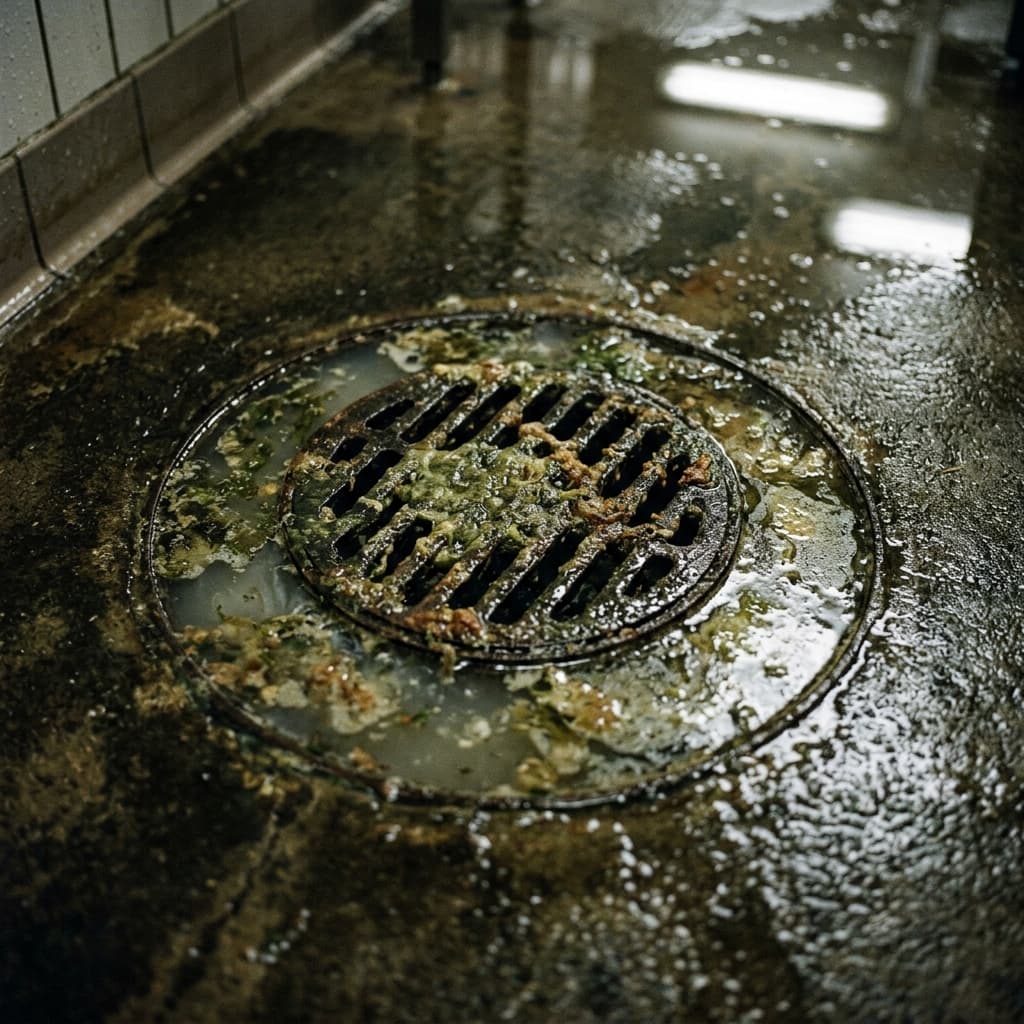
In food industries and slaughterhouses, maintaining a dry environment is a daily battle. Despite the efforts of hygiene teams, specific areas (drains, gutters, machine undersides, cold wall corners) constantly remain damp. These permanent damp zones act as giant bacterial incubators. They continuously recontaminate the entire workshop, making disinfection efforts on direct contact surfaces futile.
Moisture: the fuel for microbiological proliferation
Standing water, combined with microscopic organic debris, provides the two elements essential for bacterial survival and multiplication: water and food. In these areas, bacterial growth is explosive:
- Rapid formation of mature biofilms: Constant moisture promotes the secretion of protective polymers by bacteria. In less than 48 hours, a resistant biofilm establishes in gutters and under machine bases.
- Dispersion by projection and traffic: Operators or forklifts passing over puddles project contaminated micro-droplets onto adjacent production equipment.
- Atmospheric contamination: Poorly cleaned floor drains generate aerosols rich in Listeria during airflow passes or air pressure shifts in the room.
Why classic cleaning of damp zones fails
Applying a simple disinfectant in a gutter containing greasy standing water is ineffective. The biocide is instantly diluted and deactivated by the heavy organic load at the bottom of the drain. To durably sanitise these critical areas, use chemistry capable of mechanically and biologically detaching the greasy matrix.
The damp zone sanitation protocol recommended by N2K Laboratoires
To break the recontamination loop in workshops, apply a targeted attack treatment on moisture points:
Step 01 — Dismantling and disinfection with OXYLIS HOCl. Spray OXYLIS HOCl pure or diluted directly into drains, siphons, and damp corners. It destroys accumulated grease and eliminates the biofilm's adhesion to concrete or stainless steel walls.
Step 02 — Chlorinated shock washing with CLORAGRO. Applying CLORAGRO as a dense foam emulsifies degraded materials and deeply sanitises the substrate.
Step 03 — Rinsing and total water evacuation. It is crucial to squeegee residual water toward siphons to leave the area as dry as possible.
Step 04 — Validated surface disinfection with OPTIMAGRO. The final application of OPTIMAGRO ensures total microbiological destruction of residual bacteria.
Key takeaway
As long as a damp zone remains contaminated, it will pollute the air and clean surfaces of your workshop through simple mechanical or airflow movement. Eliminating the greasy biofilm through regular enzymatic stripping is the only effective method to eradicate Listeria and Pseudomonas from these critical points.
Recurring contamination problems?
Request a complete audit of your facilities by our biosecurity experts.
Request a Field Audit