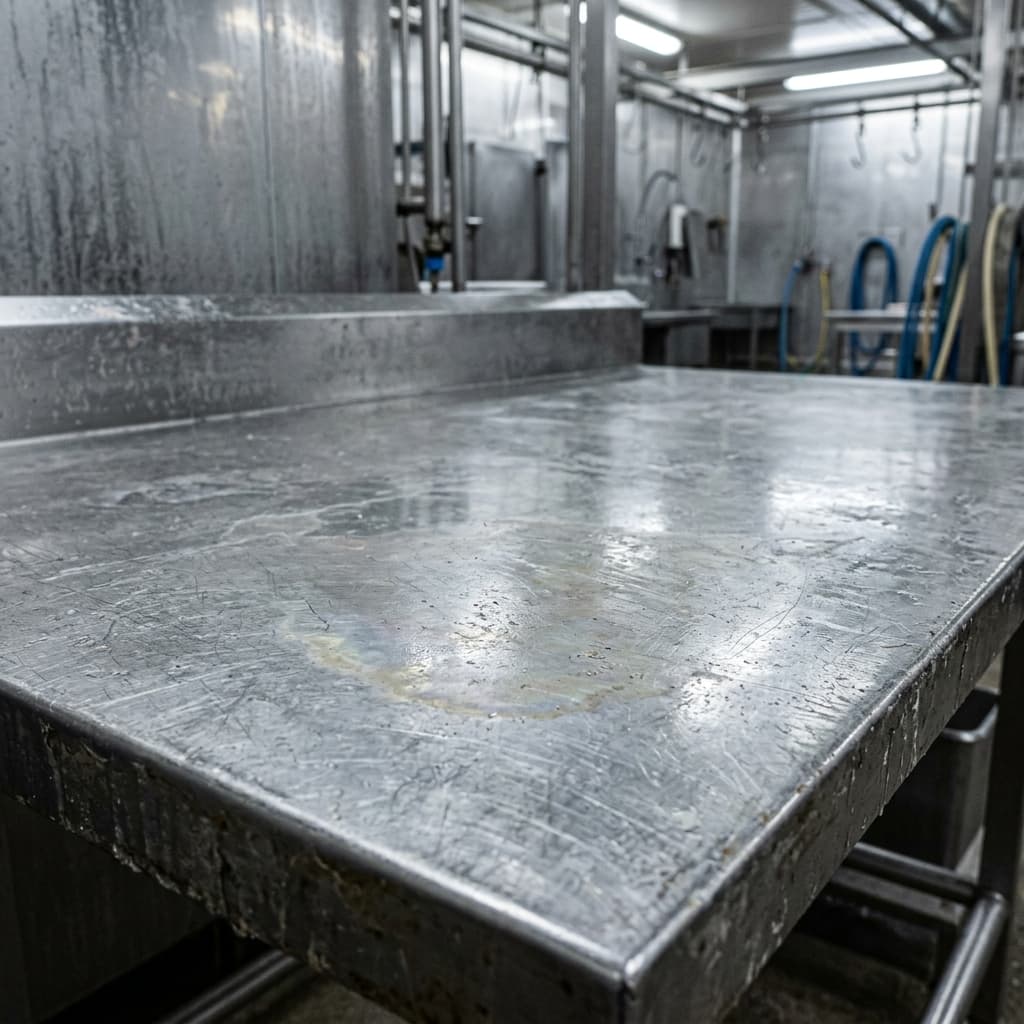
In the food industry and slaughterhouses, stainless steel (commonly known as inox) is the preferred material. Chosen for its resistance to corrosion, smooth surface, and longevity, it is viewed as the ultimate standard of industrial hygiene. Yet, quality managers are often faced with a confusing paradox: stainless steel surfaces that appear perfectly clean after washing continue to reveal unacceptable bacterial loads or recurring traces of pathogens. Stainless steel is not self-sanitising; its microscopic structure can shelter complex biological traps.
The physics of stainless steel facing microbial adhesion
Although stainless steel appears smooth to the naked eye, microscopic examination reveals micro-roughness, micro-cracks (welds, wear), and abrasion scratches from the daily use of tools or wire brushes. These physical imperfections constitute ideal ecological niches:
- Passive bacterial adhesion: Van der Waals forces and electrostatic bonds allow pioneer bacteria to attach firmly in the microscopic crevices of the steel.
- Rapid biofilm formation: once attached, bacteria synthesise a polymer matrix that isolates them from physical and chemical attacks.
- Damaged passivation film: the chromium oxide layer that protects the steel can be altered by unsuitable detergents, creating micro-corrosion spots favorable to biological accumulations.
Critical retention zones on stainless steel equipment
- Cutting and trimming tables: subjected to repeated deep scratches that trap meat proteins and blood.
- Belt conveyors and transfer drums: whose mechanical joints and lower structure are difficult for foam lances to access.
- Slaughter hooks and transfer rails: which rub constantly, creating micro-metallic particles mixed with organic greases.
- Injection nozzles and dosing process circuits: subjected to laminar flows favorable to biofilms.
Why direct disinfection without enzymatic stripping fails
Attempting to disinfect stainless steel equipment that retains an invisible organic film (protein or lipid film) is ineffective. Coagulated meat or fish proteins react chemically with disinfectants (such as peracetic acid or chlorine), neutralising their oxidising power before they can touch bacterial membranes. The disinfection slides off the biofilm without altering it.
The precision cleaning protocol recommended by N2K Laboratoires
To permanently eliminate residual contamination on stainless steel, you must chemically destroy the organic cement binding the biofilm to the metal:
Step 01 — Intensive stripping with CLORAGRO. Applying CLORAGRO saponifies grease, eliminates encrusted proteins, and breaks the biofilm matrix fixed in the scratches of stainless steel.
Step 02 — Chlorinated alkaline stripping with CLORAGRO. Applying CLORAGRO as a foam emulsifies unstructured fats and detaches liquefied organic residues during high-pressure rinsing.
Step 03 — Certified final disinfection with OPTIMAGRO. Applying the biocide OPTIMAGRO to bare metal guarantees maximum, long-lasting microbial reduction, validated by microbiological controls.
Key takeaway
Stainless steel is not an absolute barrier against bacteria. Without cleaning that targets micro-scratches and degrades deep organic matter, stainless steel becomes a preferred support for biofilm persistence. Only alternating an enzymatic phase with an alkaline phase guarantees genuinely sanitised stainless steel.
Recurring contamination problems?
Request a complete audit of your facilities by our biosecurity experts.
Request a Field Audit