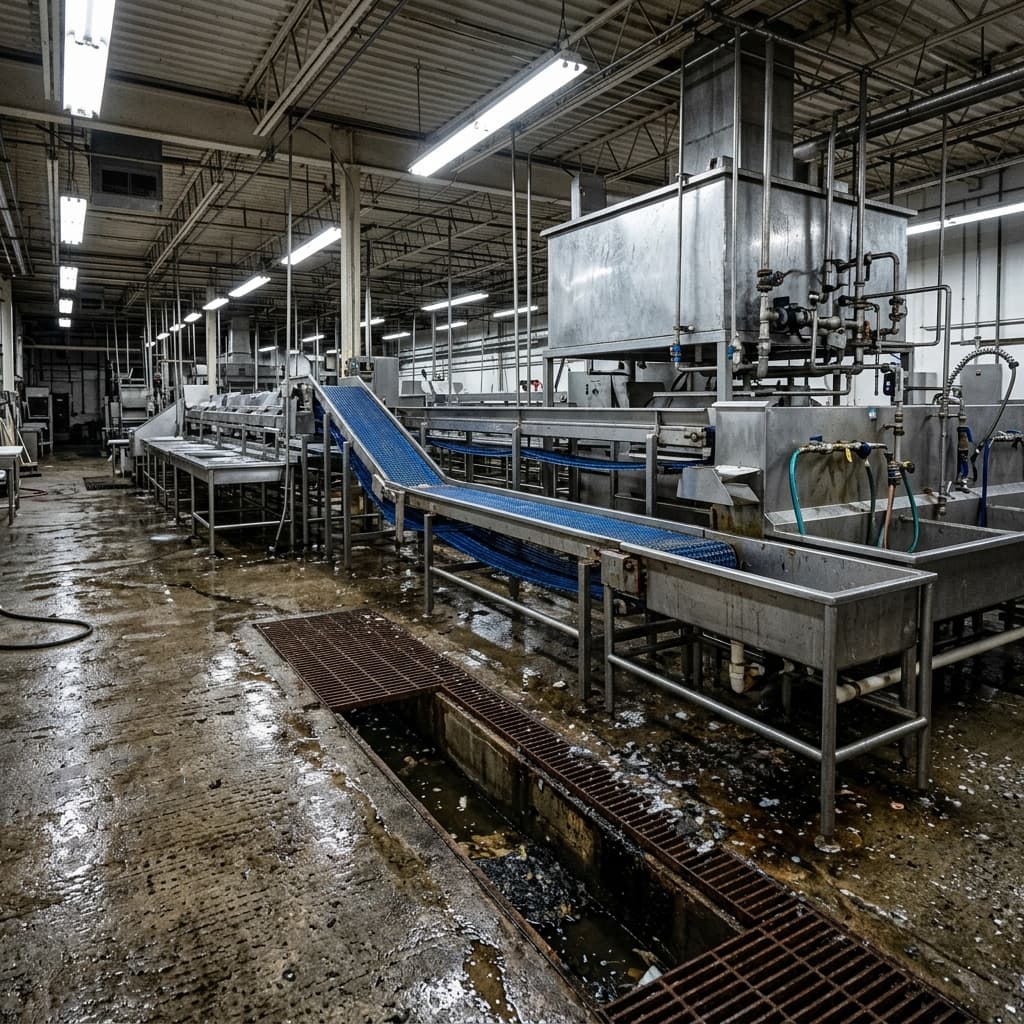
In the seafood processing industry, the characteristic smell of the sea or volatile amines is a daily challenge. Even when hygiene teams carry out thorough cleanings at the end of shifts, a heavy and persistent odour often reappears just a few hours after washing. This phenomenon is not inevitable; it indicates scientifically that a layer of highly adherent organic matter has resisted classic chemical agents and continues to ferment.
Why seafood complicates industrial hygiene
Organic materials from fish and shellfish possess unique physicochemical properties that make them particularly complex to eliminate:
- Highly unsaturated lipids: fish fats oxidise very quickly in the open air, forming sticky, smelly compounds (aldehydes and ketones) that adhere strongly to metals and plastics.
- Soluble and gelling proteins: during trimming or filleting, fish juices dry to form a waterproof, transparent protein glaze.
- Volatile amines (such as Trimethylamine or TMA): derived from the natural bacterial breakdown of fish proteins, these molecules have an extremely low olfactory detection threshold for humans.
Priority accumulation zones in the plant
- Modular articulated belt conveyors: plastic hinges and belt undersides trap micro-debris of flesh and grease.
- Floor drains and channels: which continuously receive process water loaded with soluble organic matter.
- Industrial scales and weighing heads: subjected to repeated splashes and difficult to clean mechanically.
- Plastic transport bins and crates: whose surface scratches shelter biofilms of altering bacteria.
Why hot water washing and classic chlorine fail
Using very hot water (above 60°C) during pre-washing is a common mistake. Heat instantly coagulates fish proteins on surfaces, fixing them like glue. Furthermore, applying chlorinated disinfectants directly without prior degreasing merely bleaches the surface without eliminating the underlying lipid matrix. Bacteria continue to proliferate beneath this protective shell.
The targeted hygiene protocol recommended by N2K Laboratoires
To permanently eliminate odours and secure seafood production lines, N2K Laboratoires recommends a rigorous enzymatic and alkaline treatment:
Step 01 — Degreasing pretreatment with CLORAGRO. Applying CLORAGRO specifically emulsifies complex proteins and liquefies fish fats stuck to conveyors and structures.
Step 02 — Chlorinated alkaline degreasing with CLORAGRO. Applying the active foam of CLORAGRO emulsifies the oxidised lipids restructured by the enzymatic phase and washes away the remaining organic debris.
Step 03 — Validated final disinfection with OPTIMAGRO. Applying OPTIMAGRO eliminates the altering bacterial flora (responsible for TMA production) on a perfectly cleaned substrate.
Key takeaway
Fish odour in a plant is the visible sign of incomplete cleaning. Treating this problem requires avoiding overly hot pre-washes and using enzymatic chemistry capable of breaking down the matrix of proteins and unsaturated fats.
Recurring contamination problems?
Request a complete audit of your facilities by our biosecurity experts.
Request a Field Audit