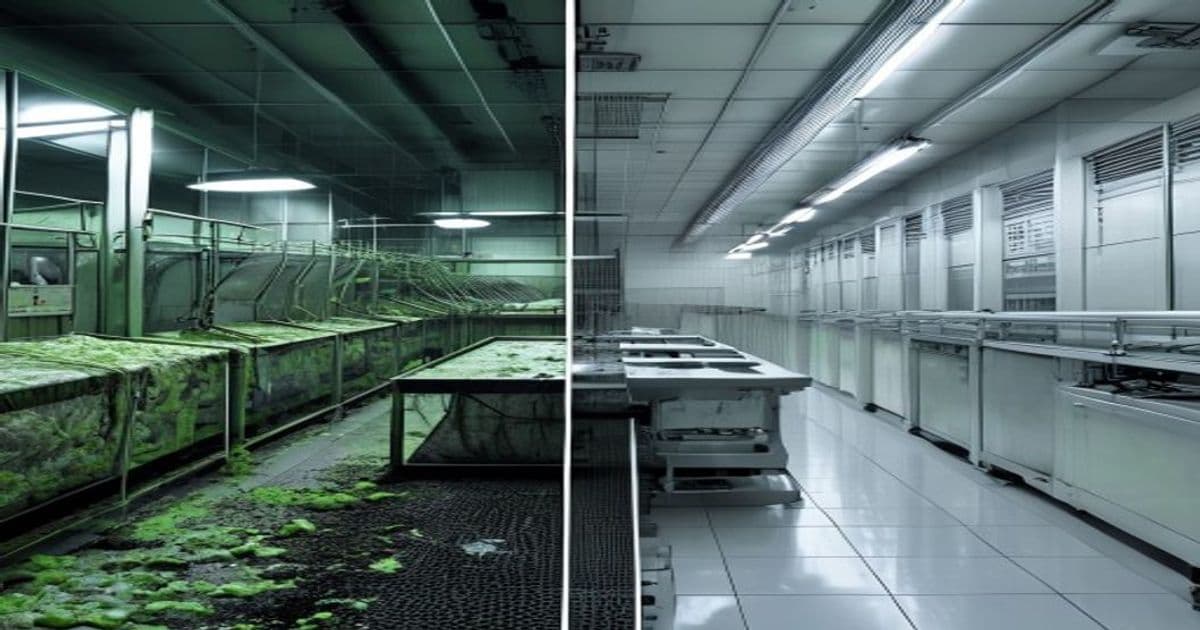
In food industries and slaughterhouses, ATP-metry (bioluminescence monitoring) is the standard tool to instantly validate the quality of production surface cleaning. However, many quality managers face a puzzling paradox: surfaces that look visually spotless and properly rinsed yield unstable or abnormally high ATP test results. This instability indicates that the human eye is unable to detect the micro-organic residue films protecting the biological load.
Causes of non-compliant ATP-metry on visually clean surfaces
Visual cleanliness guarantees macro-waste removal but does not validate the absence of molecular and microbial residues:
- Persistence of protein and fat films: During superficial cleaning without targeted chemical or enzymatic action, an invisible molecular film of fats and proteins remains fixed to stainless steel or plastic walls. ATP-metry detects the adenosine triphosphate present in these dead organic cells, even if there are no more living bacteria.
- Underlying residual biofilm: Bacteria embedded in a mature biofilm are protected by a polymeric matrix. Simple rinsing or rapid water disinfection only deactivates surface bacteria, leaving the biofilm intact underneath. During swab sampling, friction tears away fragments of this matrix, releasing large amounts of ATP.
- Interfering chemical residues: Paradoxically, traces of some poorly rinsed detergents or disinfectants can skew the bioluminescence measurement by inhibiting or amplifying the enzymatic reaction of the test reagent.
Why multiplying disinfections does not solve the problem
Applying successive disinfection cycles on a biologically loaded surface is ineffective. Without prior deep cleaning to expose the bare stainless steel surface, the biocide does not reach the micro-organisms sheltered under the organic matter. The key lies in the chemical and enzymatic dismantling of organic bonds.
The shock cleaning protocol recommended by N2K Laboratoires
To stabilise your ATP test results and eliminate invisible organic load, follow a rigorous three-step procedure:
Step 01 — Intensive degreasing with CLORAGRO. Applying CLORAGRO specifically emulsifies proteins and lipids stuck to surfaces. It eliminates organic macromolecules forming the substrate of residual ATP.
Step 02 — Chlorinated alkaline stripping with CLORAGRO. Applying CLORAGRO as a foam emulsifies and mechanically detaches the hydrolysed organic matrix. Subsequent rinsing leaves the surface completely bare.
Step 03 — Validated final disinfection with OPTIMAGRO. Applying OPTIMAGRO guarantees complete microbiological destruction on a substrate free of all residual organic matter, thus durably stabilising ATP measurements.
Key takeaway
A surface clean to the eye is not necessarily clean to the swab. Instability in ATP results is the symptom of invisible organic residues. Only a deep cleaning action combining stripping with CLORAGRO and contact disinfection with ALCOSEPT PRO guarantees the compliance of your self-checks and the safety of your production.
Recurring contamination problems?
Request a complete audit of your facilities by our biosecurity experts.
Request a Field Audit