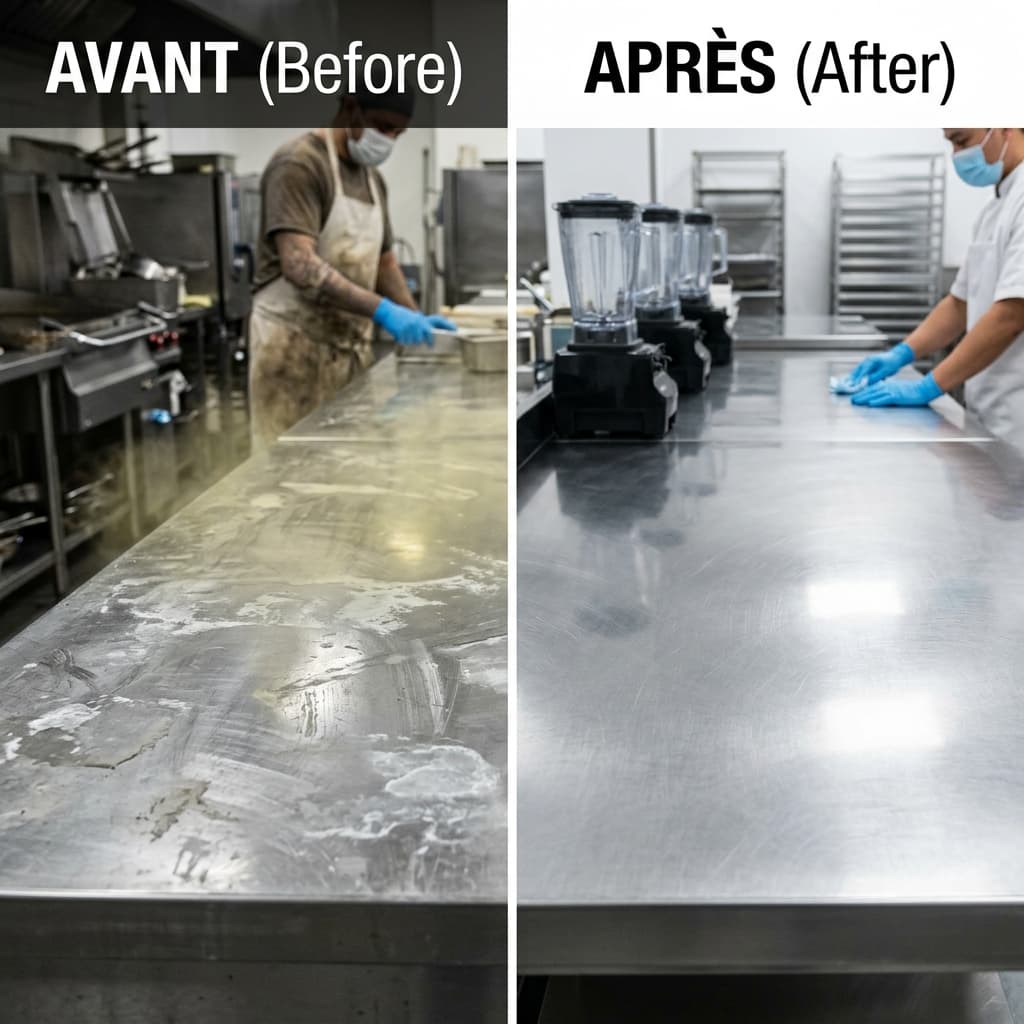
In some industrial facilities, a strong and unpleasant metallic or chemical smell may persist in the air, even after cleaning and disinfection operations have been completed. This phenomenon, often a source of discomfort for the teams, is frequently misinterpreted as proof of excessive cleanliness or, conversely, an incorrectly dosed product.
The true causes of this persistent odor
A persistent metallic odor is not a sign of a healthy environment. On the contrary, it reveals that an undesirable chemical reaction is occurring on the surfaces. This reaction is generally the result of a complex interaction between:
- Stagnant moisture: Poorly dried areas or residual puddles.
- Chemical residues: Traces of detergents or disinfectants that have not been properly flushed away.
- Residual organic matter: Microscopic organic films that survived the initial cleaning.
- Metal surfaces (stainless steel): The prolonged interaction between these elements and the metal creates odorous volatile compounds.
The consequences of this imbalance
Far from being a simple olfactory annoyance, this unstable atmosphere has concrete repercussions:
- Operator discomfort: A feeling of heavy air, potential irritation, and degraded working conditions.
- Progressive corrosion: Persistent chemical reactions slowly attack the passivation layer of the stainless steel, reducing equipment lifespan.
- Decreased cleaning efficiency: The presence of chemical residues partially neutralizes the action of subsequently applied disinfectants, creating a vicious cycle of recontamination.
The fundamental problem: rinsing
Most often, the origin of this problem does not come from the choice of cleaning product, but from the crucial step that follows it: rinsing. Insufficient rinsing, performed too quickly, with inadequate pressure, or poorly distributed over the entire surface, inevitably leaves traces of active chemistry that will react with the metal and moisture.
The recommended protocol
To permanently eliminate these metallic odors and stabilize the environment, a strict method is required:
Step 01 — Thorough cleaning and structured rinsing: The use of CLORAGRO allows for powerful cleaning, but its total effectiveness depends on a structured and complete rinse with clean water, ensuring the total elimination of any alkaline or chlorinated residues.
Step 02 — Disinfection on prepared surface: The application of OPTIMAGRO for final disinfection must only be done on a chemically neutral and perfectly rinsed surface. The absence of prior chemical residues guarantees optimal biocidal action without parasitic reactions or metallic odors.
Key takeaway
A persistent chemical or metallic odor in a clean workshop almost always indicates an imbalance in the protocol, specifically a lack of rinsing, rather than an excess of effectiveness of the products used.
Recurring contamination problems?
Request a complete audit of your facilities by our biosecurity experts.
Request a Field Audit