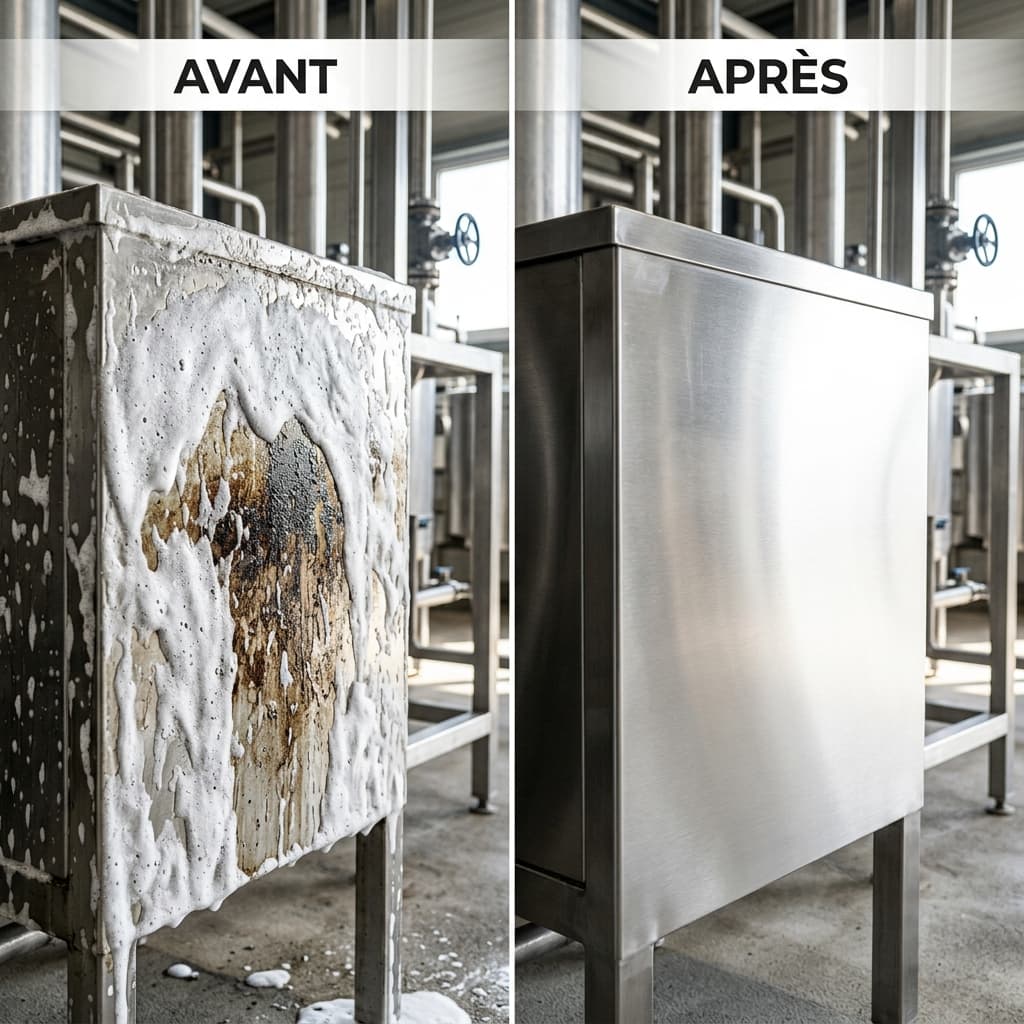
In many food processing plants or slaughterhouses, a recurring phenomenon is observed: over the months, cleaning teams tend to progressively increase the concentration or quantity of foaming product used during washing operations. The illusion is reassuring: a thick, abundant foam gives an impression of cleanliness and power. However, despite this abundance of foam, bacteriological results do not improve, or worse, they degrade.
The illusion of abundant foam
The most common mistake is to equate the volume of foam with cleaning effectiveness. Foam is merely a carrier; its primary role is to make chemical agents (surfactants, caustic soda, chlorine) adhere to vertical or inclined surfaces in order to prolong contact time.
However, if the underlying problem lies in the very nature of the soil, doubling the amount of foam will solve nothing. Faced with deep and old fouling, the superficial foam will simply slide over the organic film without managing to degrade it in depth.
Why do soils become increasingly resistant?
If the foam seems less effective over time, it is generally because the characteristics of the soil have changed:
- Fat polymerization: Under the action of time, oxygen, and temperature variations, residual animal and vegetable fats harden and polymerize, forming an extremely resistant varnish.
- Accumulation of layers: Imperfect daily cleaning leaves an invisible micro-film every day. Week after week, these layers accumulate to form an organic armor.
- Biofilm protection: These organic layers offer a perfect refuge for bacteria that develop a stubborn biofilm, making the surface untouchable by standard surface chemistry.
The recommended protocol: changing the chemical approach
Faced with a noted loss of effectiveness, the solution is not to add more product, but to change the method of attack to destroy these accumulated layers:
Step 01 — Enzymatic/biological preparation with BIOACTIVE. Before applying harsh chemistry, the use of a product like BIOACTIVE allows for the pretreatment of these accumulations. Its biological agents target and predigest polymerized fats and proteins embedded in the micro-cracks of materials.
Step 02 — Structural stripping with CLORAGRO. Once the organic matrix is softened and destructured, the application of a chlorinated alkaline foam like CLORAGRO regains all its effectiveness. The product can finally reach the actual surface of the substrate (stainless steel or plastic) for deep stripping and total emulsification of the remaining residues.
Key takeaway
An impressive foam does not guarantee effective cleaning. When results stagnate despite an increase in doses, it is a sign that a transition must be made from simple surface cleaning to true two-step structural stripping.
Recurring contamination problems?
Request a complete audit of your facilities by our biosecurity experts.
Request a Field Audit