In the food industry, controlling the cold chain is an absolute priority. Cold rooms are often closely monitored, with temperatures scrupulously maintained to standards. However, in some of these perfectly refrigerated enclosures, a persistent "stuffy" or "musty" odor emerges as soon as the door is opened. This is a sign that cold sometimes provides a false sense of sanitary security.
Cold slows down, but does not eliminate
The common mistake is to consider that a low temperature sterilizes the environment. While cold (positive or negative) significantly slows the multiplication of bacteria and molds, it does not kill them. Certain psychrotrophic microorganisms (like Listeria monocytogenes) are even capable of slowly developing at temperatures close to 0°C.
Therefore, correct temperatures do not solve the real problems causing bad odors, which are linked to the simultaneous presence of water and organic matter.
Sources of biological instability in a cold room
A musty odor is often the olfactory translation of a slow biological degradation, sustained by several environmental factors:
- Stagnant moisture: Defrosting cycles, frequent door openings (creating a thermal shock), or poor drainage leave residual water on floors and walls.
- Contaminated condensation: Water vapor condenses on cold surfaces (especially evaporators and ceilings), trapping airborne organic particles.
- Hidden residues: The cold solidifies fats, making them very hard to clean, favoring the accumulation of organic residues under pallets, in joints, or along guide rails.
Critical areas to monitor
In a cold room, contamination does not float in the middle of the room; it is concentrated in specific, often hard-to-reach areas:
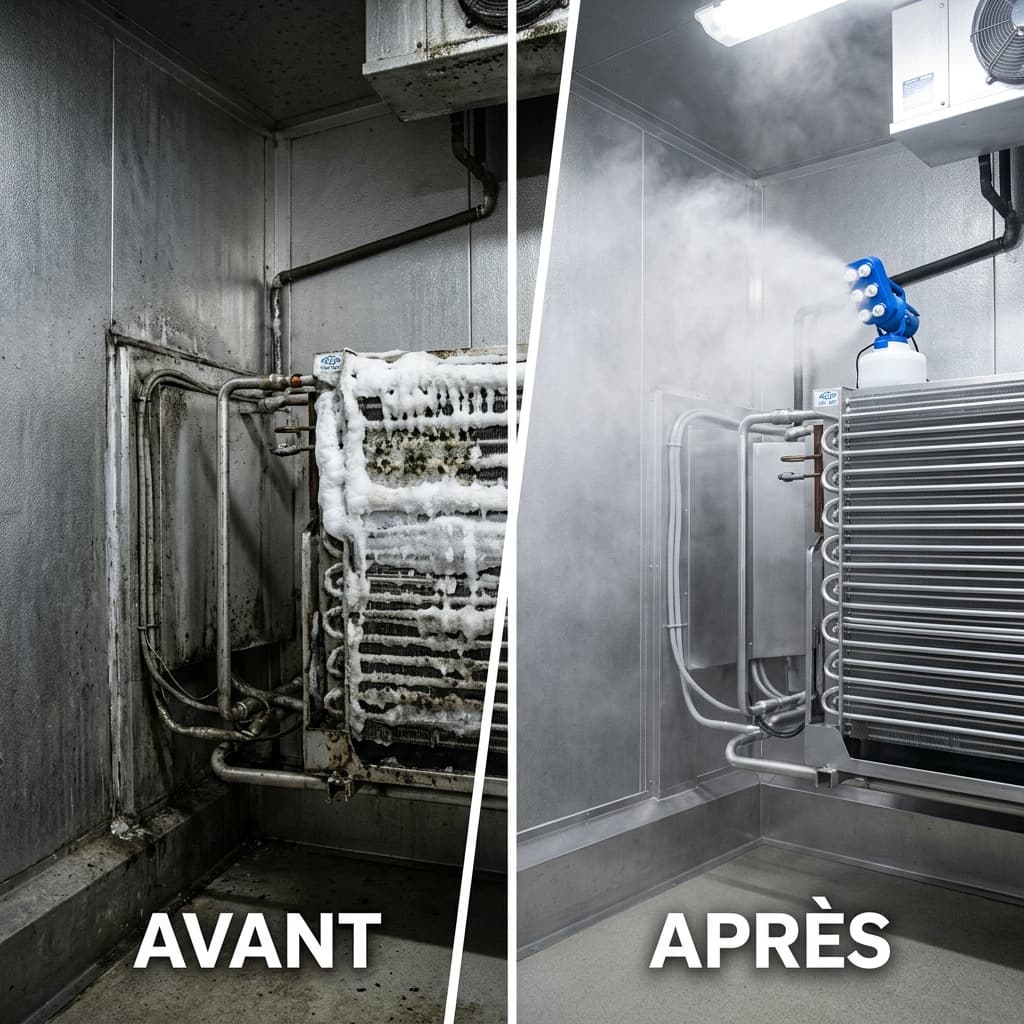
- Evaporators: The true "lungs" of the cold room, they concentrate moisture and dust, becoming excellent incubators for mold if neglected.
- Drains and siphons: Collection points for condensation water, they are often heavily loaded with organic matter.
- Corners and insulation joints: Retention areas where mechanical cleaning is complicated.
The recommended protocol: a 360-degree treatment
To permanently eliminate these odors and stabilize the cold room, a comprehensive approach is required:
Step 01 — Reduction of the organic load. The application of BIOACTIVE helps to soften fats solidified by the cold and pre-digest organic accumulations in drains and corners.
Step 02 — Stripping and contact disinfection. A structural cleaning with CLORAGRO will physically remove the destructured soils, followed by a final surface disinfection with OPTIMAGRO.
Step 03 — Atmospheric control. To treat the evaporators and ambient air, fogging or micro-spraying of OXYLIS HOCl allows reaching inaccessible areas and destroying airborne mold spores, thus giving the cold room back a healthy, neutral odor.
Key takeaway
A cold room can be thermally stable while remaining biologically unstable. A musty odor is an early warning of an environmental contamination under development, which requires deep stripping and specific treatment of the atmosphere.
Recurring contamination problems?
Request a complete audit of your facilities by our biosecurity experts.
Request a Field Audit