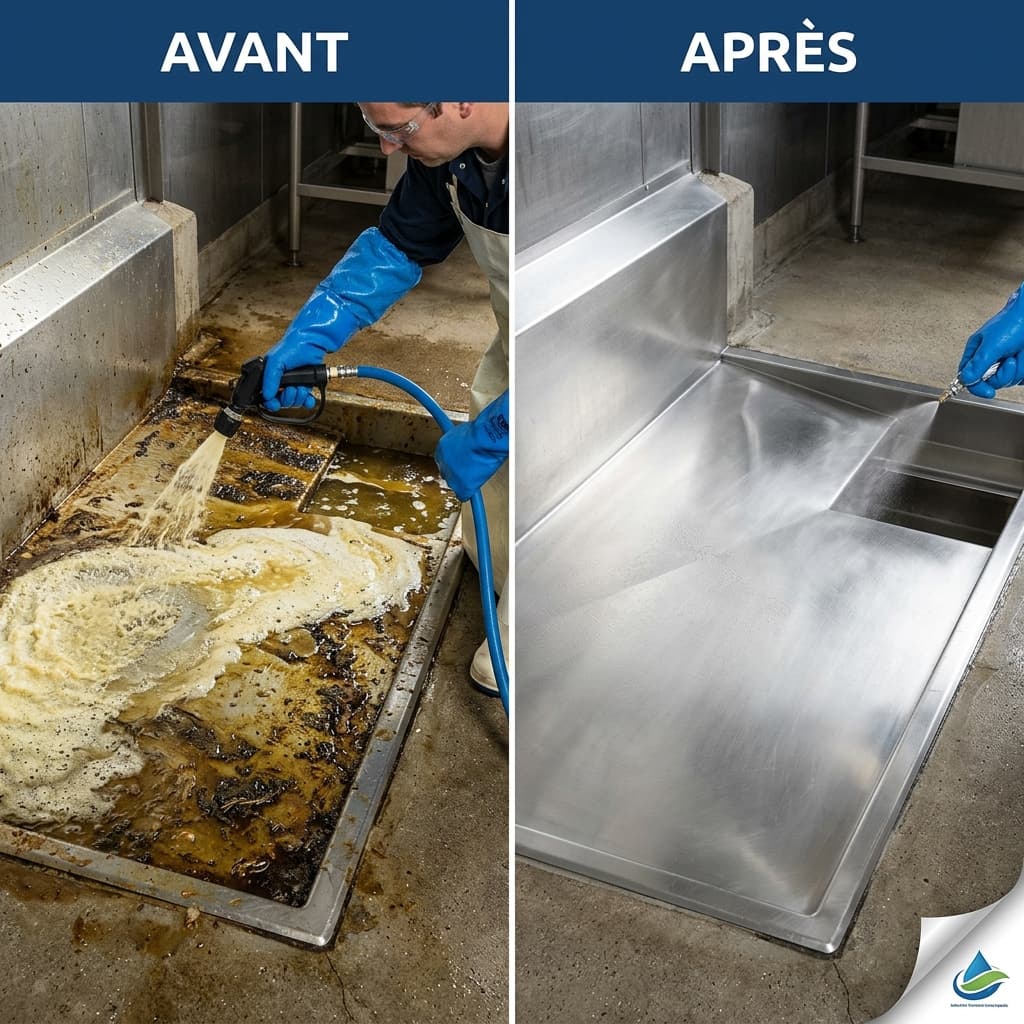
It happens in some industrial facilities or processing workshops that cleaning teams face a discouraging situation: despite the repeated application of so-called "shock" disinfections, with high concentrations of biocides, a stubborn contamination (such as Listeria or Salmonella) continues to reappear. This microbial survival against the chemical arsenal is explained by the ability of bacteria to isolate themselves from their environment.
The limit of surface disinfection
The most frequent error of interpretation when faced with persistent contamination is to question the power of the disinfectant. There is then a tendency to increase doses or change the biocidal molecule. However, disinfection, even extremely powerful, only acts by direct contact. If the bacterium is physically protected, the biocide will slide over the obstacle without ever reaching its target.
The bacterial shield: the organic matrix
To survive external aggressions (heat, chemistry, drought), bacteria develop highly effective avoidance strategies:
- Seeking refuge in micro-cracks: Bacteria lodge themselves in scratches in stainless steel, porosity in plastic, or worn joints, where the surface tension of the water prevents disinfectants from penetrating.
- Protection from organic matter: Under a micro-film of residual proteins or fats, bacteria are perfectly sheltered. This film acts like a sponge that neutralizes the biocide before it reaches the microorganism.
- Biofilm formation: The ultimate stage of protection, bacteria secrete a matrix of polymers (EPS) that cements them to the surface and makes them almost impermeable to conventional chemicals.
The consequences of chemical persistence
Multiplying shock disinfections on a poorly prepared environment is not only ineffective but often counterproductive:
- Chemical overconsumption and unnecessary costs.
- Premature wear and corrosion of equipment (especially the oxidation of stainless steel by chlorides).
- Frustration of the teams faced with the lack of results.
The recommended protocol: the deconstruction method
To defeat an endemic contamination, one must stop disinfecting a dirty surface and attack the protective shield in three logical steps:
Step 01 — Destroy the protective matrix with BIOACTIVE. Applying BIOACTIVE allows the digestion of proteins, fats, and the biofilm matrix. The enzymatic and biological agents deconstruct the shield protecting the bacteria.
Step 02 — Structural stripping with CLORAGRO. Once the protection is softened, CLORAGRO physically removes the residues through its powerful chlorinated alkaline action, exposing the bacteria on the original substrate.
Step 03 — Final disinfection with OPTIMAGRO. Only now does disinfection make full sense. Applied to a neutral and chemically clean surface, OPTIMAGRO can exert its full biocidal potential and permanently eliminate the targeted contamination.
Key takeaway
Contamination that resists multiple disinfections is not a "super-bacterium," it is most often a super-protected bacterium. Success lies in surface preparation (stripping) rather than solely in the power of the disinfectant.
Recurring contamination problems?
Request a complete audit of your facilities by our biosecurity experts.
Request a Field Audit