Personnel safety and premises hygiene are closely linked. One of the most recurring and dangerous problems in food processing plants, particularly in slaughterhouses or cutting areas, is the persistence of slippery floors. It is common to see areas remain dangerously smooth and greasy underfoot, even after the cleaning crew has finished. This phenomenon proves that standard mechanical and chemical action has failed.
The nature of "slipperiness"
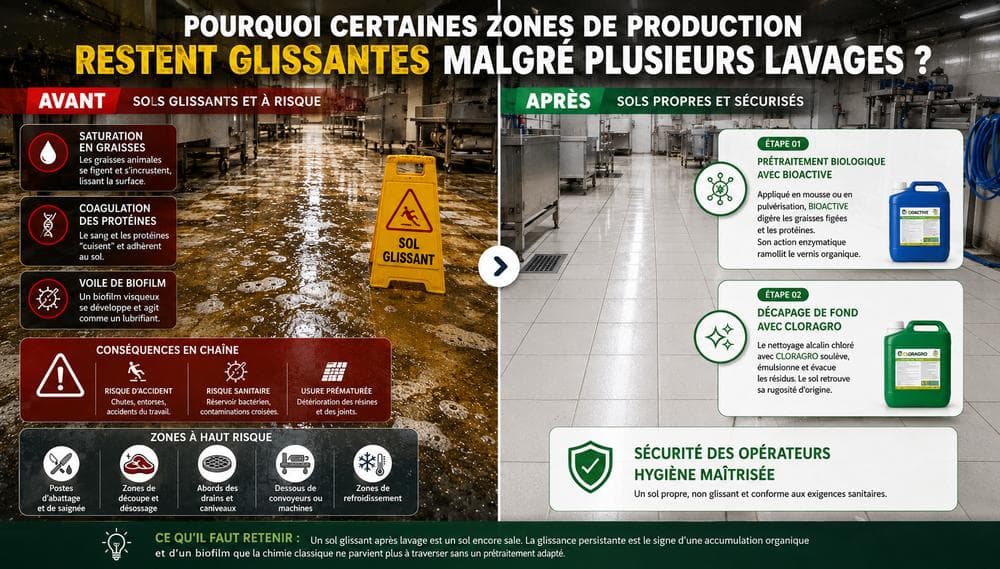
A floor that is slippery after cleaning is generally not due to insufficient rinsing of the detergent, but rather to what has not been removed. Slipperiness is the physical indicator of an unresolved organic accumulation:
- Fat saturation: Animal fats, especially as they cool, congeal and become embedded in the roughness of anti-slip floors, thus smoothing the surface.
- Protein coagulation: Blood and tissue proteins, if cleaned with water that is too hot, "cook" and adhere strongly to the floor.
- The biofilm veil: On this nutritious substrate, a bacterial biofilm develops rapidly. The matrix of this biofilm is extremely viscous (mucilage) and acts as a real lubricant under safety shoes.
High-risk areas
This problem is not randomly distributed. It concentrates where the organic load meets water continuously:
- Slaughter and bleeding stations (massive protein load).
- Cutting and deboning areas (fat trimmings).
- Around drains and evacuation gutters.
- Under conveyors or leaking machines.
- Cooling areas (where fat congeals quickly).
Chain consequences
A floor that remains slippery generates a spiral of problems:
- Accident risk: Slips, trips, falls, and workplace accidents for operators.
- Health risk: A greasy floor is a major bacterial reservoir that promotes cross-contamination (via boots or cart wheels).
- Premature wear: Teams tend to use increasingly hot water or strong acids in an attempt to "strip," which destroys resins and tile grout over the long term.
The recommended protocol: decomposition and stripping
To restore the original grip and cleanliness of an industrial floor, you must attack the molecular structure of the soil:
Step 01 — Biological pretreatment with BIOACTIVE. Applied as a foam or spray, BIOACTIVE will "digest" and break the long chains of congealed fats and proteins. Its enzymatic action softens this slippery organic varnish.
Step 02 — Deep stripping with CLORAGRO. Once the soil is destructured, chlorinated alkaline cleaning with CLORAGRO lifts, emulsifies, and permanently removes these residues during rinsing. The floor regains its original roughness, ensuring both operator safety and controlled hygiene.
Key takeaway
A floor that is slippery after washing is a floor that is still dirty. Persistent slipperiness is the sign of an organic accumulation and a biofilm that classic chemistry can no longer penetrate without an appropriate pretreatment.
Recurring contamination problems?
Request a complete audit of your facilities by our biosecurity experts.
Request a Field Audit