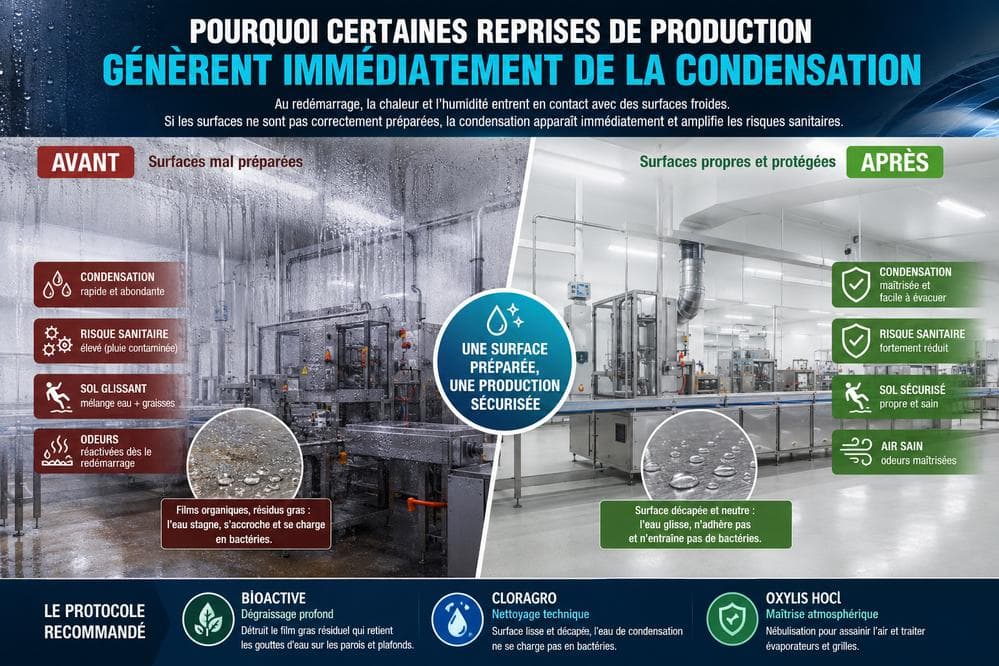
This is a classic scenario during morning startups in food processing plants: no sooner are the machines turned back on than the walls, ceilings, and equipment are covered with a fine layer of water. This rapid condensation, often perceived as a mere thermal nuisance, is actually a major amplifier of sanitary risks, particularly if surfaces have not been properly prepared.
The mechanics of post-cleaning condensation
Condensation forms when warm, moist air comes into contact with a colder surface. Upon restart, activity quickly generates heat (motors, hot water, human presence). If the walls and equipment are still cold from the night or weekend, thermal shock is inevitable.
However, the problem is considerably worsened if the surfaces remained:
- Already wet: Incomplete drying after night cleaning locally saturates the air, accelerating the dew point.
- Organically loaded: This is the crucial point. An invisible organic film (grease, unstripped proteins) modifies the surface tension of the wall. Instead of draining quickly, condensation water stagnates and clings as micro-droplets.
High-risk areas
Condensation does not strike everywhere with the same intensity. It targets "thermal bridges" and areas of high amplitude:
- Cold rooms (when doors are opened).
- Packaging rooms (often air-conditioned but subjected to heat from wrapping machines).
- Ceilings (where hot air accumulates).
- Evaporators and ventilation grilles.
The consequences: a contaminated "rain"
Condensation that forms on a poorly stripped surface immediately becomes a breeding ground:
- The "rain" effect: Drops loaded with bacteria and nutrients eventually fall onto lines, bare products, or packaging, causing direct contamination from above.
- Slipperiness: On floors, condensation water mixes with residual greasy residues, creating a dangerous skating rink.
- Awakening of odors: Sudden moisture reactivates the metabolism of dormant bacteria in the residues, generating a heavy odor within the first hours of production.
The recommended protocol: prepare the surface
To limit the impact of condensation, you must ensure that if water condenses, it does so on a chemically neutral surface and can drain away:
Deep degreasing with BIOACTIVE. Applied during cleaning, BIOACTIVE destroys the residual greasy film that holds water drops on walls and ceilings.
Technical cleaning with CLORAGRO. The action of CLORAGRO guarantees a smooth surface, stripped of any organic matter, preventing condensation water from becoming loaded with bacteria before falling.
Atmospheric control with OXYLIS HOCl. Fogging with OXYLIS HOCl sanitizes the ambient air and treats evaporators, reducing the microbial load that could be transported by air moisture.
Key takeaway
We cannot always prevent condensation upon restart, but we can control what it transports. Rapid and stubborn condensation often reveals a surface that is still biologically active and requires better preliminary stripping.
Recurring contamination problems?
Request a complete audit of your facilities by our biosecurity experts.
Request a Field Audit