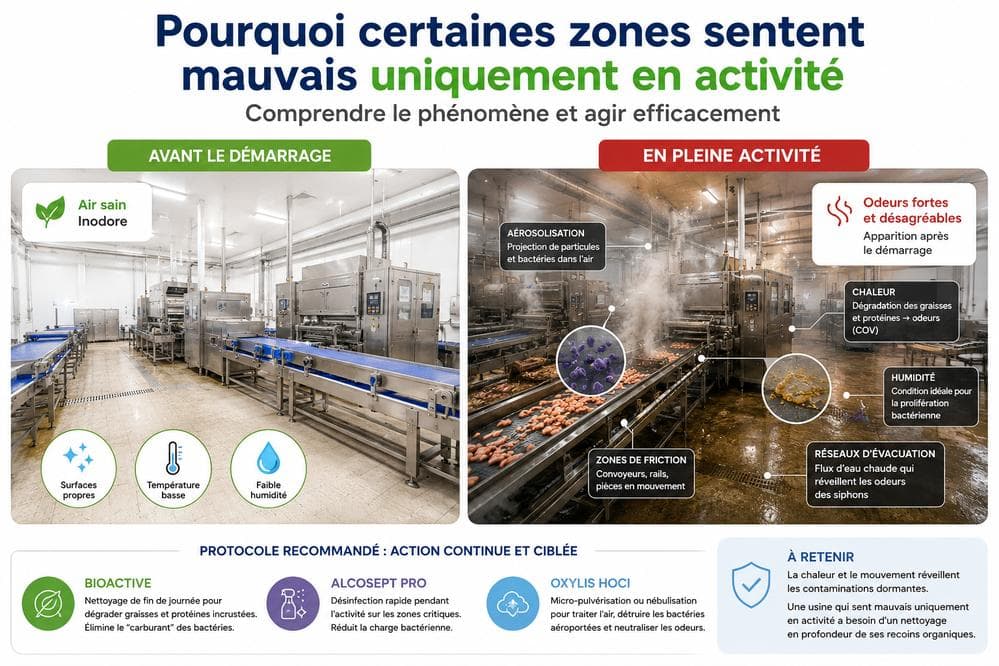
In the food industry, a perplexing situation often arises: in the early morning, before the workshop starts, the air seems clean and odorless. Yet, a few hours into production, a heavy, sometimes unpleasant odor begins to saturate the atmosphere. Why do these odors only manifest during full activity, and then disappear during rest periods? This phenomenon is explained by the very dynamics of production.
The mobilization of silent contamination
Industrial production is not static. It generates intense mechanical and thermal activity that acts as a revealer of hidden contamination:
- The mechanical effect (Aerosolization): The operation of fast machines (slicers, saws), the movement of conveyors, or the use of pressurized water creates micro-droplets. These aerosols "wash" the air but also tear organic particles and bacteria from surfaces to suspend them in the atmosphere.
- The thermal effect: Production generates heat (motors, hot water washing, cooking). This heat warms up fats and proteins congealed in corners or under machines, accelerating their degradation by bacteria and multiplying the release of odorous gases (Volatile Organic Compounds).
- Moisture: Activity keeps floors and equipment wet, a sine qua non condition for bacteria to metabolize organic matter and produce these odors.
Turbulence zones
Odors during activity rarely come from the center of the room, but from friction and heat zones:
- Conveyors (friction of belts on dirty rails).
- Hot zones (proximity to ovens or motors).
- Cutting workshops (splashing of juices and fragments).
- Drainage networks (hot water flows awaken odors from siphons).
An indicator of environmental pressure
The appearance of these odors is not just a comfort issue (although it makes the air heavy for operators). It is the sign of an increase in environmental pressure: contaminated organic particles circulate in the air, significantly increasing the risk of airborne recontamination of finished products.
The recommended protocol: continuous and targeted action
To prevent production from waking up these odors, hygiene must adapt to this dynamic:
Underlying action with BIOACTIVE. To reduce the source of the problem, using BIOACTIVE during end-of-day cleaning digests fats and proteins embedded in hot zones and conveyors, thus eliminating the "fuel" of odor-causing bacteria.
Quick disinfection with ALCOSEPT PRO. During activity, during short breaks, using ALCOSEPT PRO on cutting zones breaks the bacterial load build-up without heavily wetting the surfaces.
Atmospheric control with OXYLIS HOCl. Micro-spraying or fogging OXYLIS HOCl treats the air itself. Its mild oxidative action destroys airborne bacteria and neutralizes odorous molecules, ensuring a healthy environment even during full activity.
Key takeaway
Some contamination remains dormant until the heat and movement of production wake them up. A factory that smells bad only during activity is a factory whose organic recesses need deep stripping.
Recurring contamination problems?
Request a complete audit of your facilities by our biosecurity experts.
Request a Field Audit