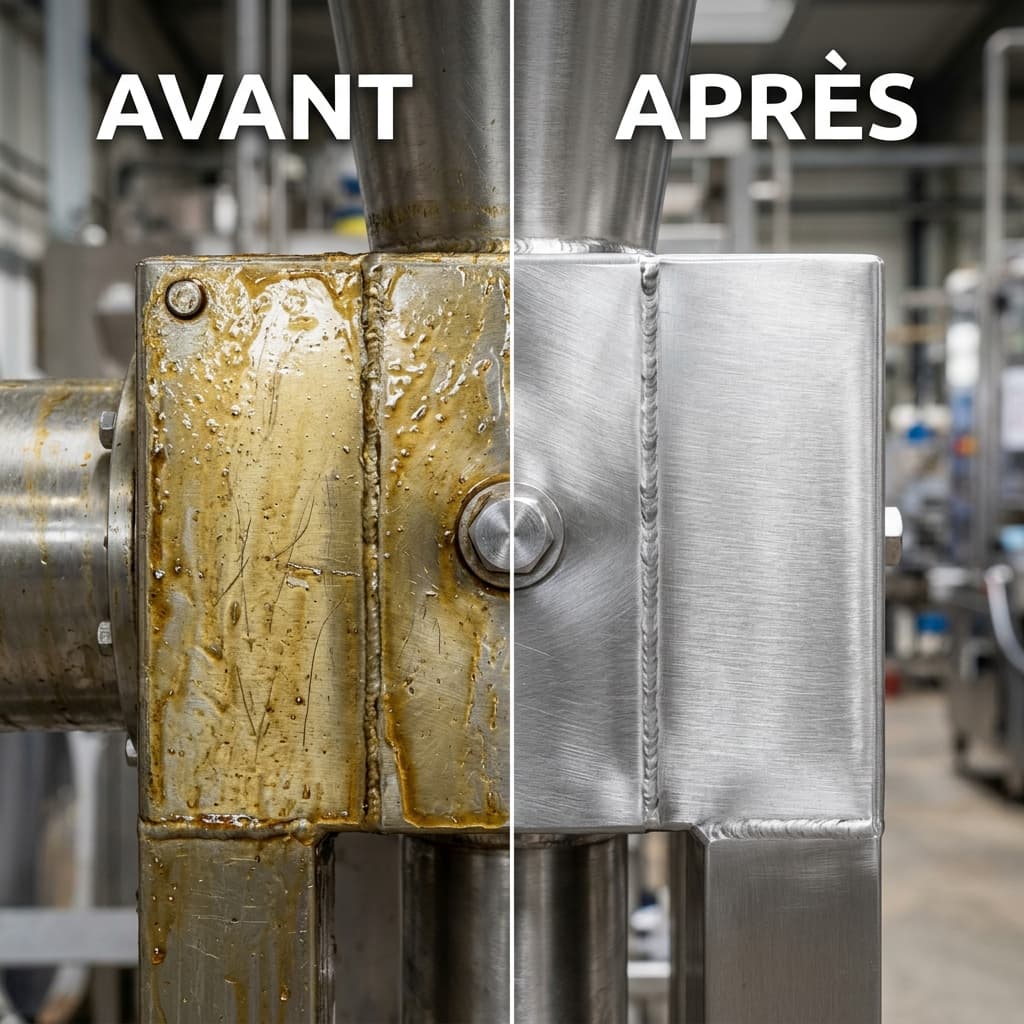
This is a frustrating phenomenon often encountered by quality managers and hygiene teams in industrial settings: a cleaning and disinfection protocol that used to give excellent results seems, over the months or years, to progressively lose its effectiveness. Faced with unstable microbiological analyses, the first reflex is often to increase the concentration of disinfectants. However, the origin of the problem is rarely linked to the biocide itself, but rather to the evolution of the surface to be treated.
The aging of soils: polymerization
Over time and with repeated production cycles (heat, friction) and cleaning (chemistry, sometimes incomplete rinsing), organic residues that have not been perfectly eliminated evolve. Fats and proteins undergo a process of polymerization and cross-linking: they harden, chemically bond with each other, and become deeply embedded in the micro-porosities of materials (stainless steel, resin, plastic).
These old accumulations become increasingly compact, smooth, and adherent. They form an almost impenetrable barrier to standard cleaning products.
The wrong path of chemical overdose
When disinfections become less effective on these "aged" surfaces, the strategy of increasing disinfectant doses is doomed to fail:
- The disinfectant acts on the surface; it does not have the necessary detergent properties to penetrate the organic crust.
- Chemical overconsumption leads to major additional costs.
- Cleaning times are unnecessarily extended (excessive scrubbing, multiple applications).
- Recontamination remains rapid because the bacterial reserve buried under the organic layers has not been reached.
The real difficulty, therefore, does not come from the disinfection, but from the preliminary stripping.
The recommended protocol: resetting the surface
To regain the initial effectiveness of hygiene protocols, it is necessary to "reset" the surface condition of the equipment by breaking up these old, hardened residues:
Step 01 — Enzymatic softening with BIOACTIVE. The application of BIOACTIVE will specifically target polymerized fats and proteins. Its biological components "cut" the long, hard molecular chains, thus breaking the structure of old residues without damaging the equipment.
Step 02 — Alkaline stripping with CLORAGRO. Once the organic crust is softened, CLORAGRO takes over. Its chlorinated alkaline foam emulsifies the destructured soils, totally clearing the surface and exposing it, ready to receive the disinfection.
Step 03 — Optimal disinfection with OPTIMAGRO. Applied to a surface that is finally chemically clean again and devoid of any organic barrier, OPTIMAGRO regains 100% of its biocidal effectiveness, guaranteeing stable and lasting analysis results.
Key takeaway
When disinfections seem to lose their effectiveness over cycles, the problem is not bacteria becoming accustomed, but the accumulation of organic layers hardened by time. Only deep stripping can restore the surface's receptivity.
Recurring contamination problems?
Request a complete audit of your facilities by our biosecurity experts.
Request a Field Audit