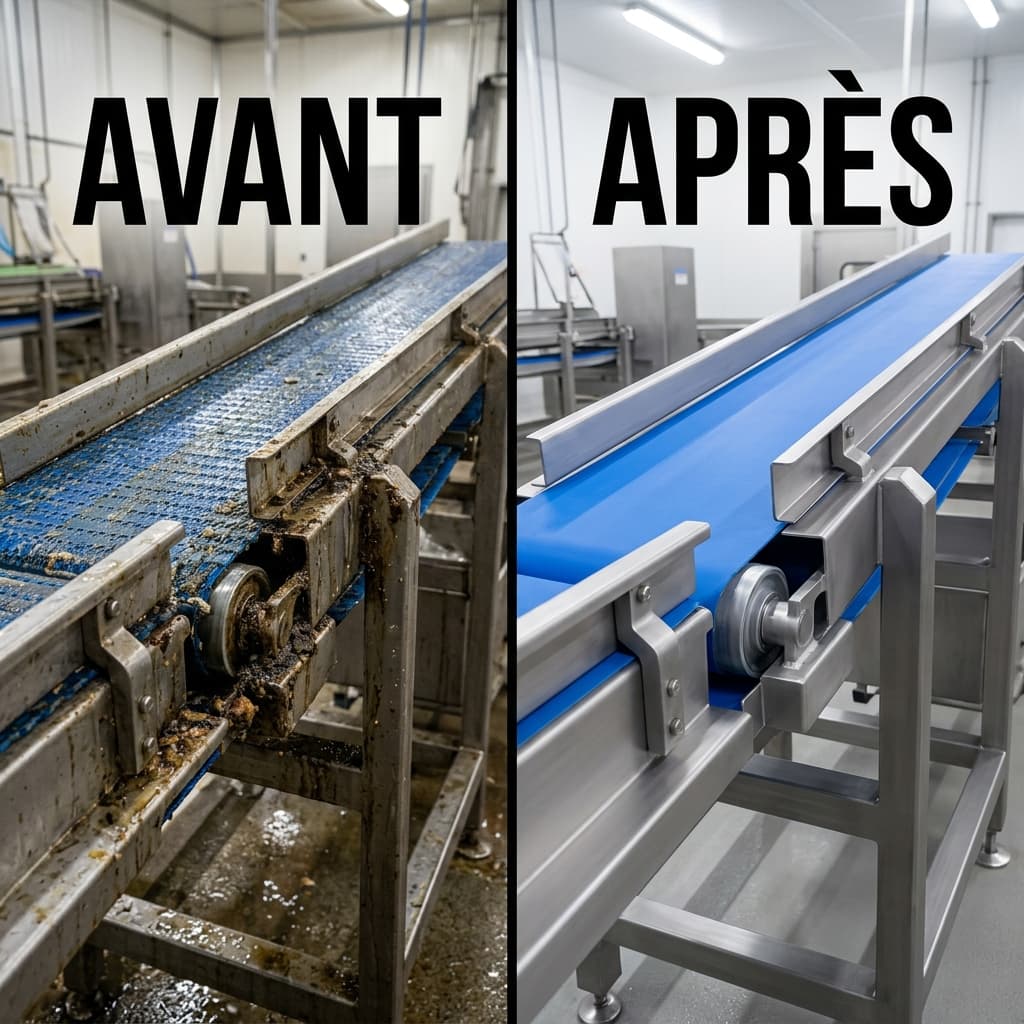
In food processing workshops, wet conveyors are among the most critical areas from a sanitary standpoint. They combine all risk factors in a single point: permanent humidity, organic residues, continuous product contact and systematic cross-contamination.
The most problematic conveyor zones
Field experience shows that certain parts of conveyors are particularly difficult to control:
- Undersides of belts: Rarely accessible during quick cleaning, this area accumulates protein and grease residues that rapidly form an adherent biofilm.
- Rollers: In constant rotation, they collect residues from the belt and compact them into bearings, creating invisible contamination reservoirs.
- Axles and mechanisms: Lubrication greases mixed with food residues form an organic matrix highly favourable to microbial development.
- Junctions: Connection points between conveyor sections often have gaps where residues accumulate and resist rinsing.
Even after apparently thorough washing, these zones can remain biologically active and recontaminate products as soon as production resumes.
Frequent consequences on quality
A poorly managed wet conveyor generates recurring problems that directly affect sanitary compliance:
- Repetitive contamination on the same production lines
- Persistent organic odours despite daily cleaning
- Unstable environmental analyses with fluctuating results
- Need to increase cleaning frequency without lasting improvement
The recommended protocol
Pre-treatment of organic accumulations with BIOACTIVE. Applying BIOACTIVE breaks down protein and grease residues embedded in hard-to-reach conveyor areas, facilitating their subsequent removal.
Stripping the adherent matrix with CLORAGRO. Alkaline chlorinated cleaning with CLORAGRO exposes the actual surfaces by eliminating organic layers that protect contaminations.
Final sanitary treatment with OPTIMAGRO. Structured disinfection with OPTIMAGRO completes the protocol by ensuring comprehensive microbiological control of treated surfaces.
Key takeaway
A wet conveyor quickly becomes a vector of continuous recontamination if not treated with an adapted sequential protocol. The key lies in organic preparation of surfaces before any disinfection.
Recurring contamination problems?
Request a complete audit of your facilities by our biosecurity experts.
Request a Field Audit