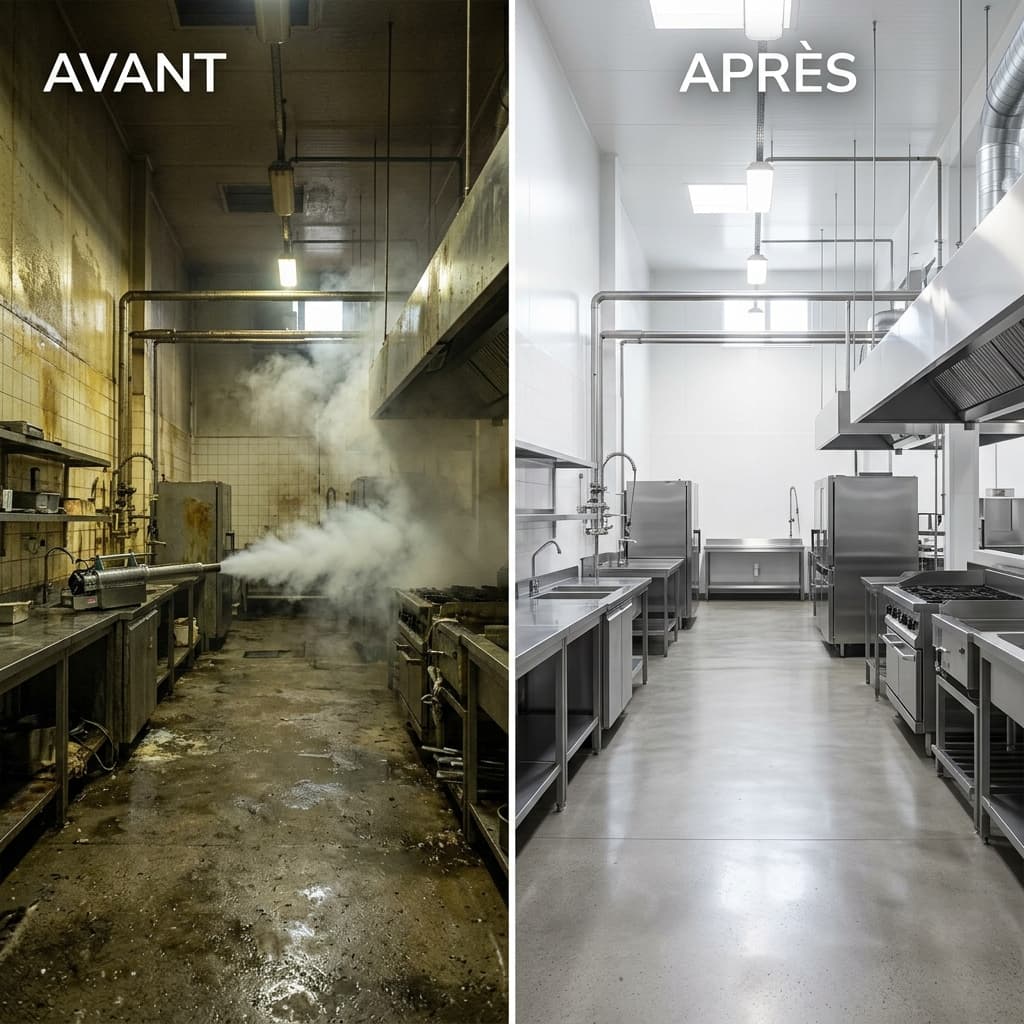
In food plants and slaughterhouses, it is common to observe surfaces that remain wet for long hours after sanitation crews have finished. This phenomenon, sometimes considered a mere aesthetic detail or a minor drying issue, has a considerable biological impact. Residual surface moisture neutralises the efficacy of applied disinfectants and promotes immediate bacterial recolonisation.
Standing water: a shield for micro-organisms
Water is the primary limiting factor for bacterial growth. When production areas do not dry quickly, they create conditions highly favourable to pathogen survival:
- Immediate active ingredient dilution: Surface disinfectants are formulated for application at precise concentrations. If the surface is already covered with a film of water, the disinfectant product is diluted upon application, dropping its concentration below the biocidal efficacy threshold.
- Transport and dispersion of contaminants: Residual water serves as a physical vector. It allows bacteria surviving in hard-to-reach areas (drains, screw threads, conveyor undersides) to migrate via capillary action to clean food contact surfaces.
- Instant reactivation of biofilms: Dried biofilms enter a dormant phase. Adding moisture without mechanical cleaning reactivates them immediately, restarting protective matrix production within hours.
Critical accumulation zones in workshops
Certain technical points are particularly prone to standing moisture: conveyor undersides, blind spots of machine frames, worn gaskets, drainage gutters, and cold room evaporators. In these micro-environments, the lack of air circulation prevents effective natural drying.
The sanitation protocol recommended by N2K Laboratoires
To counter the risks associated with residual moisture, N2K Laboratoires recommends a combined approach that eliminates water-retaining organic matter and sanitises the atmosphere:
Step 01 — Rapid surface disinfection with ALCOSEPT PRO. Applying ALCOSEPT PRO allows rapid disinfection of sensitive equipment without wet residue.
Step 02 — Structured cleaning and rinsing with CLORAGRO. Applying CLORAGRO mechanically removes biofilms and residues, facilitating water runoff toward drains for faster drying.
Step 03 — Microbiological control of the damp environment with OXYLIS HOCI. Misting OXYLIS HOCI (hypochlorous acid) into the air of the workshops and on cold surfaces treats atmospheric humidity continuously and sanitises inaccessible areas where condensation forms.
Key takeaway
Drying is an integral phase of the sanitary protocol. A surface that remains wet is a surface that recontaminates. By eliminating greasy deposits with CLORAGRO and disinfecting without water using ALCOSEPT PRO, while protecting air volumes by misting OXYLIS HOCI, you secure your installations against microbial proliferation.
Recurring contamination problems?
Request a complete audit of your facilities by our biosecurity experts.
Request a Field Audit